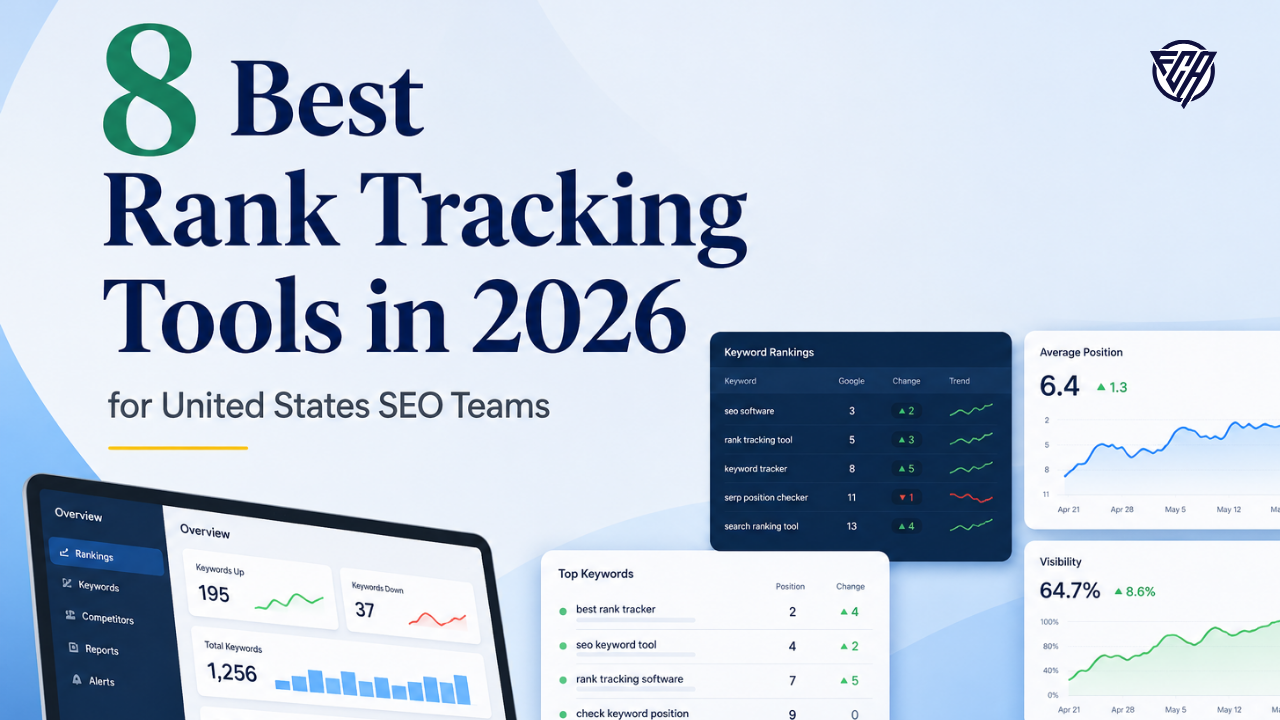
Rank tracking has moved beyond checking whether a keyword is number three or number seven in Google. United States SEO teams now have to monitor device differences, city level results, search features, local packs, AI generated result surfaces, competitor movement, and changes that happen between scheduled reports. A useful rank tracker should therefore help a team explain what changed, where it changed, and whether the movement matters to traffic and revenue.
This guide compares eight tools that can support different levels of SEO work, from a small business checking a focused keyword set to an agency managing many locations. The list is based on current product documentation, current pricing pages, live search result research, reporting depth, update cadence, location controls, and fit for United States search campaigns. We did not assign artificial numerical scores because the right tool depends heavily on keyword volume, client count, reporting needs, and whether AI visibility belongs in the same workflow.
If your team is still building its SEO foundation, the FCA guide to digital marketing and SEO fundamentals explains how search optimization fits with content, paid search, analytics, and broader acquisition work. The digital marketing curriculum overview also covers web analytics and search measurement, which are essential when rank data is used for decisions rather than screenshots.
Best rank tracking tools at a glance
| Platform | Best for | Current pricing approach | Primary strength | Main consideration |
|---|---|---|---|---|
| SE Ranking | Agencies and in house teams that want rank tracking plus broader SEO workflows | Core from $129 monthly, with annual savings available | Daily keyword tracking with SEO and AI visibility features | Broader suite cost may be unnecessary for tracking only |
| AccuRanker | SEO teams that prioritize fast and focused rank tracking | Professional from about $224 monthly | Fast updates, deep segmentation, and strong rank reporting | Premium price for teams that need only a small keyword set |
| Semrush | Marketing teams that want rank tracking inside a large competitive intelligence suite | SEO Toolkit Pro from $139.95 monthly | Position tracking tied to keyword, competitor, content, and site data | Higher total cost and feature complexity |
| Ahrefs | SEO teams already using Ahrefs for backlinks and organic research | Starter from $29 monthly, Lite from $129 monthly in US pricing | Rank tracking connected to strong backlink and keyword research data | Standard rank updates are less frequent than specialist daily trackers |
| Advanced Web Ranking | Agencies that need detailed white label ranking reports | Pro from $139 monthly | Agency reporting, localization, and flexible rank data | Reporting depth creates a learning curve |
| Wincher | Small and mid sized teams that want straightforward daily tracking | Pricing varies by selected keyword and website limits | Simple daily rank monitoring with accessible reporting | Less broad competitive research than enterprise SEO suites |
| Google Search Console | Every website that needs first party Google Search performance data | Free | Actual Google query, impression, click, and position data | Not a fixed keyword rank tracker and offers limited competitor context |
| Nightwatch | Local and multi location SEO teams that need granular geographic tracking | Plan pricing depends on tracked keyword volume | Strong local rank monitoring and segmentation | Value is highest for location sensitive campaigns |
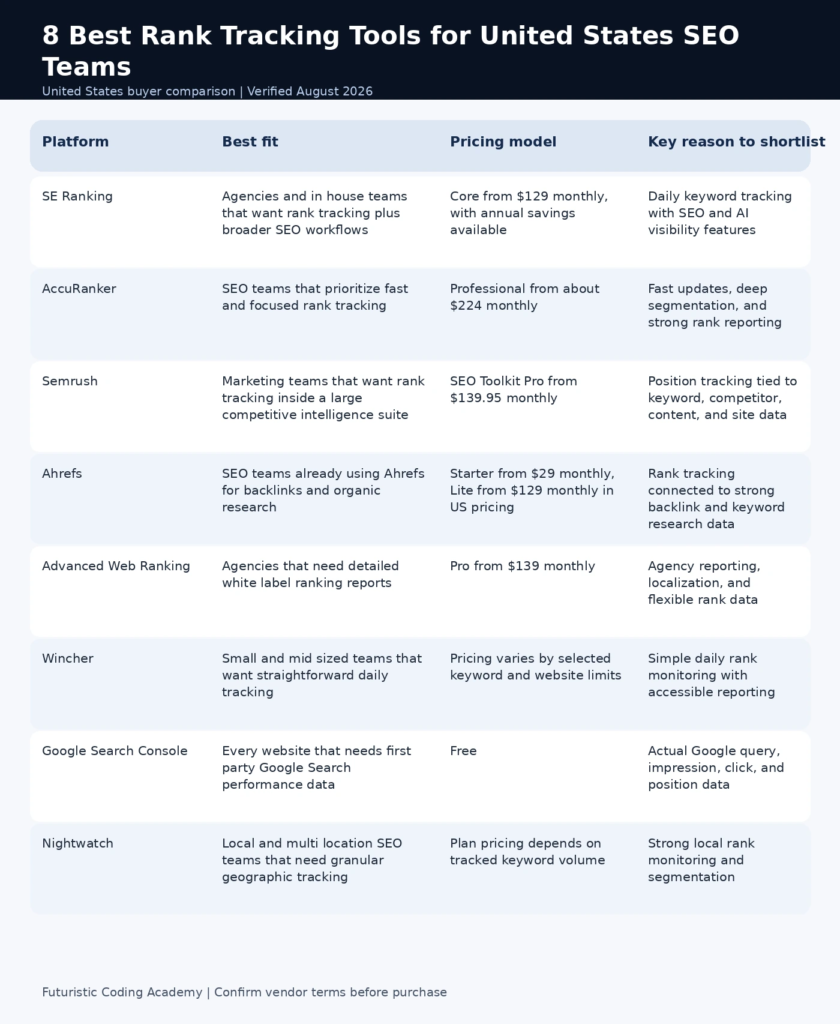
Infographic: Best rank tracking tools at a glance
How we evaluated these options
Search results for this topic consistently emphasize accuracy, update frequency, location specificity, reporting, competitor tracking, and price per tracked keyword. Current ranking pages also place more weight on search features and AI result surfaces than older comparisons did. We used those recurring buyer questions to build the framework below, then checked each vendor against its own documentation rather than relying on third party feature summaries.
Google Search Console remains an important control source because it reports actual Google Search impressions, clicks, queries, and average position for verified properties. A dedicated rank tracker should complement that first party data by adding fixed keyword monitoring, location controls, competitor comparison, and reporting that Search Console does not attempt to provide.
- United States location and device tracking
- Update frequency and on demand refresh options
- Competitor and SERP feature visibility
- Local and city level tracking where relevant
- Historical reporting and share of voice analysis
- Agency reporting and export options
- AI search visibility where included in the product
- Current pricing clarity and practical limits
For review quality, we followed Google guidance for high quality review content says comparison pages should provide original analysis, explain important decision factors, discuss benefits and drawbacks, and give readers enough evidence to make a choice. That is why each section below includes who the tool fits, what the pricing model means in practice, and where the product is less suitable.
Pricing was checked in August 2026. Vendors change plan names, limits, currencies, and promotional terms, so confirm the checkout or sales quote before purchase.
1. SE Ranking
Best for: Agencies and in house teams that want rank tracking plus broader SEO workflows
SE Ranking combines keyword position monitoring with site auditing, competitor research, backlink tools, reporting, and newer AI visibility capabilities. Its current Core plan includes 2,000 tracked keywords and a pool of AI prompts, which makes it attractive for teams that want one workspace for conventional search and emerging answer surfaces. United States teams can track by location and device and can organize keyword groups around markets, products, or clients.
Why it stands out
- Daily rank updates on paid plans
- Location and device controls for keyword projects
- Competitor tracking and historical visibility
- Agency reporting and client oriented workflows
- AI visibility monitoring included in current platform tiers
Pricing and buying considerations
SE Ranking currently lists Core at $129 per month on monthly billing, with lower effective monthly pricing for annual commitments. Growth is positioned for larger keyword sets and team requirements. The important buying question is not only the headline price but how many keywords, projects, competitors, and AI prompts your account actually needs.
Limitations to consider
Teams that need only a lightweight position checker may pay for capabilities they do not use. Agencies should also model how keyword limits grow when every client needs desktop, mobile, and multiple city variants.
Bottom line: Choose SE Ranking when you want a balanced platform that can replace several separate SEO tools while keeping rank tracking central.
2. AccuRanker
Best for: SEO teams that prioritize fast and focused rank tracking
AccuRanker is a specialist rank tracker rather than a broad SEO suite. That focus shows in its fast keyword updates, tagging, segmentation, share of voice reporting, competitor monitoring, and reporting controls. It is especially useful when rank data is reviewed frequently by an SEO team and needs to be filtered by market, tag, search intent, landing page, or competitor.
Why it stands out
- Daily updates with options for frequent refreshes
- Google and other search engine tracking
- Share of voice and competitor reporting
- Tagging and segmentation for large keyword sets
- Agency friendly reporting and integrations
Pricing and buying considerations
AccuRanker currently lists Professional at $224 per month and Expert at $764 per month, with annual billing discounts. Larger enterprise keyword volumes are quoted separately. The tool is easier to justify when rank monitoring is a core operational workflow rather than an occasional report.
Limitations to consider
It does not try to replace a complete backlink, content, and site audit suite. Small businesses may get enough position data from a lower cost platform or Search Console combined with a simpler tracker.
Bottom line: Choose AccuRanker when fast, precise rank monitoring matters more than owning an all purpose SEO platform.
3. Semrush
Best for: Marketing teams that want rank tracking inside a large competitive intelligence suite
Semrush Position Tracking sits inside a broad marketing platform that includes keyword research, competitive research, site auditing, backlink analysis, content tools, and reporting. This makes it useful for a United States team that wants to connect ranking changes with competitor movements, keyword opportunity, and technical SEO work without exporting data between many products.
Why it stands out
- Daily position tracking for configured campaigns
- Location and device targeting
- Competitor discovery and visibility reporting
- SERP feature monitoring
- Integration with wider Semrush research and reporting
Pricing and buying considerations
The current SEO Toolkit Pro plan is listed at $139.95 per month with 500 tracked keywords. Higher plans increase tracked keyword limits and reporting capabilities. Annual billing lowers the effective monthly rate. Teams should check whether their required keyword count pushes them into a higher tier.
Limitations to consider
The platform can feel excessive for a business that only needs ranking history. Some advanced workflows and larger tracking limits require more expensive plans.
Bottom line: Choose Semrush when ranking data is one part of a wider competitive SEO and digital marketing program.
4. Ahrefs
Best for: SEO teams already using Ahrefs for backlinks and organic research
Ahrefs Rank Tracker is useful when the team already depends on Site Explorer, Keywords Explorer, Site Audit, and competitive organic research. It can track keywords by location and device, compare competitors, and connect ranking movement with a large search and link data set. Ahrefs also offers separate AI visibility capabilities through Brand Radar and custom prompt tracking.
Why it stands out
- Rank tracking across many locations
- Competitor comparison and SERP history
- Strong connection to backlink and keyword research
- Starter access for very small tracking needs
- AI prompt tracking available through current product options
Pricing and buying considerations
Ahrefs currently lists Starter at $29 per month and its official 2026 plan guide lists Lite at $129 per month for United States billing. Starter supports a small rank tracking allowance, while Lite and higher plans expand tracked keyword capacity. Verify account currency because the public pricing page can localize prices.
Limitations to consider
The standard Rank Tracker update cadence on core plans is weekly, which is less suitable for teams that need daily movement data. Teams that only need rank tracking may also find the rest of the suite unnecessary.
Bottom line: Choose Ahrefs when rank tracking should sit beside backlink analysis, organic competitor research, and technical audits.
5. Advanced Web Ranking
Best for: Agencies that need detailed white label ranking reports
Advanced Web Ranking is built around professional keyword tracking, local search monitoring, competitor analysis, and agency reporting. It supports detailed location settings and is a strong option when an agency needs to manage many client campaigns without making every client learn the tool itself.
Why it stands out
- Localized rank tracking
- Agency and white label reporting
- Competitor and market share reporting
- Multiple search engine coverage
- Historical rank data and exports
Pricing and buying considerations
The current pricing page lists Pro at $139 per month, Agency at $279 per month, and Enterprise at $699 per month. A trial is available, and annual billing can reduce the effective price. Agencies should compare included units and refresh frequency against their client reporting schedule.
Limitations to consider
The interface and reporting options are more detailed than a small business may need. It also remains primarily a rank monitoring platform rather than an end to end marketing suite.
Bottom line: Choose Advanced Web Ranking when client reporting, localization, and agency control matter more than having a simple dashboard.
6. Wincher
Best for: Small and mid sized teams that want straightforward daily tracking
Wincher focuses on making rank tracking understandable for marketers who do not want a complex enterprise interface. It provides daily ranking data, keyword groups, location and device monitoring, competitor tracking, and reporting. It is a sensible fit for content teams that need to see whether priority pages are moving without managing a large technical SEO platform.
Why it stands out
- Daily keyword monitoring
- Location and device tracking
- Keyword groups and page monitoring
- Competitor comparison
- Scheduled reporting
Pricing and buying considerations
Wincher uses plan limits based on tracked keywords, websites, and features, and its current pricing page can display values dynamically. Confirm the current quote for your required keyword volume before buying rather than relying on an old third party price.
Limitations to consider
Large agencies may want more sophisticated cross client reporting and competitive intelligence. Teams also need a separate technical audit and backlink platform if those functions are required.
Bottom line: Choose Wincher when ease of use and daily tracking matter more than a large suite of unrelated SEO tools.
7. Google Search Console
Best for: Every website that needs first party Google Search performance data
Google Search Console is not a conventional rank tracking product, but it belongs in every SEO measurement stack because its Search Performance reports show the queries and pages that actually earned impressions and clicks in Google. It provides average position, click through rate, indexing information, and URL inspection data that can validate or challenge what a third party tracker reports.
Why it stands out
- First party Google Search performance data
- Query and page level clicks and impressions
- Average position and click through rate
- Indexing and sitemap diagnostics
- URL inspection for individual pages
Pricing and buying considerations
Search Console is free for verified site owners. There is no keyword quota purchase, but the interface is designed for site performance analysis rather than fixed keyword campaign management.
Limitations to consider
Average position is not the same as a controlled rank check from a specific city, device, and clean environment. Search Console also does not provide competitor rankings or a traditional client reporting workflow.
Bottom line: Use Search Console alongside a dedicated rank tracker, not as a complete replacement for one.
8. Nightwatch
Best for: Local and multi location SEO teams that need granular geographic tracking
Nightwatch is known for location focused rank tracking, segmentation, dashboards, and reporting. It can be especially useful for United States businesses where rankings differ meaningfully by city or service area. The platform is designed to help teams break large keyword sets into practical views rather than treating every rank movement as equally important.
Why it stands out
- Local and city level rank tracking
- Keyword segmentation and filtering
- Competitor monitoring
- Reporting and dashboard customization
- Support for large location sensitive campaigns
Pricing and buying considerations
Nightwatch prices plans according to keyword volume and account configuration. Because current plan values can change with the selected tracking allowance, use the official pricing calculator for an accurate quote.
Limitations to consider
A national content site that does not depend on local results may not use the location depth enough to justify the product over a broader SEO suite.
Bottom line: Choose Nightwatch when local market differences are a central part of the SEO strategy.
How to choose a rank tracker for a United States SEO program
Start with the decisions your team needs to make from the data. A local service business needs city and map visibility. A publisher may care more about thousands of informational keywords and SERP features. An agency needs client segmentation, permissions, scheduled reports, and predictable costs. A national ecommerce business may care about desktop and mobile splits, competitor share of voice, and category level visibility.
- Calculate total tracked keyword checks, not only the number of keyword phrases
- Decide whether daily updates are operationally necessary
- Confirm city, ZIP level, or state targeting where local search matters
- Check whether AI visibility is included or sold separately
- Test reporting before committing to an agency platform
- Keep Search Console connected as a first party benchmark
How rank tracking fits with content and technical SEO
Rank data becomes useful when it is connected to action. If a page drops, the next question is whether search intent changed, a competitor improved, technical indexing changed, or the page lost relevance. FCA resources on SEO and digital marketing and the FCA blog library can help connect monitoring with content updates and broader optimization work.
Use rankings with traffic and conversion data
A position increase without impressions, qualified clicks, or conversions may have little business value. Pair rank data with Search Console, analytics, and conversion reporting before declaring a campaign successful.
Track keyword groups around business outcomes
Group keywords by product line, funnel stage, market, or content cluster. This makes it easier to see whether a strategy is improving an entire topic instead of celebrating isolated keyword movement.
What changed in rank tracking in 2026
Current search result pages can include local results. Teams that need a broader foundation can also review the FCA overview of SEO, digital marketing, and analytics skills. Search result pages can include, shopping modules, video, discussion results, AI generated summaries, and other features that change how a traditional blue link position translates into visibility. The strongest tracking workflow therefore measures more than a single rank number and keeps human analysis in the loop.
Frequently Asked Questions
What is the best rank tracking tool overall?
SE Ranking is the most balanced choice for many teams because it combines daily rank monitoring with broader SEO and AI visibility workflows. AccuRanker is stronger when specialist rank tracking speed is the priority.
What is the most accurate rank tracker?
Accuracy depends on location, device, search engine, refresh timing, and personalization controls. Specialist tools such as AccuRanker and Advanced Web Ranking are built for controlled rank checks, but results should still be compared with Search Console and business analytics.
Is Google Search Console a rank tracker?
Search Console reports average position from real Google impressions, but it is not a fixed keyword campaign tracker. It is best used as first party validation alongside a dedicated tracking platform.
Do rank trackers work for local SEO?
Yes, but the tool must support granular location settings. Nightwatch, Advanced Web Ranking, SE Ranking, and other local capable tools can monitor city or location specific results.
How often should rankings be checked?
Daily tracking is useful for active SEO campaigns, launches, and competitive markets. Weekly data may be enough for stable informational content. The right cadence should match how quickly your team can respond.
Should I track desktop and mobile separately?
Yes when mobile and desktop results differ materially for your audience. Separate tracking can reveal changes that would be hidden in a blended report.
How many keywords should a small business track?
A focused small business can often begin with a few hundred commercial, local, branded, and supporting informational terms. The goal is useful coverage, not collecting keywords that never influence a decision.
Can a rank tracker measure AI visibility?
Some current SEO platforms now include prompt or AI visibility monitoring, but these features use different methods from classic keyword tracking. Evaluate them as a separate measurement layer.
Why does a rank tracker disagree with what I see in Google?
Location, device, personalization, language, data center, timing, and search features can all change visible results. A controlled tracker is designed to reduce those variables.
What rank tracking features do agencies need?
Agencies usually need client segmentation, scheduled reporting, permissions, white label exports, reliable local settings, competitor comparison, and a pricing model that remains predictable as keyword volume grows.
Is daily rank tracking necessary for every website?
No. Daily data is valuable when decisions are made frequently, but a slower cadence can be sufficient for stable sites with limited search competition.
How should rank tracking data be reported to executives?
Focus on visibility trends, priority keyword groups, traffic impact, conversion impact, and the actions taken. Avoid presenting thousands of individual keyword positions without business context.
Final recommendation
For most United States SEO teams, SE Ranking offers the strongest balance of daily monitoring, reporting, broader SEO capabilities, and newer AI visibility features. AccuRanker is the better specialist choice when rank tracking itself is mission critical, while Semrush and Ahrefs make sense when the team already depends on their wider research ecosystems.
Whatever tool you choose, keep Search Console connected and evaluate rankings as an input to decisions rather than the final success metric. The best rank tracking workflow explains what changed and helps the team decide what to do next.