Customer service platforms now combine ticketing, email, chat, messaging, knowledge, automation, reporting, AI agents, and workforce workflows. That makes the buying decision harder than comparing a list of ticket features. A United States business should start with support volume, channels, customer type, agent workflow, self service, data requirements, and the cost of AI automation. The eight products below serve different parts of the market, from small support teams to global service organizations.
This guide targets best help desk and customer service platforms for United States buyers and also covers related searches such as best help desk software, customer service platforms, support ticket software, customer support software, omnichannel help desk, AI customer service software. The structure was informed by recurring sections in current ranking comparison pages, including quick picks, product comparisons, methodology, detailed reviews, buying criteria, tradeoffs, and frequently asked questions. Product facts and pricing models were checked against current official vendor pages wherever public information is available.
Quick Recommendations
- Zendesk: Mature support teams that need dependable ticketing, omnichannel service, and a large ecosystem
- Freshdesk Omni: Growing companies that want omnichannel support with Freddy AI built into a modern service suite
- Fin by Intercom: Digital businesses that prioritize conversational support and AI resolution
- Help Scout: Small and mid sized teams that want a simple human support experience
- Zoho Desk: Value focused businesses using Zoho CRM and the broader Zoho ecosystem
- Gorgias: Ecommerce brands that want support connected closely to store and order workflows
- HubSpot Service Hub: Companies that want support connected to marketing, sales, CRM, and customer success data
- Salesforce Service Cloud: Enterprise service organizations that need deep CRM, workflow, AI, and governance
Comparison Table
| Tool | Best for | Pricing approach | Important limitation |
|---|---|---|---|
| Zendesk | Mature support teams that need dependable ticketing, omnichannel service, and a large ecosystem | Support Team from $19 per agent monthly with annual billing; Suite Team from $55 | The product can become expensive as agents, advanced analytics, AI, workforce features, and enterprise controls are added. Smaller teams should compare the total suite cost with simpler products. |
| Freshdesk Omni | Growing companies that want omnichannel support with Freddy AI built into a modern service suite | Growth $29 per agent monthly annual; Pro $79; Enterprise $119 | AI sessions and other add ons can create usage costs beyond the base seat price. Buyers should estimate automation volume, connectors, day passes, and required channels using real support data. |
| Fin by Intercom | Digital businesses that prioritize conversational support and AI resolution | Essential $19 per seat monthly annual; Advanced $85; Expert $132; Fin AI outcomes from $0.99 | Seat charges and AI outcome charges should be modeled together. Traditional call center or highly customized enterprise ticketing requirements may be better served by a broader service platform. |
| Help Scout | Small and mid sized teams that want a simple human support experience | Free plan available for limited contact volume; paid user based plans scale by features and usage | Large enterprises may outgrow its governance, complex routing, multibrand, and highly customized process capabilities. AI resolution and advanced usage should be evaluated separately from the base help desk plan. |
| Zoho Desk | Value focused businesses using Zoho CRM and the broader Zoho ecosystem | Free edition supports a small team; paid plans vary by region and billing cycle | US buyers should verify the current regional price before publication or purchase because displayed currency and offers can change by market. Organizations with highly complex service operations should test administration and reporting depth. |
| Gorgias | Ecommerce brands that want support connected closely to store and order workflows | Usage based plans across Basic, Pro, Advanced, and Enterprise tiers; confirm current ticket and automation allowances | The value is highest for ecommerce. A B2B SaaS or internal IT support team may pay for specialization it does not need. Usage based ticket and automation models should be tested against seasonal peaks. |
| HubSpot Service Hub | Companies that want support connected to marketing, sales, CRM, and customer success data | Free tools available; Starter from roughly $7 per seat monthly on current annual offers; Professional from $90 per seat monthly plus onboarding | Professional and Enterprise editions become a larger software investment and may include onboarding costs. Companies not using HubSpot CRM may get less value from the platform integration advantage. |
| Salesforce Service Cloud | Enterprise service organizations that need deep CRM, workflow, AI, and governance | Starter Suite $25 per user monthly; Enterprise $175; Unlimited $350; Agentforce 1 Service $550 with annual billing on higher tiers | Licensing, configuration, implementation, and administration can be substantial. Small support teams rarely need the full platform depth and should compare simpler products before accepting enterprise complexity. |
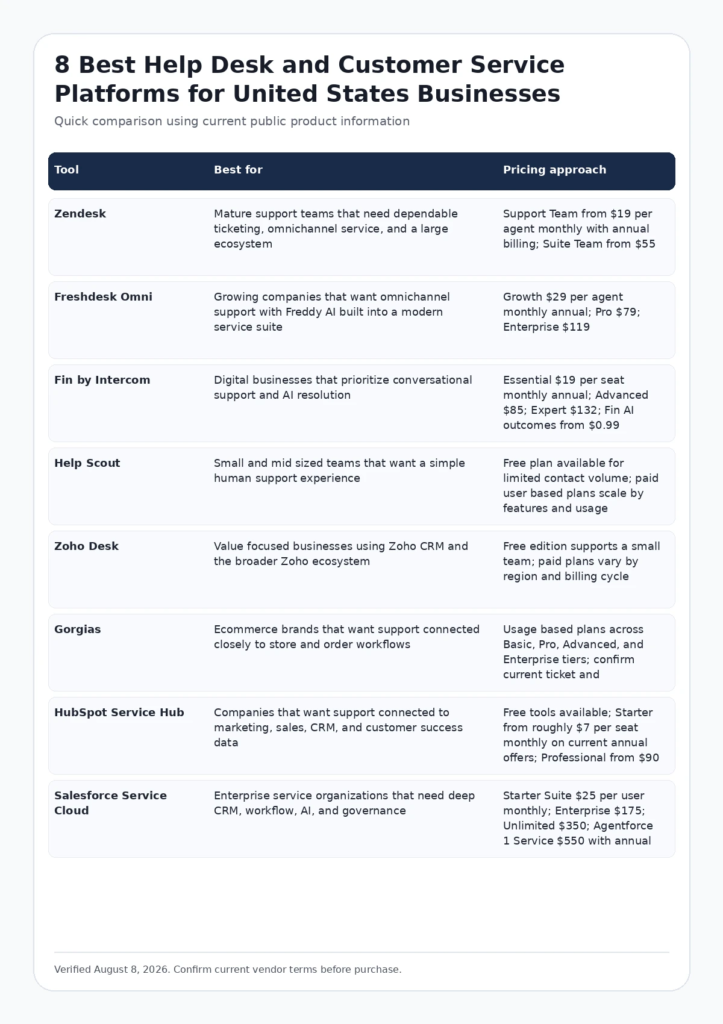
Infographic: Comparison Table
FCA_INFOGRAPHIC
Alt text: Comparison of leading best help desk and customer service platforms for United States buyers by use case and pricing approach.
How We Evaluated These Tools
- Search intent fit: the product must genuinely solve the job implied by the query rather than appear only because it is adjacent to the category.
- Workflow fit: we considered how naturally the platform connects to the people, systems, approvals, and operating model a US team already uses.
- Current evidence: official pricing, feature pages, documentation, and current authoritative research were favored over unsourced feature claims.
- Total cost: seat price was considered together with usage, credits, data volume, AI outcomes, compute, add ons, onboarding, and administration where relevant.
- Tradeoffs: each product includes a reason a buyer may choose something else. A useful comparison should clarify limitations rather than hide them.
Google recommends product review content that provides original analysis, evidence, meaningful comparisons, benefits, drawbacks, and useful links. See Google Search Central guidance for high quality reviews and Google guidance for helpful content.
Current Evidence and E E A T Signals
Freshworks current 2026 pricing makes AI related service costs more explicit by publishing included sessions and add on rates for Freddy AI Agent, helping buyers model automation alongside agent seats. Source: Freshdesk Omni pricing.
Salesforce current Service Cloud pricing ranges from a $25 Starter Suite to higher enterprise service editions, illustrating how customer service platforms now span very different operating models and budgets. Source: Salesforce Service Cloud pricing.
Detailed Reviews
1. Zendesk
Best for: Mature support teams that need dependable ticketing, omnichannel service, and a large ecosystem
Zendesk remains one of the most established customer service platforms because its ticketing model, agent workspace, reporting, knowledge, messaging, automation, and marketplace can support a wide range of service operations. It works particularly well when a company wants a proven help desk foundation and expects processes, integrations, brands, and support channels to become more complex over time.
Where Zendesk is strongest
- Mature ticketing and agent workflows for growing support organizations
- Large integration and marketplace ecosystem reduces custom connection work
- Suite plans combine messaging, knowledge, reporting, automation, and service channels
Pricing and buying model
Support Team from $19 per agent monthly with annual billing; Suite Team from $55. Check current official pricing
Limitations to consider
The product can become expensive as agents, advanced analytics, AI, workforce features, and enterprise controls are added. Smaller teams should compare the total suite cost with simpler products.
Visit the official Zendesk website
2. Freshdesk Omni
Best for: Growing companies that want omnichannel support with Freddy AI built into a modern service suite
Freshdesk Omni combines ticketing, chat, social and messaging channels, knowledge, automation, routing, analytics, and Freddy AI. The current pricing structure is easy for US buyers to understand because the annual per agent prices and major AI session add ons are public. It is a strong candidate for mid market teams that want broad service capabilities without committing immediately to the largest enterprise suites.
Where Freshdesk Omni is strongest
- Omnichannel support combines customer conversations in one agent workspace
- Public per agent pricing makes early budgeting relatively straightforward
- Freddy AI Agent and AI Copilot features are integrated into the service environment
Pricing and buying model
Growth $29 per agent monthly annual; Pro $79; Enterprise $119. Check current official pricing
Limitations to consider
AI sessions and other add ons can create usage costs beyond the base seat price. Buyers should estimate automation volume, connectors, day passes, and required channels using real support data.
Visit the official Freshdesk Omni website
3. Fin by Intercom
Best for: Digital businesses that prioritize conversational support and AI resolution
Intercom has increasingly centered its service strategy around Fin, its AI customer service agent, while retaining inbox, messenger, knowledge, automation, and support workflow capabilities. It is a strong fit for SaaS and digital products where chat, in product support, self service, and AI resolution are central to the customer experience rather than an add on to email ticketing.
Where Fin by Intercom is strongest
- Strong conversational support experience for web and product based businesses
- Fin connects AI resolution with human handoff and knowledge workflows
- Modern messenger and automation are useful for product led customer service
Pricing and buying model
Essential $19 per seat monthly annual; Advanced $85; Expert $132; Fin AI outcomes from $0.99. Check current official pricing
Limitations to consider
Seat charges and AI outcome charges should be modeled together. Traditional call center or highly customized enterprise ticketing requirements may be better served by a broader service platform.
Visit the official Fin by Intercom website
4. Help Scout
Best for: Small and mid sized teams that want a simple human support experience
Help Scout is designed to make shared support feel closer to normal email while adding the collaboration, knowledge, automation, reporting, and customer context a team needs. It is a good fit for companies that want agents productive quickly and do not need the configuration depth of a large enterprise CRM service suite.
Where Help Scout is strongest
- Simple agent experience reduces training and administrative overhead
- Shared inbox, knowledge, customer context, and reporting cover common support needs
- Free entry option can work for very small support teams with limited contact volume
Pricing and buying model
Free plan available for limited contact volume; paid user based plans scale by features and usage. Check current official pricing
Limitations to consider
Large enterprises may outgrow its governance, complex routing, multibrand, and highly customized process capabilities. AI resolution and advanced usage should be evaluated separately from the base help desk plan.
Visit the official Help Scout website
5. Zoho Desk
Best for: Value focused businesses using Zoho CRM and the broader Zoho ecosystem
Zoho Desk offers ticketing, automation, knowledge, SLAs, reporting, customer context, and AI capabilities at a price structure that is often attractive to smaller organizations. Its strongest advantage appears when the business already uses Zoho CRM or other Zoho applications because customer and operational data can stay within one broader software ecosystem.
Where Zoho Desk is strongest
- Strong value for small and mid sized support organizations
- Integration with Zoho CRM and other Zoho products can reduce system fragmentation
- Automation, self service, analytics, and AI features scale across paid tiers
Pricing and buying model
Free edition supports a small team; paid plans vary by region and billing cycle. Check current official pricing
Limitations to consider
US buyers should verify the current regional price before publication or purchase because displayed currency and offers can change by market. Organizations with highly complex service operations should test administration and reporting depth.
Visit the official Zoho Desk website
6. Gorgias
Best for: Ecommerce brands that want support connected closely to store and order workflows
Gorgias is built specifically around ecommerce customer service. Agents can handle email, chat, social, voice, and store related requests with customer and order context close to the conversation. That specialization makes it attractive to Shopify and direct to consumer brands where support agents routinely answer delivery, return, order, subscription, and product questions.
Where Gorgias is strongest
- Deep ecommerce orientation keeps order and customer context near support conversations
- Rules, automation, and AI can resolve repetitive shopping and order questions
- Multi channel service is designed around retail support rather than generic ticketing alone
Pricing and buying model
Usage based plans across Basic, Pro, Advanced, and Enterprise tiers; confirm current ticket and automation allowances. Check current official pricing
Limitations to consider
The value is highest for ecommerce. A B2B SaaS or internal IT support team may pay for specialization it does not need. Usage based ticket and automation models should be tested against seasonal peaks.
Visit the official Gorgias website
7. HubSpot Service Hub
Best for: Companies that want support connected to marketing, sales, CRM, and customer success data
HubSpot Service Hub is compelling when support is part of a broader customer lifecycle inside HubSpot. Tickets, conversations, knowledge, feedback, customer health, CRM records, sales activity, and marketing context can live on the same customer platform. This is useful for growth stage companies that want service teams to understand the complete relationship rather than manage an isolated help desk.
Where HubSpot Service Hub is strongest
- Native CRM context connects support with sales, marketing, and customer records
- Knowledge, ticketing, feedback, automation, and reporting support a broad service workflow
- Good fit for companies already standardizing on HubSpot as the customer platform
Pricing and buying model
Free tools available; Starter from roughly $7 per seat monthly on current annual offers; Professional from $90 per seat monthly plus onboarding. Check current official pricing
Limitations to consider
Professional and Enterprise editions become a larger software investment and may include onboarding costs. Companies not using HubSpot CRM may get less value from the platform integration advantage.
Visit the official HubSpot Service Hub website
8. Salesforce Service Cloud
Best for: Enterprise service organizations that need deep CRM, workflow, AI, and governance
Salesforce Service Cloud is an enterprise service platform for organizations that need complex case management, CRM data, knowledge, self service, digital engagement, workflow, analytics, and AI within the Salesforce ecosystem. It is a strong choice when service is one part of a large customer platform and the company already has Salesforce administrators, data models, and integration standards.
Where Salesforce Service Cloud is strongest
- Deep CRM and workflow capabilities support complex service processes
- Enterprise security, customization, data, analytics, and AI can support large organizations
- Agentforce options connect customer service automation with the wider Salesforce platform
Pricing and buying model
Starter Suite $25 per user monthly; Enterprise $175; Unlimited $350; Agentforce 1 Service $550 with annual billing on higher tiers. Check current official pricing
Limitations to consider
Licensing, configuration, implementation, and administration can be substantial. Small support teams rarely need the full platform depth and should compare simpler products before accepting enterprise complexity.
Visit the official Salesforce Service Cloud website
How to Choose the Right Platform
A useful business platform should reduce operational work while preserving customer context, governance, and measurable outcomes.
Map customer journeys before choosing channels
List how customers actually ask for help today: email, web chat, app, phone, social, SMS, messaging, community, and self service. Do not buy every channel because a suite offers it.
Model support economics by resolution
Compare cost per agent, cost per ticket, cost per AI resolution, automation usage, telephony, messaging, onboarding, integrations, and seasonal peaks. The cheapest seat can still produce the highest cost per solved issue.
Test knowledge and handoff quality
AI support is only as good as the knowledge and escalation path behind it. Measure answer accuracy, unsupported answers, human handoff, context transfer, and whether agents can correct knowledge quickly.
Evaluate reporting against management decisions
A dashboard should help leaders understand volume, backlog, response, resolution, customer satisfaction, contact drivers, automation, staffing, and product issues. Ask vendors to build a report from your real support questions during the trial.
Relevant Futuristic Coding Academy Resources
For related technical, analytics, marketing, and software context, explore digital marketing guide, full stack developer roadmap, full stack Python guide, Futuristic Coding Academy blog library, and the Futuristic Coding Academy.
Frequently Asked Questions
What is help desk software?
Help desk software organizes customer or employee requests into a structured workflow. It usually includes tickets, shared inboxes, assignment, automation, SLAs, knowledge, reporting, and integrations with communication channels and business systems.
What is the best help desk software for a small business?
Help Scout, Freshdesk, Zoho Desk, and lower tier Zendesk plans are common starting points. The right choice depends on support volume, channels, number of agents, and whether a CRM or ecommerce platform must be integrated.
What is the best customer service platform for ecommerce?
Gorgias is designed specifically for ecommerce support and is strong when agents need order and customer context. Zendesk, Freshdesk, and other platforms can also support ecommerce through integrations.
What is the best help desk for SaaS companies?
Fin by Intercom is strong for conversational and in product support, while Zendesk and HubSpot work well when the team needs broader ticketing and CRM workflows. The best option depends on the customer experience model.
How much does help desk software cost?
Entry plans can start below $20 per agent monthly, while enterprise service suites can cost hundreds of dollars per user monthly. AI resolutions, messaging, telephony, onboarding, and add ons can materially increase total cost.
What is omnichannel customer service?
Omnichannel service lets agents handle conversations from multiple channels inside a coordinated customer experience. The important difference is that context and history follow the customer rather than creating isolated conversations in each channel.
Can AI customer service agents replace human support?
They can resolve repetitive and well documented requests, gather information, and route cases. Human agents remain important for ambiguity, emotion, exceptions, negotiations, policy decisions, and high impact customer issues.
What should a help desk trial measure?
Use real ticket categories and measure agent setup time, routing, response, resolution, search, knowledge quality, automation, reporting, customer context, integrations, AI accuracy, and the amount of administrative work required.
What help desk metrics matter most?
Useful metrics include response time, resolution time, backlog, reopen rate, contact drivers, customer satisfaction, self service success, automation rate, cost per resolution, and quality. Metrics should connect to actual customer outcomes.
Should support software connect to CRM data?
Yes when relationship context changes how the agent should respond. Account history, product usage, orders, renewals, sales activity, and customer tier can help support teams prioritize and personalize service.
What is the difference between a shared inbox and a help desk?
A shared inbox mainly coordinates messages among several people. A help desk adds ticket state, routing, SLAs, automation, knowledge, reporting, customer records, permissions, and integrations needed for a larger service operation.
How often should a company review its help desk setup?
Review routing, automation, knowledge, ticket categories, reports, access, and AI behavior at least quarterly and after major product or policy changes. High growth support teams may need monthly operational reviews.
Final Recommendation
The best choice among Zendesk, Freshdesk Omni, Fin by Intercom, Help Scout, Zoho Desk, Gorgias, HubSpot Service Hub, Salesforce Service Cloud depends on the operating problem, existing software stack, team skills, governance requirements, and the cost model at realistic usage. Use a short list of two or three products, test them with representative work, verify current pricing and contract terms, and measure a business outcome rather than a feature count. The strongest platform is the one that improves a real workflow with acceptable risk, cost, and administration.
Editorial note: Product features and pricing change frequently. This guide was verified on August 8, 2026. Confirm current terms on the linked official vendor pages before purchasing.