Cloud security platforms have expanded from posture dashboards into broad CNAPP products that can connect configuration risk, vulnerabilities, identities, data, application security, and runtime activity. That breadth makes vendor comparisons difficult because two platforms can both call themselves CNAPP while emphasizing very different strengths. This guide is designed for United States organizations comparing cloud security platforms for real deployment, including multicloud coverage, operating model, compliance, remediation workflow, and how pricing is structured.
This article targets the primary keyword best cloud security platforms and also addresses related buyer questions such as cloud security platforms, CNAPP tools, cloud security posture management, multicloud security software, cloud workload protection. The recommendations use current public product information, current ranking page patterns, official documentation, and independent research. Prices are shown in US dollars when a vendor publishes them and were checked on August 8, 2026.
Quick Recommendations
- Wiz: Large multicloud organizations that want agentless risk context
- Orca Security: Agentless multicloud security with strong contextual prioritization
- Cortex Cloud: Enterprises that want cloud security connected to application security and SOC operations
- CrowdStrike Falcon Cloud Security: Organizations that want cloud detection connected to endpoint and threat intelligence
- Microsoft Defender for Cloud: Azure centered and Microsoft security environments that still need multicloud coverage
- Sysdig: Container and Kubernetes heavy environments that want runtime insight
- Aqua Security: Cloud native application security across build, deploy, and runtime stages
Comparison Table
| Tool | Best for | Pricing approach | Important limitation |
|---|---|---|---|
| Wiz | Large multicloud organizations that want agentless risk context | Custom enterprise pricing | Public self serve pricing is not available, so procurement requires a sales process. Large platforms can also surface more findings than a team can immediately remediate, making ownership and workflow integration critical. |
| Orca Security | Agentless multicloud security with strong contextual prioritization | Custom pricing based on environment and requirements | Organizations with specialized runtime detection needs should validate where agentless coverage ends and where deeper workload protection begins. Pricing requires a quote, so a proof of concept should include a realistic cost model. |
| Cortex Cloud | Enterprises that want cloud security connected to application security and SOC operations | Annual subscription based on protected workload capacity | The platform is broad and best suited to organizations that can use its integration depth. Procurement, deployment design, workload counting, and existing Palo Alto investments should all be considered before choosing it as a consolidation platform. |
| CrowdStrike Falcon Cloud Security | Organizations that want cloud detection connected to endpoint and threat intelligence | Custom quote; 15 day free trial available | Pricing is quote based and the most compelling value often comes from platform consolidation. Teams that do not use Falcon elsewhere should compare the cost and complexity against cloud focused specialists. |
| Microsoft Defender for Cloud | Azure centered and Microsoft security environments that still need multicloud coverage | Free and Standard tiers with workload specific paid plans | The pricing structure is divided across protected resource types, which can be harder to compare with a single CNAPP quote. Non Azure teams should confirm that the operational experience is equally strong for their primary cloud. |
| Sysdig | Container and Kubernetes heavy environments that want runtime insight | Plan pricing varies by workload and package; request current quote | Organizations with mostly traditional virtual machines or SaaS infrastructure may not need the same container depth. Buyers should map licensed workloads and data volumes to the expected cost. |
| Aqua Security | Cloud native application security across build, deploy, and runtime stages | Enterprise pricing is customized; open source components are available separately | The platform can be broader than needed for organizations with simple cloud estates. Enterprise pricing is not posted as a simple public rate, so a proof of concept should include both security outcomes and total operating cost. |
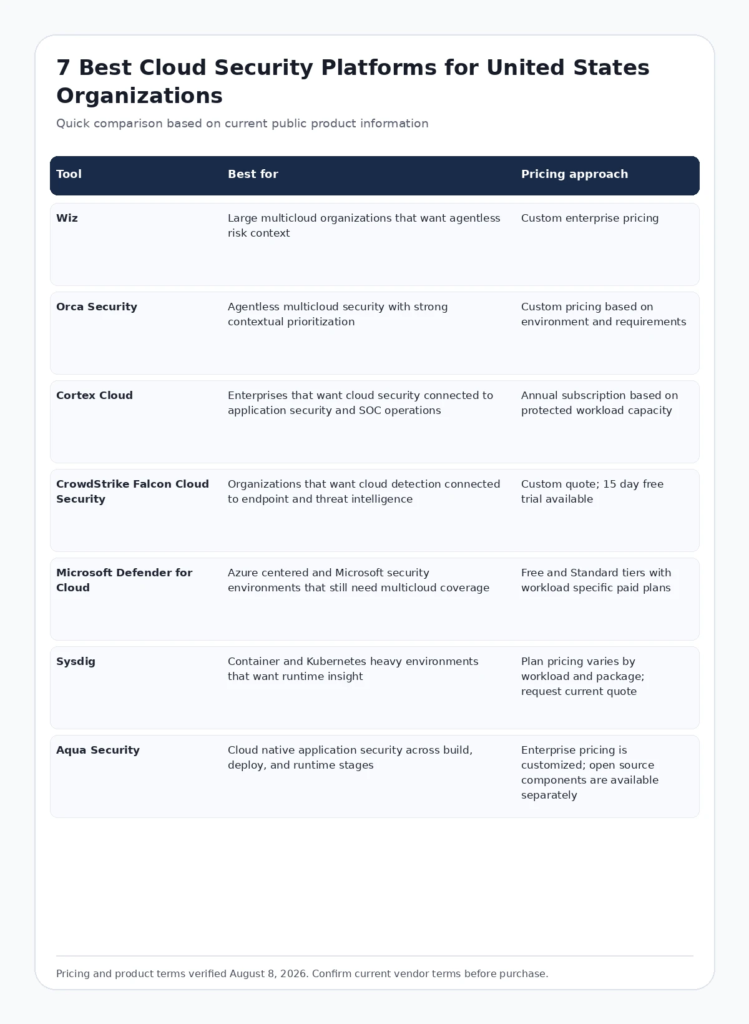
Infographic: Comparison Table
FCA_INFOGRAPHIC
Alt text: Comparison of leading best cloud security platforms for United States buyers, including best use case and pricing approach.
How We Evaluated These Tools
- Search intent fit: whether the product genuinely solves the job implied by the query rather than appearing only because it is adjacent to the category.
- Workflow fit: how easily the product connects to the systems, people, and review steps a US team already uses.
- Public evidence: official documentation, current pricing information, current feature pages, and credible independent research were favored over unsourced claims.
- Cost structure: we considered whether buyers pay by seat, usage, workload, traffic, credits, or custom contract because the same headline price can produce very different total cost.
- Operational limitations: every recommendation includes a reason a buyer might choose something else. A useful list should make tradeoffs easier to see, not hide them.
Google recommends that review content provide insightful analysis, original research, meaningful comparisons, and clear evidence rather than thin summaries. See Google Search Central guidance on high quality reviews and Google guidance on helpful, people first content.
Current Data and E E A T Signals to Consider
For US organizations, cloud security selection should begin with architecture and risk, not a feature count. NIST Cybersecurity Framework 2.0 gives teams a common way to organize governance, identification, protection, detection, response, and recovery activities across technology vendors. Source: NIST Cybersecurity Framework.
Palo Alto Networks documentation states that Cortex Cloud can keep logs and ingested data within the United States and offers FedRAMP authorized environments for US federal use cases. This is an example of why data residency and compliance must be checked at the plan and deployment level, not assumed from a vendor brand. Source: Cortex Cloud supported regions.
Detailed Reviews
1. Wiz
Best for: Large multicloud organizations that want agentless risk context
Wiz is a widely considered CNAPP option for organizations that want an agentless view across cloud configurations, vulnerabilities, identities, data, workloads, and application risk. Its core value is prioritization, connecting individual findings into attack paths and business context so teams can focus on risks that are actually exposed.
Where Wiz is strongest
- Strong multicloud visibility and attack path context
- Agentless architecture can accelerate initial discovery across large environments
- Broad CNAPP scope covers posture, identity, vulnerabilities, data, and application security
Pricing and buying model
Custom enterprise pricing. Check current official pricing
Limitations to consider
Public self serve pricing is not available, so procurement requires a sales process. Large platforms can also surface more findings than a team can immediately remediate, making ownership and workflow integration critical.
Visit the official Wiz website
2. Orca Security
Best for: Agentless multicloud security with strong contextual prioritization
Orca Security is another agentless first CNAPP that emphasizes rapid visibility across cloud assets, vulnerabilities, identities, data, and misconfigurations. It is a strong candidate for teams that want broad discovery without deploying an agent to every workload before they can see risk.
Where Orca Security is strongest
- Fast agentless onboarding for supported cloud environments
- Risk context helps combine vulnerabilities and exposure instead of treating findings independently
- Useful for organizations with several cloud accounts and fragmented ownership
Pricing and buying model
Custom pricing based on environment and requirements. Check current official pricing
Limitations to consider
Organizations with specialized runtime detection needs should validate where agentless coverage ends and where deeper workload protection begins. Pricing requires a quote, so a proof of concept should include a realistic cost model.
Visit the official Orca Security website
3. Cortex Cloud
Best for: Enterprises that want cloud security connected to application security and SOC operations
Palo Alto Networks Cortex Cloud brings application security, cloud posture, runtime protection, and security operations into one platform and data layer. It is compelling when an organization wants cloud findings to connect directly with detection and response rather than live in a separate posture dashboard.
Where Cortex Cloud is strongest
- Combines application, posture, runtime, and SOC capabilities
- Licensing is based on protected workloads, which can align cost with cloud footprint
- US hosting and federal compliance options are relevant to regulated American organizations
Pricing and buying model
Annual subscription based on protected workload capacity. Check current official pricing
Limitations to consider
The platform is broad and best suited to organizations that can use its integration depth. Procurement, deployment design, workload counting, and existing Palo Alto investments should all be considered before choosing it as a consolidation platform.
Visit the official Cortex Cloud website
4. CrowdStrike Falcon Cloud Security
Best for: Organizations that want cloud detection connected to endpoint and threat intelligence
CrowdStrike Falcon Cloud Security extends the Falcon platform into cloud posture, application security, workload runtime protection, container security, and cloud detection and response. It is particularly attractive to organizations that already use CrowdStrike and want shared threat intelligence and operational workflows across endpoints and cloud workloads.
Where CrowdStrike Falcon Cloud Security is strongest
- Connects cloud security with a mature detection and response ecosystem
- Options cover posture, runtime, containers, and full CNAPP capabilities
- Free trial creates a practical route to validate coverage before a contract
Pricing and buying model
Custom quote; 15 day free trial available. Check current official pricing
Limitations to consider
Pricing is quote based and the most compelling value often comes from platform consolidation. Teams that do not use Falcon elsewhere should compare the cost and complexity against cloud focused specialists.
Visit the official CrowdStrike Falcon Cloud Security website
5. Microsoft Defender for Cloud
Best for: Azure centered and Microsoft security environments that still need multicloud coverage
Microsoft Defender for Cloud combines posture management and workload protection across Azure, AWS, Google Cloud, and hybrid environments. It is a natural choice for organizations already using Microsoft security, Azure policy, and the Defender portal because cloud findings can connect to an existing operations model.
Where Microsoft Defender for Cloud is strongest
- Native integration with Azure and the broader Microsoft security ecosystem
- Supports Azure, AWS, Google Cloud, and hybrid resources
- Public pricing pages and a cost calculator help model specific workloads
Pricing and buying model
Free and Standard tiers with workload specific paid plans. Check current official pricing
Limitations to consider
The pricing structure is divided across protected resource types, which can be harder to compare with a single CNAPP quote. Non Azure teams should confirm that the operational experience is equally strong for their primary cloud.
Visit the official Microsoft Defender for Cloud website
6. Sysdig
Best for: Container and Kubernetes heavy environments that want runtime insight
Sysdig is particularly relevant to cloud native engineering teams where containers, Kubernetes, runtime behavior, and open source observability are central. Its security platform combines posture, vulnerability management, permissions, runtime detection, and investigation with strong emphasis on what is actually running.
Where Sysdig is strongest
- Deep container and Kubernetes heritage
- Runtime context helps prioritize vulnerabilities that can actually affect active workloads
- Useful for DevSecOps teams that want security connected closely to cloud native operations
Pricing and buying model
Plan pricing varies by workload and package; request current quote. Check current official pricing
Limitations to consider
Organizations with mostly traditional virtual machines or SaaS infrastructure may not need the same container depth. Buyers should map licensed workloads and data volumes to the expected cost.
Visit the official Sysdig website
7. Aqua Security
Best for: Cloud native application security across build, deploy, and runtime stages
Aqua Security focuses on protecting cloud native applications from development through runtime. It is a strong option for teams that want container, Kubernetes, software supply chain, posture, and runtime controls tied into one security program rather than a collection of independent scanners.
Where Aqua Security is strongest
- Strong focus on cloud native applications and containers
- Covers build time controls as well as runtime security
- Useful for organizations formalizing DevSecOps across multiple engineering teams
Pricing and buying model
Enterprise pricing is customized; open source components are available separately. Check current official pricing
Limitations to consider
The platform can be broader than needed for organizations with simple cloud estates. Enterprise pricing is not posted as a simple public rate, so a proof of concept should include both security outcomes and total operating cost.
Visit the official Aqua Security website
How to Choose the Right Platform
Define the risk model first
List clouds, accounts, workloads, identities, data stores, CI systems, containers, serverless workloads, and compliance requirements before evaluating a dashboard.
Test prioritization, not discovery volume
A platform that finds more issues is not automatically better. Evaluate whether it connects exposure, privilege, exploitability, runtime, and business context well enough to identify what should be fixed first.
Map every finding to an owner
Decide whether remediation belongs to platform engineering, application teams, security engineering, identity teams, or the SOC. Routing and evidence matter as much as detection.
Price a representative environment
Give every vendor the same cloud inventory and modules to price. Ask how ephemeral workloads, containers, data scanning, retention, and add ons affect the bill.
Relevant Futuristic Coding Academy Resources
For related technical and marketing context, explore dedicated server planning guide, full stack Java development guide, .NET full stack developer guide, full stack Python development guide, full stack development guide, and the Futuristic Coding Academy blog library.
Frequently Asked Questions
What is a cloud security platform?
A cloud security platform helps organizations discover assets, identify misconfigurations and vulnerabilities, analyze permissions, protect workloads, monitor runtime activity, and manage compliance across cloud environments.
What does CNAPP mean?
CNAPP means cloud native application protection platform. The category combines several capabilities that were once bought separately, including posture management, workload protection, identity analysis, application security, and often data security.
Which cloud security platform is best for multicloud environments?
Wiz, Orca, Cortex Cloud, CrowdStrike, Microsoft Defender for Cloud, Sysdig, and Aqua all support broad cloud security use cases. The best choice depends on which clouds, workloads, identity systems, and security operations tools the organization already uses.
What is the difference between CSPM and CNAPP?
Cloud security posture management focuses mainly on cloud configuration, exposure, and compliance. A CNAPP typically adds workload, identity, vulnerability, application, code, data, or runtime capabilities around that posture foundation.
Do cloud security platforms replace native AWS, Azure, or Google Cloud security tools?
Not always. Many organizations keep native controls for provider specific visibility and use a CNAPP to create a consistent view across accounts and clouds. The right architecture depends on team ownership and the number of platforms in use.
How should a US company evaluate cloud security compliance?
Map regulatory and contractual obligations to concrete controls such as data residency, encryption, audit logs, identity, retention, evidence export, FedRAMP where relevant, and support for frameworks your auditors actually use.
Is agentless cloud security enough?
Agentless discovery is excellent for rapid inventory and posture analysis, but some runtime and workload use cases require deeper sensors or agents. Teams should evaluate what must be detected in real time before choosing an agentless only architecture.
What should a cloud security proof of concept measure?
Measure asset discovery, false positives, attack path quality, runtime detection, identity risk, remediation workflows, developer integrations, time to triage, coverage gaps, deployment effort, and projected cost at production scale.
Why is cloud security pricing hard to compare?
Vendors may meter workloads, cloud assets, hosts, containers, accounts, data volume, modules, or contract bundles. A useful comparison starts with the same representative environment and asks every vendor to price that exact scope.
Which cloud security platform is best for Kubernetes?
Sysdig and Aqua have deep container and Kubernetes heritage, while CrowdStrike, Cortex Cloud, Wiz, Orca, and Defender for Cloud also protect cloud native workloads. The best fit depends on how much runtime depth the team needs.
Can one CNAPP replace several security tools?
It can consolidate posture, vulnerability, identity, application, and runtime capabilities, but replacement should be based on validated coverage. Specialized tools may still be needed for certain code, endpoint, network, data, or incident response requirements.
What is the biggest mistake when buying cloud security software?
Buying the broadest feature list without deciding who owns remediation. A platform only creates value when findings are prioritized, routed to the right engineering team, fixed, and measured over time.
Final Recommendation
There is no responsible way to choose among Wiz, Orca Security, Cortex Cloud, CrowdStrike Falcon Cloud Security, Microsoft Defender for Cloud, Sysdig, Aqua Security from a feature checklist alone. Start with the job your team needs to improve, test the product on representative work, verify the current price and contract terms, and measure the result that matters to the business. A platform deserves to stay in the stack only when it reduces meaningful work, improves quality, or creates measurable revenue or risk reduction without introducing more operational complexity than it removes.
Editorial note: Product features and pricing change frequently. This guide was verified on August 8, 2026. Always confirm current terms on the linked official vendor pages before purchasing.