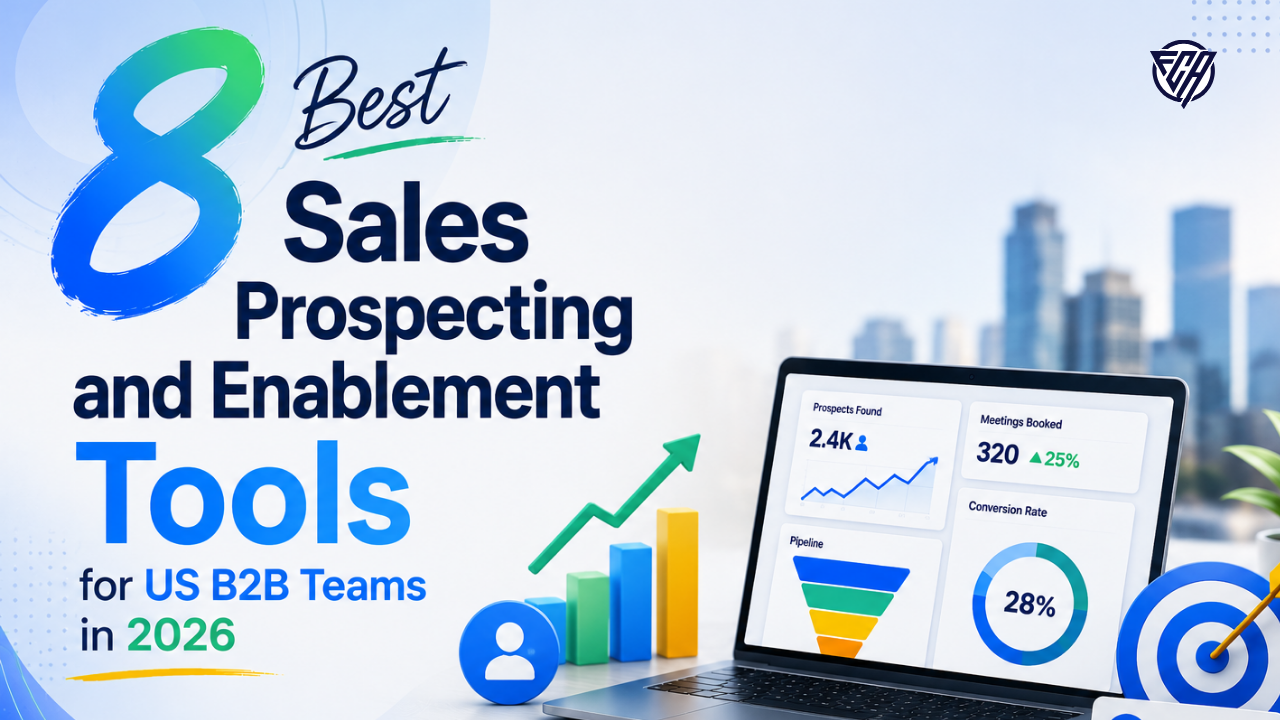
A modern prospecting stack has to do more than return a long contact list. Sales teams need accurate account research, usable contact data, enrichment, buying signals, CRM hygiene, outreach workflows, and a process that sellers will actually follow. The best tool therefore depends on where the bottleneck sits. This guide compares eight sales prospecting and enablement tools for United States B2B teams by the job each product does best, its pricing approach, and the tradeoffs buyers should validate before signing a contract.
This article targets the primary keyword best sales prospecting tools and also addresses related buyer questions such as sales enablement tools, B2B prospecting software, sales intelligence tools, lead generation software, B2B contact database. The recommendations use current public product information, current ranking page patterns, official documentation, and independent research. Prices are shown in US dollars when a vendor publishes them and were checked on August 8, 2026.
Quick Recommendations
- Apollo: Small and midsize B2B teams wanting data plus outreach in one platform
- LinkedIn Sales Navigator: Relationship based prospecting and account research
- Cognism: Teams prioritizing compliant global B2B data and verified mobile coverage
- Clay: GTM operations teams building enrichment and research workflows across many data sources
- ZoomInfo: Enterprise sales organizations that need broad intelligence, intent, and account data
- Lusha: Teams wanting straightforward contact data and enrichment with a flexible credit model
- LeadIQ: Sales development teams capturing and enriching prospects directly from their workflow
- Outreach: Larger revenue teams that need sales engagement, coaching, and controlled sequences
Comparison Table
| Tool | Best for | Pricing approach | Important limitation |
|---|---|---|---|
| Apollo | Small and midsize B2B teams wanting data plus outreach in one platform | Free and paid plans available; verify current credit and seat limits | Data quality varies by market and contact type, so teams should verify a sample against their target accounts. Credit rules and usage limits also matter when outreach volume grows. |
| LinkedIn Sales Navigator | Relationship based prospecting and account research | Core from $119.99 per license monthly; Advanced from $159.99 | Sales Navigator is not a full contact database with guaranteed emails and phone numbers for every prospect. Many teams pair it with an enrichment or contact data provider, increasing the total stack cost. |
| Cognism | Teams prioritizing compliant global B2B data and verified mobile coverage | Standard and Pro use tailored quotes; five seats included in current packages | Public dollar pricing is not posted, so comparison requires a quote. Credit use and mobile verification needs should be modeled against a real prospect list rather than a small demo. |
| Clay | GTM operations teams building enrichment and research workflows across many data sources | Free; Launch from $185 monthly; Growth from $495 monthly according to current FAQ | The product has both Actions and Data Credits, so teams need to understand two usage meters. It is also easier to overspend when experimental workflows are run at large scale without clear budgets. |
| ZoomInfo | Enterprise sales organizations that need broad intelligence, intent, and account data | Custom pricing based on package, seats, and data requirements | Pricing is usually customized and can be significantly higher than self serve prospecting tools. Buyers should validate contact accuracy in their exact market and negotiate around actual seat and export needs. |
| Lusha | Teams wanting straightforward contact data and enrichment with a flexible credit model | Credit based plans with free access and paid upgrades; confirm current allowance in the account | Credit consumption still needs monitoring, and data coverage can differ by region, seniority, and industry. Teams should run a sample of their own target market before using it as the only source of contact data. |
| LeadIQ | Sales development teams capturing and enriching prospects directly from their workflow | Free and paid plans; verify current seat and credit allowances on the official pricing page | The value depends on the rest of the revenue stack. Teams that need a full intent platform, a huge independent database, or advanced orchestration may need additional products. |
| Outreach | Larger revenue teams that need sales engagement, coaching, and controlled sequences | Custom enterprise pricing | It is not the cheapest way to find contacts and public self serve pricing is not available. Small teams may get more value from an all in one product until process complexity justifies a dedicated engagement platform. |
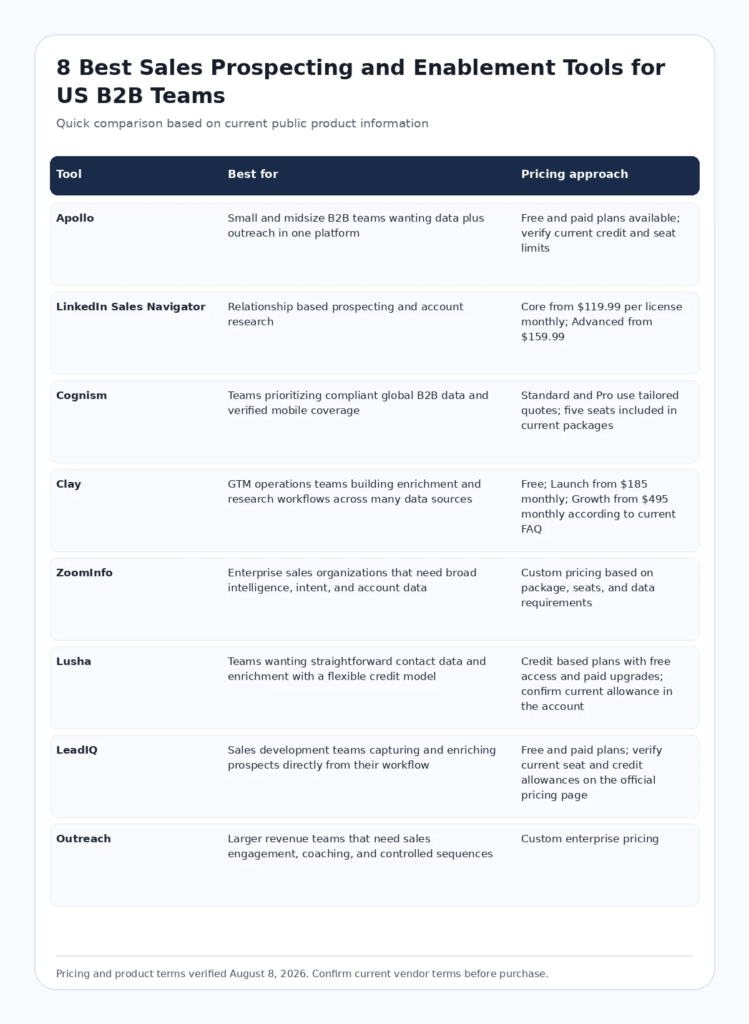
Infographic: Comparison Table
FCA_INFOGRAPHIC
Alt text: Comparison of leading best sales prospecting tools for United States buyers, including best use case and pricing approach.
How We Evaluated These Tools
- Search intent fit: whether the product genuinely solves the job implied by the query rather than appearing only because it is adjacent to the category.
- Workflow fit: how easily the product connects to the systems, people, and review steps a US team already uses.
- Public evidence: official documentation, current pricing information, current feature pages, and credible independent research were favored over unsourced claims.
- Cost structure: we considered whether buyers pay by seat, usage, workload, traffic, credits, or custom contract because the same headline price can produce very different total cost.
- Operational limitations: every recommendation includes a reason a buyer might choose something else. A useful list should make tradeoffs easier to see, not hide them.
Google recommends that review content provide insightful analysis, original research, meaningful comparisons, and clear evidence rather than thin summaries. See Google Search Central guidance on high quality reviews and Google guidance on helpful, people first content.
Current Data and E E A T Signals to Consider
Salesforce reported in its 2026 State of Sales research that sales reps spend almost a full workday each week on prospecting, while 47 percent say their team lacks bandwidth for cold outreach. That makes workflow efficiency a real buying criterion, not just a convenience feature. Source: Salesforce State of Sales 2026.
The same Salesforce research says 92 percent of sales professionals who use AI agents report that agents benefit prospecting. High performers were also 1.7 times more likely than underperformers to use prospecting agents. Source: Salesforce prospecting agent findings.
Detailed Reviews
1. Apollo
Best for: Small and midsize B2B teams wanting data plus outreach in one platform
Apollo is a common starting point for US B2B teams because it combines a large prospect database, filters, contact data, sequencing, enrichment, and CRM workflows in one product. That breadth can reduce the number of subscriptions a smaller sales team needs during its first stage of outbound.
Where Apollo is strongest
- Combines prospect data and outreach workflows in one interface
- Useful filters for building targeted account and contact lists
- Free access makes it easy to validate coverage before committing to a paid plan
Pricing and buying model
Free and paid plans available; verify current credit and seat limits. Check current official pricing
Limitations to consider
Data quality varies by market and contact type, so teams should verify a sample against their target accounts. Credit rules and usage limits also matter when outreach volume grows.
Visit the official Apollo website
2. LinkedIn Sales Navigator
Best for: Relationship based prospecting and account research
LinkedIn Sales Navigator is difficult to replace when the goal is to identify the right people inside specific accounts, follow job changes, understand relationships, and prospect using the professional graph rather than a static contact database. It is especially useful for account based sellers who care about role changes and warm paths.
Where LinkedIn Sales Navigator is strongest
- Strong account and people search built on LinkedIn professional data
- Lead and account alerts help sellers react to changes instead of relying on static lists
- Advanced tiers add team and CRM workflows for larger organizations
Pricing and buying model
Core from $119.99 per license monthly; Advanced from $159.99. Check current official pricing
Limitations to consider
Sales Navigator is not a full contact database with guaranteed emails and phone numbers for every prospect. Many teams pair it with an enrichment or contact data provider, increasing the total stack cost.
Visit the official LinkedIn Sales Navigator website
3. Cognism
Best for: Teams prioritizing compliant global B2B data and verified mobile coverage
Cognism focuses on B2B contact and company data with compliance, verified mobile numbers, intent, enrichment, and AI assisted research. It is a strong candidate for sales teams that operate across multiple countries and want a provider that makes data governance part of the buying conversation.
Where Cognism is strongest
- Strong focus on compliant B2B data and mobile verification
- Standard and Pro packages combine research, targeting, and enrichment capabilities
- Useful for teams that sell internationally and need a consistent data process
Pricing and buying model
Standard and Pro use tailored quotes; five seats included in current packages. Check current official pricing
Limitations to consider
Public dollar pricing is not posted, so comparison requires a quote. Credit use and mobile verification needs should be modeled against a real prospect list rather than a small demo.
Visit the official Cognism website
4. Clay
Best for: GTM operations teams building enrichment and research workflows across many data sources
Clay is less a single database and more a go to market data and workflow layer. It can combine multiple providers, run waterfall enrichment, use AI research, track signals, sync CRM data, and orchestrate personalized outreach. It is powerful when a team has someone who can design the workflow rather than only search a contact database.
Where Clay is strongest
- Multi provider enrichment reduces dependence on one contact source
- Claygent and workflow logic support custom account research at scale
- Growth tier adds CRM synchronization, web intent, API calls, and webhook automation
Pricing and buying model
Free; Launch from $185 monthly; Growth from $495 monthly according to current FAQ. Check current official pricing
Limitations to consider
The product has both Actions and Data Credits, so teams need to understand two usage meters. It is also easier to overspend when experimental workflows are run at large scale without clear budgets.
Visit the official Clay website
5. ZoomInfo
Best for: Enterprise sales organizations that need broad intelligence, intent, and account data
ZoomInfo remains a major enterprise sales intelligence option for organizations that want a large contact and company database, account intelligence, intent, enrichment, and workflows that connect to established CRM and revenue operations systems. It is most relevant when the sales motion is large enough to justify a negotiated data contract.
Where ZoomInfo is strongest
- Broad company and contact intelligence for enterprise prospecting
- Intent and enrichment can support account prioritization beyond list building
- Established integrations fit mature revenue operations teams
Pricing and buying model
Custom pricing based on package, seats, and data requirements. Check current official pricing
Limitations to consider
Pricing is usually customized and can be significantly higher than self serve prospecting tools. Buyers should validate contact accuracy in their exact market and negotiate around actual seat and export needs.
Visit the official ZoomInfo website
6. Lusha
Best for: Teams wanting straightforward contact data and enrichment with a flexible credit model
Lusha is useful for sales teams that want a relatively simple way to reveal contact details, enrich records, and work from a browser extension or prospecting platform. Its current model uses a common credit balance across several workflows, which can make usage easier to understand than separate limits for each feature.
Where Lusha is strongest
- Straightforward prospecting experience for individual sellers and teams
- Single credit system covers several data and workflow uses
- Works well as an enrichment layer alongside LinkedIn based account research
Pricing and buying model
Credit based plans with free access and paid upgrades; confirm current allowance in the account. Check current official pricing
Limitations to consider
Credit consumption still needs monitoring, and data coverage can differ by region, seniority, and industry. Teams should run a sample of their own target market before using it as the only source of contact data.
Visit the official Lusha website
7. LeadIQ
Best for: Sales development teams capturing and enriching prospects directly from their workflow
LeadIQ is aimed at sales development workflows where reps identify a prospect, capture verified data, enrich the record, and move it into the CRM or engagement platform with minimal manual entry. It is attractive to teams that already prospect heavily in LinkedIn and want less copy and paste work.
Where LeadIQ is strongest
- Designed around rep workflow rather than database exploration alone
- CRM and sales engagement integrations reduce manual data entry
- Useful for standardized capture and enrichment processes across an SDR team
Pricing and buying model
Free and paid plans; verify current seat and credit allowances on the official pricing page. Check current official pricing
Limitations to consider
The value depends on the rest of the revenue stack. Teams that need a full intent platform, a huge independent database, or advanced orchestration may need additional products.
Visit the official LeadIQ website
8. Outreach
Best for: Larger revenue teams that need sales engagement, coaching, and controlled sequences
Outreach belongs in this list because prospecting is not complete when a rep finds a contact. Larger revenue teams need consistent sequences, task management, governance, coaching, and analytics around what happens next. Outreach is strongest when a company already has data sources and wants a system for executing and managing the sales motion.
Where Outreach is strongest
- Strong sales engagement workflow for larger SDR and account executive teams
- Governance and analytics support standardized revenue processes
- Integrates with the broader CRM and sales technology stack rather than trying to be the only data source
Pricing and buying model
Custom enterprise pricing. Check current official pricing
Limitations to consider
It is not the cheapest way to find contacts and public self serve pricing is not available. Small teams may get more value from an all in one product until process complexity justifies a dedicated engagement platform.
Visit the official Outreach website
How to Choose the Right Platform
Test your market, not a generic sample
Use a representative set of US accounts, job titles, industries, and company sizes. Record valid contacts, direct dials, job accuracy, missing records, and duplicates.
Measure cost per usable opportunity
A cheaper database can be more expensive if sellers spend hours validating poor records. Include rep time, bounce rates, credits, enrichment, and opportunities created.
Decide where workflow orchestration lives
If CRM, enrichment, sequencing, intent, and research are spread across tools, define which system owns the prospect record and how changes flow between systems.
Make compliance operational
Document suppression, consent where required, data sourcing, opt out, do not call rules, retention, and how the team handles inaccurate records. Legal review should match the channels and markets you use.
Relevant Futuristic Coding Academy Resources
For related technical and marketing context, explore digital marketing guide, digital marketing training guide, digital marketing internship guide, Futuristic Coding Academy blog library, Futuristic Coding Academy, and the full stack development guide.
Frequently Asked Questions
What is a sales prospecting tool?
A sales prospecting tool helps sellers identify potential accounts or contacts, research them, find contact information, enrich records, prioritize outreach, or move prospects into a CRM and sales engagement workflow.
What is the best sales prospecting tool for a small business?
Apollo is a strong starting point for many small B2B teams because it combines data and outreach. LinkedIn Sales Navigator is valuable when relationship and account research matter more than email sequencing.
What is the difference between sales intelligence and sales engagement software?
Sales intelligence helps identify and understand the right accounts and people. Sales engagement software manages sequences, tasks, emails, calls, and rep workflows after a prospect has been selected.
Is LinkedIn Sales Navigator enough for prospecting?
It can be enough for relationship driven selling, but it does not provide every email and phone number a team may need. Many organizations pair it with an enrichment or contact data provider.
How should a company compare B2B data accuracy?
Give each vendor the same representative list of target accounts and contacts. Measure valid email rate, direct dial coverage, job title accuracy, company match quality, freshness, and how often the provider returns no result.
Which sales prospecting tool is best for international data?
Cognism is a strong candidate for teams that prioritize global coverage and compliance. ZoomInfo, Apollo, Lusha, and other providers should still be tested against the exact regions and personas the company sells to.
What is Clay used for in sales prospecting?
Clay orchestrates research and enrichment across many data providers, signals, AI research steps, and CRM workflows. It is especially useful for teams that want custom go to market logic instead of one fixed database.
How much does Sales Navigator cost in the United States?
LinkedIn lists Sales Navigator Core from $119.99 per license monthly and Advanced from $159.99 per license monthly, with lower effective monthly pricing on annual plans.
Do AI prospecting tools replace SDRs?
They can automate research, enrichment, prioritization, personalization, and repetitive outreach tasks. Human sellers still need to define the market, handle nuanced conversations, qualify real needs, and build trust with buyers.
What should be included in a prospecting tool pilot?
Test one representative segment for data accuracy, time saved, reply quality, CRM cleanliness, seller adoption, compliance workflow, cost per usable contact, and opportunities created rather than judging only the number of records returned.
Should a company buy one platform or a prospecting stack?
Small teams often benefit from one broad platform. Mature revenue organizations usually combine relationship data, contact data, enrichment, engagement, CRM, and intent tools because each layer solves a different problem.
How often should prospect data be refreshed?
Refresh important records continuously or before campaigns, especially job titles, company status, phone numbers, and buying signals. Static lists decay quickly because people change roles and companies every day.
Final Recommendation
There is no responsible way to choose among Apollo, LinkedIn Sales Navigator, Cognism, Clay, ZoomInfo, Lusha, LeadIQ, Outreach from a feature checklist alone. Start with the job your team needs to improve, test the product on representative work, verify the current price and contract terms, and measure the result that matters to the business. A platform deserves to stay in the stack only when it reduces meaningful work, improves quality, or creates measurable revenue or risk reduction without introducing more operational complexity than it removes.
Editorial note: Product features and pricing change frequently. This guide was verified on August 8, 2026. Always confirm current terms on the linked official vendor pages before purchasing.