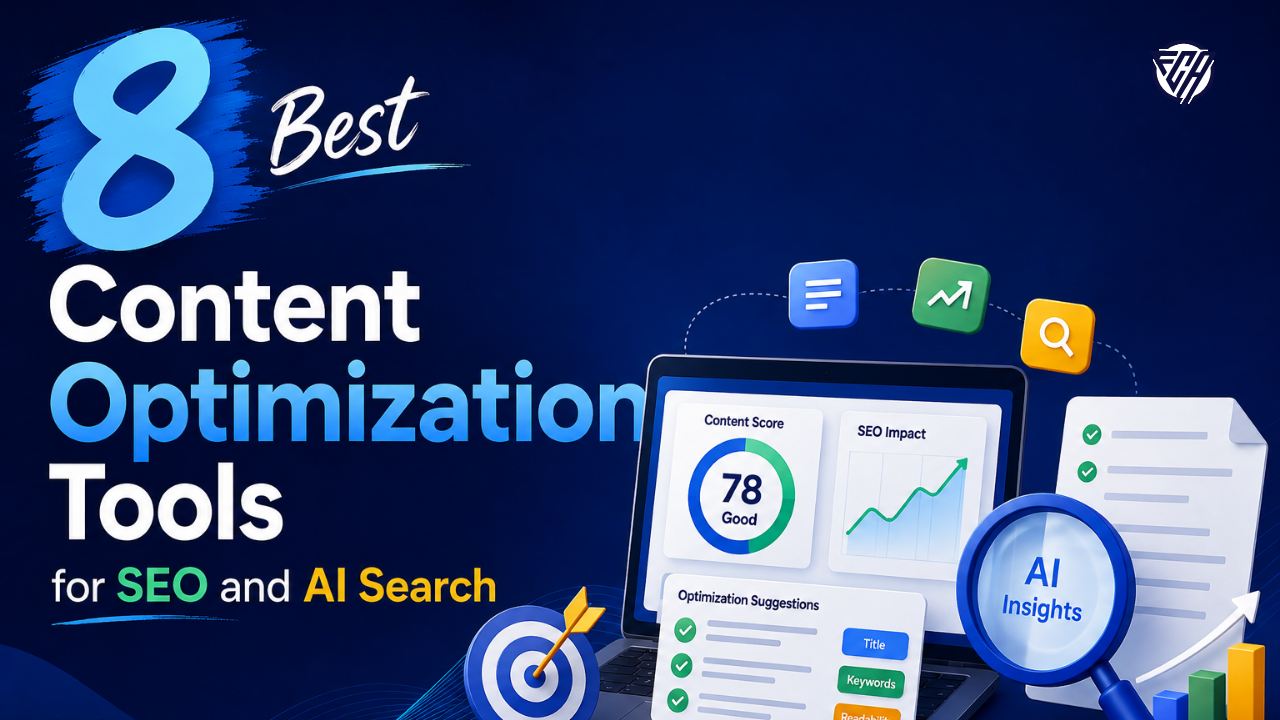
Content optimization software can save research time, but the wrong workflow can also make an article sound like every other page in the search results. The best tools help a writer understand intent, missing questions, topic coverage, competing pages, internal opportunities, and post publication performance. They should support editorial judgment rather than replace it. This guide focuses on tools that US content and SEO teams can use to plan, improve, and refresh content for both traditional search and newer AI discovery experiences.
This article targets the primary keyword best content optimization tools and also addresses related buyer questions such as SEO content optimization tools, content optimization software, SERP content editor, content brief tools, AI search content optimization. The recommendations use current public product information, current ranking page patterns, official documentation, and independent research. Prices are shown in US dollars when a vendor publishes them and were checked on August 8, 2026.
Quick Recommendations
- Surfer: Writers who want live SERP guidance while drafting
- Clearscope: Editorial teams that value clear topic coverage and AI search visibility
- Semrush Content Toolkit: Teams that want content production connected to a wider SEO data stack
- Frase: Teams that want research, optimization, refresh monitoring, and publishing in one loop
- MarketMuse: Content strategists prioritizing topical authority and portfolio decisions
- Dashword: Small teams wanting straightforward briefs, optimization, and monitoring
- Ahrefs AI Content Helper: Ahrefs users who want content guidance next to keyword and competitor research
- Google Search Console with an editorial workflow: Free refresh decisions based on real performance data
Comparison Table
| Tool | Best for | Pricing approach | Important limitation |
|---|---|---|---|
| Surfer | Writers who want live SERP guidance while drafting | Discovery from $49 monthly with annual billing | A content score is a diagnostic, not a writing target that should be maximized at any cost. Overusing suggested terms can make copy repetitive, so editorial judgment is still required. |
| Clearscope | Editorial teams that value clear topic coverage and AI search visibility | Essentials $129 monthly; Business $399 monthly | The entry price is higher than lightweight tools. Teams producing a very large number of briefs or drafts need to model included credits and add ons rather than comparing only the monthly subscription. |
| Semrush Content Toolkit | Teams that want content production connected to a wider SEO data stack | Base plan $60 monthly with annual billing; 7 day trial | The base Content Toolkit is not the same as having every Semrush SEO product. Buyers should check which capabilities live in the content plan and which require another Semrush subscription or add on. |
| Frase | Teams that want research, optimization, refresh monitoring, and publishing in one loop | Starter $39 monthly with annual billing; Professional $103; Scale $239 | Usage limits differ by plan for articles, audit pages, monitored pages, and AI visibility features. Buyers should map those limits to their monthly publishing volume before choosing a tier. |
| MarketMuse | Content strategists prioritizing topical authority and portfolio decisions | Free limited plan; paid Optimize, Research, and Strategy plans use quote based pricing | The product is more strategic than a simple content editor, so smaller teams may not use its depth. Current paid plan pricing is not posted as a simple public dollar figure and requires a sales conversation. |
| Dashword | Small teams wanting straightforward briefs, optimization, and monitoring | Startup $99 monthly; Business from $349 monthly | Teams that need deep backlink research, technical SEO, or broad keyword databases will still need other tools. The value is strongest when content optimization is the primary job to be done. |
| Ahrefs AI Content Helper | Ahrefs users who want content guidance next to keyword and competitor research | Available within eligible Ahrefs subscriptions; verify the current plan before purchase | It is most economical when the organization already needs Ahrefs. A team shopping only for a writing editor should compare the total subscription cost with specialist tools. |
| Google Search Console with an editorial workflow | Free refresh decisions based on real performance data | Free | Search Console does not write briefs or tell a writer exactly what to add. Teams need an editorial process that turns query and page data into decisions instead of treating the dashboard as a content recommendation engine. |
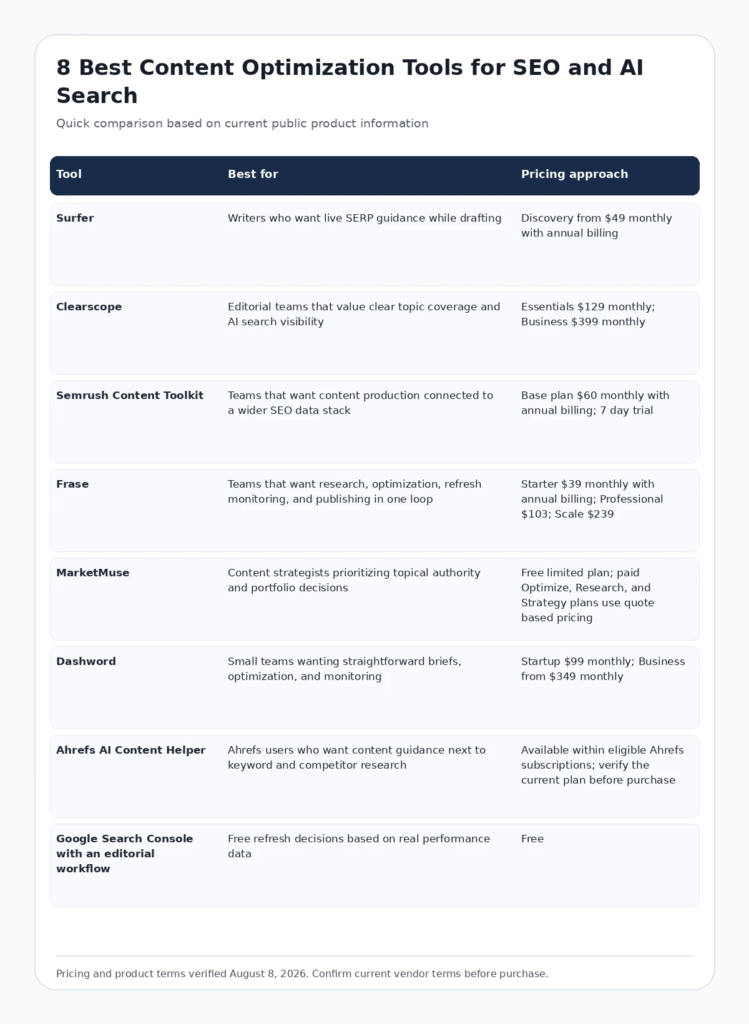
Infographic: Comparison Table
FCA_INFOGRAPHIC
Alt text: Comparison of leading best content optimization tools for United States buyers, including best use case and pricing approach.
How We Evaluated These Tools
- Search intent fit: whether the product genuinely solves the job implied by the query rather than appearing only because it is adjacent to the category.
- Workflow fit: how easily the product connects to the systems, people, and review steps a US team already uses.
- Public evidence: official documentation, current pricing information, current feature pages, and credible independent research were favored over unsourced claims.
- Cost structure: we considered whether buyers pay by seat, usage, workload, traffic, credits, or custom contract because the same headline price can produce very different total cost.
- Operational limitations: every recommendation includes a reason a buyer might choose something else. A useful list should make tradeoffs easier to see, not hide them.
Google recommends that review content provide insightful analysis, original research, meaningful comparisons, and clear evidence rather than thin summaries. See Google Search Central guidance on high quality reviews and Google guidance on helpful, people first content.
Current Data and E E A T Signals to Consider
Google says its systems are designed to prioritize helpful and reliable information created primarily to benefit people, and specifically warns against mass producing content that adds little value. That makes original analysis and editing more important than chasing a content score. Source: Google people first content guidance.
Google also states that the same core SEO practices remain relevant for AI Overviews and AI Mode, with no special markup required simply to appear in those experiences. Source: Google AI search guidance.
Detailed Reviews
1. Surfer
Best for: Writers who want live SERP guidance while drafting
Surfer remains one of the clearest options for teams that want a writing interface built around current search results. Its editor turns competing pages into topic and coverage guidance, while newer plans add AI visibility tracking, content audits, topical maps, and workflow automation. The product is strongest when a writer wants recommendations during drafting rather than a separate research report.
Where Surfer is strongest
- Live content guidance is easy to understand inside the editor
- Content audit and topical planning extend beyond one article at a time
- Current plans add AI visibility features alongside traditional search optimization
Pricing and buying model
Discovery from $49 monthly with annual billing. Check current official pricing
Limitations to consider
A content score is a diagnostic, not a writing target that should be maximized at any cost. Overusing suggested terms can make copy repetitive, so editorial judgment is still required.
Visit the official Surfer website
2. Clearscope
Best for: Editorial teams that value clear topic coverage and AI search visibility
Clearscope combines topic exploration, content drafts, page tracking, prompt tracking, and search intent guidance in a relatively focused interface. It is well suited to editorial teams that want recommendations without turning every article into a heavily automated production pipeline. Unlimited users on current plans can also simplify collaboration for larger content groups.
Where Clearscope is strongest
- Strong topic and intent guidance with a simple editorial workflow
- Tracks pages and prompts across search and AI discovery environments
- Unlimited users reduce friction for editors, writers, and subject experts
Pricing and buying model
Essentials $129 monthly; Business $399 monthly. Check current official pricing
Limitations to consider
The entry price is higher than lightweight tools. Teams producing a very large number of briefs or drafts need to model included credits and add ons rather than comparing only the monthly subscription.
Visit the official Clearscope website
3. Semrush Content Toolkit
Best for: Teams that want content production connected to a wider SEO data stack
Semrush Content Toolkit brings topic discovery, SEO briefs, optimization, brand voice, AI writing, and WordPress publishing into a product backed by the broader Semrush ecosystem. It is attractive when keyword research, competitive intelligence, site audits, and content operations already happen in Semrush and the team wants fewer disconnected tools.
Where Semrush Content Toolkit is strongest
- Country specific topic ideas are useful for US focused content planning
- SEO brief generation and optimization sit beside broader Semrush research
- WordPress publishing support can shorten the path from draft to CMS
Pricing and buying model
Base plan $60 monthly with annual billing; 7 day trial. Check current official pricing
Limitations to consider
The base Content Toolkit is not the same as having every Semrush SEO product. Buyers should check which capabilities live in the content plan and which require another Semrush subscription or add on.
Visit the official Semrush Content Toolkit website
4. Frase
Best for: Teams that want research, optimization, refresh monitoring, and publishing in one loop
Frase has expanded from a content brief and optimization tool into a broader content operations platform. Current plans combine SEO and GEO scores, AI visibility, content monitoring, internal link suggestions on Professional, and direct publishing to several content management systems. That makes it useful for teams that want one workflow from research through refresh.
Where Frase is strongest
- Strong combination of brief creation, writing, optimization, and monitoring
- Professional plan includes internal linking suggestions and wider site workflows
- Direct publishing options reduce manual CMS work
Pricing and buying model
Starter $39 monthly with annual billing; Professional $103; Scale $239. Check current official pricing
Limitations to consider
Usage limits differ by plan for articles, audit pages, monitored pages, and AI visibility features. Buyers should map those limits to their monthly publishing volume before choosing a tier.
Visit the official Frase website
5. MarketMuse
Best for: Content strategists prioritizing topical authority and portfolio decisions
MarketMuse is strongest when the problem is not just optimizing a draft but deciding what the site should create, update, consolidate, or prioritize. Its inventory and topic models use site specific signals such as personalized difficulty and topic authority to help teams think in clusters rather than isolated keywords.
Where MarketMuse is strongest
- Site inventory supports portfolio level content decisions
- Personalized difficulty and topic authority help prioritize work by existing strength
- Brief types cover articles, comparisons, FAQs, guides, local pages, and reviews
Pricing and buying model
Free limited plan; paid Optimize, Research, and Strategy plans use quote based pricing. Check current official pricing
Limitations to consider
The product is more strategic than a simple content editor, so smaller teams may not use its depth. Current paid plan pricing is not posted as a simple public dollar figure and requires a sales conversation.
Visit the official MarketMuse website
6. Dashword
Best for: Small teams wanting straightforward briefs, optimization, and monitoring
Dashword focuses on a compact content workflow with content reports, briefs, optimization, and monitoring. It is easier to understand than a large SEO suite and can suit teams that mainly need to turn a keyword into a useful brief, guide a writer, and revisit published content later.
Where Dashword is strongest
- Simple content report and brief workflow
- Startup plan includes multiple user seats and a substantial AI writing allowance
- Business plan adds API access and bulk report creation for larger teams
Pricing and buying model
Startup $99 monthly; Business from $349 monthly. Check current official pricing
Limitations to consider
Teams that need deep backlink research, technical SEO, or broad keyword databases will still need other tools. The value is strongest when content optimization is the primary job to be done.
Visit the official Dashword website
7. Ahrefs AI Content Helper
Best for: Ahrefs users who want content guidance next to keyword and competitor research
Ahrefs AI Content Helper is relevant for teams that already rely on Ahrefs for keyword research, backlinks, and competitive analysis. Keeping content guidance close to the same data platform can reduce tool switching and makes it easier to move from opportunity discovery to a draft that covers the search intent.
Where Ahrefs AI Content Helper is strongest
- Fits naturally into an existing Ahrefs research workflow
- Useful when keyword, competitor, and content decisions need to share one data source
- Reduces the need to buy a separate specialist editor for some teams
Pricing and buying model
Available within eligible Ahrefs subscriptions; verify the current plan before purchase. Check current official pricing
Limitations to consider
It is most economical when the organization already needs Ahrefs. A team shopping only for a writing editor should compare the total subscription cost with specialist tools.
Visit the official Ahrefs AI Content Helper website
8. Google Search Console with an editorial workflow
Best for: Free refresh decisions based on real performance data
Search Console is not a conventional content editor, but it belongs in any serious optimization stack because it shows what users actually searched, which pages received impressions, where clicks changed, and which queries are associated with an existing page. That evidence is often more valuable for refresh work than another generic content score.
Where Google Search Console with an editorial workflow is strongest
- First party performance data from Google Search
- Excellent for identifying declining pages, query expansion, and unexpected search intent
- Free and useful alongside any paid optimization platform
Pricing and buying model
Free. Check current official pricing
Limitations to consider
Search Console does not write briefs or tell a writer exactly what to add. Teams need an editorial process that turns query and page data into decisions instead of treating the dashboard as a content recommendation engine.
Visit the official Google Search Console with an editorial workflow website
How to Choose the Right Platform
Separate research from writing
Use the tool to expose questions, entities, gaps, and competing coverage. Then let the writer decide what deserves space and what would only repeat the SERP.
Prefer real performance data for refreshes
Search Console, analytics, conversion data, customer questions, and sales feedback should guide updates to existing pages. A content score alone cannot tell you whether a page helps the business.
Check whether AI visibility is a real workflow
Prompt tracking is useful when the team has defined commercial questions to monitor. Buying an AEO dashboard without a content and distribution process only creates another report.
Match limits to publishing volume
Count briefs, optimized documents, tracked pages, users, sites, AI prompts, and refresh monitoring. A lower plan price can become expensive if the team constantly buys extra credits.
Relevant Futuristic Coding Academy Resources
For related technical and marketing context, explore digital marketing guide, digital marketing training guide, digital marketing internship guide, Futuristic Coding Academy blog library, Futuristic Coding Academy, and the full stack development guide.
Frequently Asked Questions
What is a content optimization tool?
A content optimization tool analyzes a topic, search results, existing pages, or performance data and recommends ways to improve relevance, coverage, structure, internal linking, and usefulness for the intended audience.
Which content optimization tool is best for SEO writers?
Surfer, Clearscope, Frase, and Semrush Content Toolkit are strong starting points for writers. The best choice depends on whether the team needs a focused editor, broader SEO data, publishing workflows, or portfolio level planning.
Do content scores directly improve rankings?
No. A score is a vendor specific diagnostic. Google does not rank pages according to Surfer, Clearscope, Frase, or any other third party content score. Use scores to find gaps, then edit for clarity and usefulness.
Can these tools optimize for ChatGPT and AI search?
Several products now track prompts or provide AI visibility features, but visibility in AI answers still depends on useful content, crawlability, authoritative sourcing, entity clarity, and the underlying retrieval systems used by each platform.
Is Surfer better than Clearscope?
Surfer offers a broader workflow with audits, topical maps, automation, and AI visibility. Clearscope is appealing to editorial teams that want a simpler optimization and tracking experience with unlimited users. The better fit depends on workflow and scale.
What is the best free content optimization tool?
Google Search Console is the most valuable free source for optimizing existing pages because it shows real query and performance data. MarketMuse also offers a limited free tier for topical research.
Should I use a content tool before or after writing?
Use it before writing to understand intent and build a brief, during writing to check coverage, and after publication to identify refresh opportunities. The tool should inform the editorial process rather than dictate every sentence.
How many keywords should an article target?
There is no fixed number. A strong article usually focuses on one primary intent and naturally covers related questions, concepts, entities, and supporting terms that help the reader complete the task.
Do content optimization tools replace keyword research?
Not always. Some include keyword discovery, while others assume you already know the target topic. Teams often pair a specialist editor with a broader SEO platform or Search Console data.
What should agencies look for in a content optimization platform?
Agencies should evaluate multi site support, user limits, client reporting, white label options, brief volume, export workflows, WordPress integrations, monitoring, and how easily a reviewer can explain recommendations to a client.
How often should existing content be optimized?
Refresh when performance data, product changes, search intent, regulations, pricing, or the competitive landscape materially change. Updating a date without improving the page does not add value.
Can optimization tools make content sound robotic?
Yes, if writers mechanically insert every suggested term or copy generated text without editing. The best use is to identify missing information and then express it naturally in the site own editorial voice.
Final Recommendation
There is no responsible way to choose among Surfer, Clearscope, Semrush Content Toolkit, Frase, MarketMuse, Dashword, Ahrefs AI Content Helper, Google Search Console with an editorial workflow from a feature checklist alone. Start with the job your team needs to improve, test the product on representative work, verify the current price and contract terms, and measure the result that matters to the business. A platform deserves to stay in the stack only when it reduces meaningful work, improves quality, or creates measurable revenue or risk reduction without introducing more operational complexity than it removes.
Editorial note: Product features and pricing change frequently. This guide was verified on August 8, 2026. Always confirm current terms on the linked official vendor pages before purchasing.