This comparison is based on current public documentation, official pricing pages, product capabilities, buyer fit, and independent research. Futuristic Coding Academy did not accept payment for placement in this article. Prices and features can change, so confirm current terms on the vendor website before purchasing.
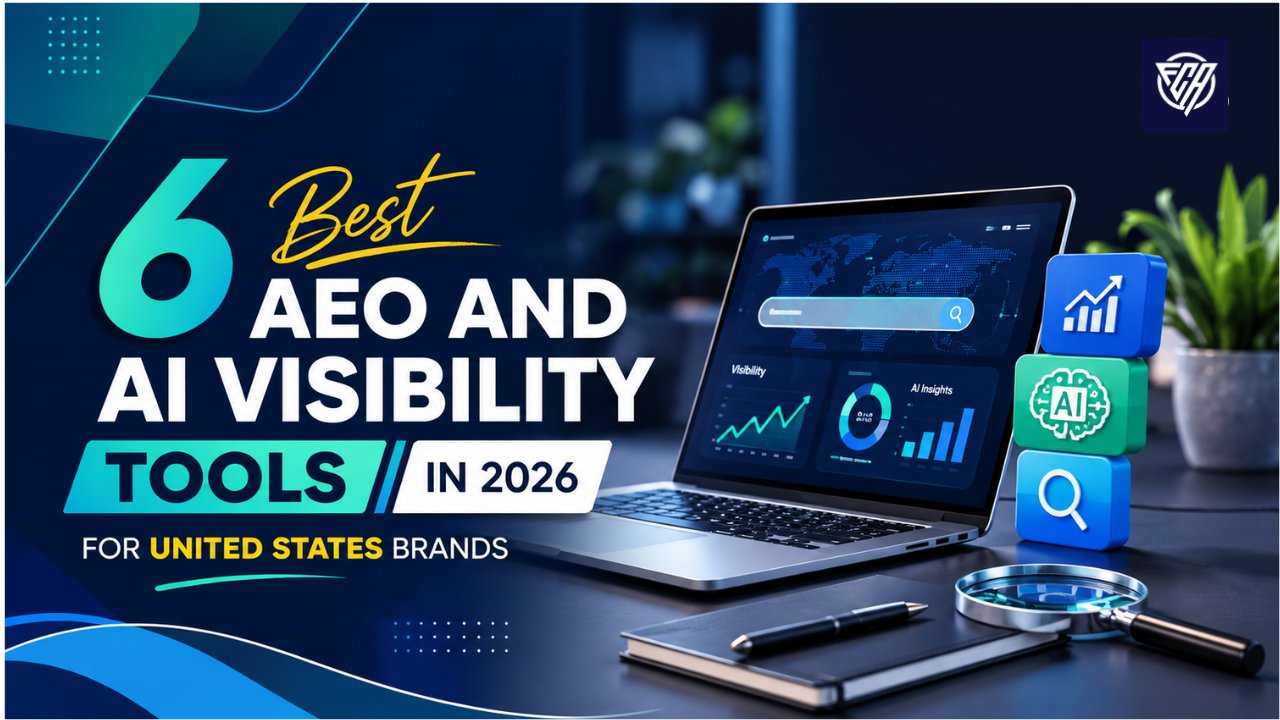
Search visibility is no longer limited to a list of blue links. Buyers now ask ChatGPT, Gemini, Perplexity, Microsoft Copilot, and Google AI experiences for recommendations, comparisons, explanations, and shortlists. AEO and AI visibility tools help marketing teams measure whether a brand appears in those answers, which sources are cited, how competitors perform, and which buyer questions deserve attention.
These tools should complement, not replace, foundational search work. Futuristic Coding Academy readers can use the digital marketing resource and the technology blog library alongside this guide. Google states that normal SEO best practices remain relevant for AI features and that websites do not need special AI specific markup to be considered.
The commercial reason to measure this channel is becoming clearer. Reuters reported June 2026 Adobe Analytics data showing that United States shoppers referred from large language models generated 53 percent more revenue per visit than shoppers arriving from non AI sources in the measured retail sample. That result will not transfer to every industry, but it shows why brands should measure AI referrals and answer visibility as real acquisition signals rather than novelty metrics.
Best Options at a Glance
- HubSpot AEO Grader: Small and midsize marketing teams that want a focused AI visibility product
- Semrush AI Visibility: SEO teams that want AI visibility connected to a broader search marketing suite
- Ahrefs Brand Radar: Search teams that want large scale brand mention and citation monitoring
- Peec AI: Brands and agencies that want prompt level visibility tracking across several AI systems
- Writesonic GEO: Content teams that want AI visibility monitoring connected to content workflows
- OtterlyAI: Teams that want straightforward brand tracking across AI answer engines
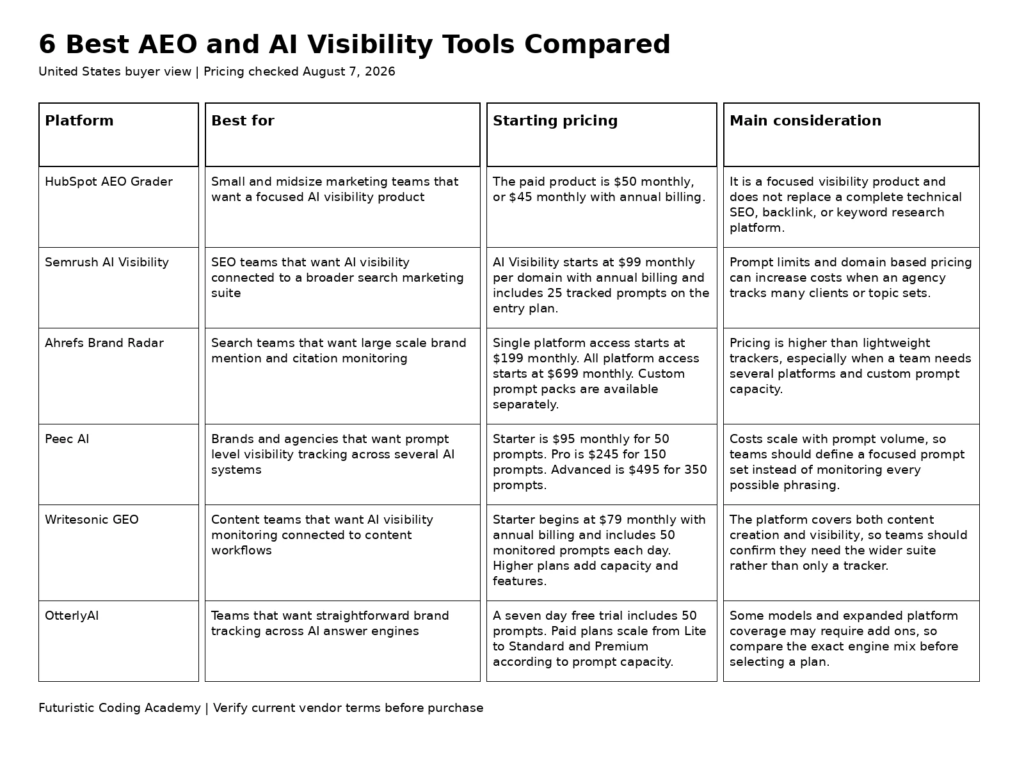
| Platform | Best for | Starting pricing | Core coverage | Main consideration |
|---|---|---|---|---|
| HubSpot AEO Grader | Small and midsize marketing teams that want a focused AI visibility product | The paid product is $50 monthly, or $45 monthly with annual billing. | Tracks visibility, sentiment, share of voice, citations, and prompts across major AI answer engines | It is a focused visibility product and does not replace a complete technical SEO, backlink, or keyword research platform. |
| Semrush AI Visibility | SEO teams that want AI visibility connected to a broader search marketing suite | AI Visibility starts at $99 monthly per domain with annual billing and includes 25 tracked prompts on the entry plan. | AI visibility, prompt research, competitor monitoring, and search marketing data | Prompt limits and domain based pricing can increase costs when an agency tracks many clients or topic sets. |
| Ahrefs Brand Radar | Search teams that want large scale brand mention and citation monitoring | Single platform access starts at $199 monthly. All platform access starts at $699 monthly. Custom prompt packs are available separately. | Brand and citation monitoring across AI search and web data | Pricing is higher than lightweight trackers, especially when a team needs several platforms and custom prompt capacity. |
| Peec AI | Brands and agencies that want prompt level visibility tracking across several AI systems | Starter is $95 monthly for 50 prompts. Pro is $245 for 150 prompts. Advanced is $495 for 350 prompts. | Prompt tracking, visibility, sentiment, citations, and competitor monitoring | Costs scale with prompt volume, so teams should define a focused prompt set instead of monitoring every possible phrasing. |
| Writesonic GEO | Content teams that want AI visibility monitoring connected to content workflows | Starter begins at $79 monthly with annual billing and includes 50 monitored prompts each day. Higher plans add capacity and features. | AI visibility, content optimization, prompt tracking, and generative search workflows | The platform covers both content creation and visibility, so teams should confirm they need the wider suite rather than only a tracker. |
| OtterlyAI | Teams that want straightforward brand tracking across AI answer engines | A seven day free trial includes 50 prompts. Paid plans scale from Lite to Standard and Premium according to prompt capacity. | Brand mention, citation, and prompt monitoring across major AI search experiences | Some models and expanded platform coverage may require add ons, so compare the exact engine mix before selecting a plan. |
How We Evaluated the Platforms
We reviewed recurring first page comparison patterns for the target United States search intent, then verified current product capabilities and public pricing on official vendor pages. The evaluation does not claim hands on testing where none was performed. It focuses on information a buyer can verify before running a structured trial.
- Platform coverage: Which AI answer systems and search experiences the tool monitors.
- Prompt methodology: How the product organizes prompts, personas, geographies, competitors, and trend history.
- Citation evidence: Whether teams can see the pages and domains that influence answers rather than only a single score.
- Actionability: How easily findings can be turned into content, authority, technical, and measurement work.
- Pricing scale: Prompt limits, domains, model coverage, users, and the cost of expanding monitoring.
1. HubSpot AEO Grader
Best for: Small and midsize marketing teams that want a focused AI visibility product
HubSpot AEO Grader is designed for marketing teams that want a simple view of how a brand appears in AI generated answers. It tracks visibility, sentiment, share of voice, citations, and prompt performance across services such as ChatGPT, Gemini, and Perplexity. Its biggest advantage is accessibility. A smaller team can begin monitoring AI visibility without buying a large enterprise intelligence platform.
Why It Stands Out
- Simple AI visibility reporting
- Brand sentiment and share of voice
- Citation and prompt tracking
- Accessible monthly price
- Natural fit for existing HubSpot teams
Pricing and Plan Structure
The paid product is $50 monthly, or $45 monthly with annual billing. Check the official HubSpot AEO Grader pricing page for current billing terms, usage limits, and promotional conditions.
Important Limitation
It is a focused visibility product and does not replace a complete technical SEO, backlink, or keyword research platform.
Who Should Choose It
Choose HubSpot AEO Grader when a marketing team wants a focused, understandable AI visibility product at a moderate fixed price.
2. Semrush AI Visibility
Best for: SEO teams that want AI visibility connected to a broader search marketing suite
Semrush connects AI visibility monitoring with a familiar SEO research environment. Teams can track brand mentions, citations, competitors, prompts, and visibility across major AI experiences while continuing to use keyword, backlink, technical, and competitive research tools elsewhere in the Semrush suite. The platform makes sense for agencies and in house SEO teams that want AI search monitoring to sit beside existing search workflows.
Why It Stands Out
- Connected to a mature SEO suite
- Prompt and competitor research
- Tracks major AI answer surfaces
- Useful for agencies and search teams
- Combines traditional and AI search context
Pricing and Plan Structure
AI Visibility starts at $99 monthly per domain with annual billing and includes 25 tracked prompts on the entry plan. Check the official Semrush AI Visibility pricing page for current billing terms, usage limits, and promotional conditions.
Important Limitation
Prompt limits and domain based pricing can increase costs when an agency tracks many clients or topic sets.
Who Should Choose It
Choose Semrush AI Visibility when the team already uses Semrush or wants AI visibility connected to a broader SEO research workflow.
3. Ahrefs Brand Radar
Best for: Search teams that want large scale brand mention and citation monitoring
Ahrefs Brand Radar extends the company research stack into brand monitoring across AI answer systems. It is designed for teams that care about which brands and pages are cited, where competitors gain visibility, and how those patterns connect with wider web authority. Existing Ahrefs users may value having backlink, search, content, and AI visibility information under one vendor relationship.
Why It Stands Out
- Strong connection to Ahrefs search data
- Brand and citation monitoring
- Useful competitor comparisons
- Several AI platform coverage options
- Fits established SEO research workflows
Pricing and Plan Structure
Single platform access starts at $199 monthly. All platform access starts at $699 monthly. Custom prompt packs are available separately. Check the official Ahrefs Brand Radar pricing page for current billing terms, usage limits, and promotional conditions.
Important Limitation
Pricing is higher than lightweight trackers, especially when a team needs several platforms and custom prompt capacity.
Who Should Choose It
Choose Ahrefs Brand Radar when citation analysis and competitive brand visibility need to sit beside backlink and search research.
4. Peec AI
Best for: Brands and agencies that want prompt level visibility tracking across several AI systems
Peec AI is built specifically around the question of how a brand appears across AI answer engines. It tracks prompts, mentions, citations, visibility, sentiment, and competitors across systems including ChatGPT, Google AI experiences, Perplexity, Gemini, and Microsoft Copilot. The product is appealing to agencies because prompt sets can be organized around clients, markets, products, and buyer journeys.
Why It Stands Out
- Dedicated AI visibility workflow
- Multi platform prompt tracking
- Citation and sentiment monitoring
- Competitor comparison
- Useful agency oriented structure
Pricing and Plan Structure
Starter is $95 monthly for 50 prompts. Pro is $245 for 150 prompts. Advanced is $495 for 350 prompts. Check the official Peec AI pricing page for current billing terms, usage limits, and promotional conditions.
Important Limitation
Costs scale with prompt volume, so teams should define a focused prompt set instead of monitoring every possible phrasing.
Who Should Choose It
Choose Peec AI when prompt level monitoring across several AI systems is the core requirement and the team can manage prompt usage deliberately.
5. Writesonic GEO
Best for: Content teams that want AI visibility monitoring connected to content workflows
Writesonic combines generative search visibility with content research and production workflows. Teams can monitor prompts and brand presence across major AI surfaces, identify where competitors are cited, and connect those findings to content actions. It can be efficient for lean marketing teams that prefer one platform for both monitoring and content operations, although dedicated SEO teams may already have overlapping tools.
Why It Stands Out
- AI visibility connected to content operations
- Daily prompt monitoring
- Competitive tracking
- Useful for lean marketing teams
- Broader content workflow features
Pricing and Plan Structure
Starter begins at $79 monthly with annual billing and includes 50 monitored prompts each day. Higher plans add capacity and features. Check the official Writesonic GEO pricing page for current billing terms, usage limits, and promotional conditions.
Important Limitation
The platform covers both content creation and visibility, so teams should confirm they need the wider suite rather than only a tracker.
Who Should Choose It
Choose Writesonic GEO when the same team will monitor AI visibility and act on those insights through content research and optimization.
6. OtterlyAI
Best for: Teams that want straightforward brand tracking across AI answer engines
OtterlyAI provides a relatively direct way to monitor brand visibility, citations, and prompts across AI answer systems. The product supports major surfaces including Google AI Overviews, ChatGPT, Perplexity, and Microsoft Copilot, with additional model coverage available. Its multi country support is useful for brands that want to compare visibility beyond the United States after establishing a domestic baseline.
Why It Stands Out
- Straightforward prompt tracking
- Citation and mention monitoring
- Multi country support
- Trial without a credit card
- Coverage across major answer engines
Pricing and Plan Structure
A seven day free trial includes 50 prompts. Paid plans scale from Lite to Standard and Premium according to prompt capacity. Check the official OtterlyAI pricing page for current billing terms, usage limits, and promotional conditions.
Important Limitation
Some models and expanded platform coverage may require add ons, so compare the exact engine mix before selecting a plan.
Who Should Choose It
Choose OtterlyAI when the team wants a focused tracker and values simple setup, multi country support, and a trial before paying.
How to Choose an AEO and AI Visibility Tool
Begin with the answer engines that matter to the audience. A business buyer may use ChatGPT, Gemini, Perplexity, Microsoft Copilot, and Google AI experiences differently. Do not pay for broad model coverage if nobody on the team will act on the additional data.
Define a prompt taxonomy before comparing tools. Include category questions, alternatives, comparisons, problem questions, high intent purchase prompts, branded prompts, and competitor prompts. Keep geography and buyer persona consistent so trend data remains interpretable.
Prioritize citation evidence over a single visibility score. A useful platform should show which sources are cited, which competitor pages recur, how brand presence changes over time, and which prompt groups create the biggest gap. Those details lead to content and authority work.
Implementation Checklist Before You Commit
- Create a baseline prompt set and record visibility before making changes. Separate informational prompts from commercial prompts so movement is easier to diagnose.
- Map recurring citations to source type. Identify whether answer engines prefer official product pages, documentation, third party comparisons, forums, news coverage, research, or industry directories for each topic.
- Improve the underlying website rather than optimizing only for a score. Strengthen original evidence, product facts, author information, internal links, crawlability, page experience, and clear answers to real buyer questions.
- Measure downstream business impact. Track AI referral sessions, qualified leads, assisted conversions, brand search growth, and sales conversations alongside visibility metrics.
Evidence and Current Market Context
Google states in its guidance for AI features and websites that normal SEO best practices still apply and that no special AI specific markup is required. Crawlability, useful text, internal links, page experience, high quality media, and structured data that matches visible content remain important.
Commercial impact is also beginning to show up in referral data. Reuters reported Adobe Analytics data showing that United States retail visitors referred by large language models generated 53 percent more revenue per visit than non AI referred visitors in the measured sample.
AEO should therefore sit beside strong website fundamentals. The full stack development roadmap provides technical context for crawlability and website architecture, while the digital marketing resource covers the acquisition side.
Frequently Asked Questions
What is an AEO tool?
An AEO tool helps a brand understand or improve visibility in answer engines and AI generated search experiences. Common features include prompt tracking, brand mentions, citations, competitor share of voice, sentiment, and recommendations for improving source content.
What is the difference between AEO, GEO, and SEO?
SEO focuses on discoverability and performance in search engines. AEO focuses on being selected as a useful answer or source. GEO is often used for optimization around generative engines. In practice, the disciplines overlap because crawlable, useful, authoritative web content supports all three.
What is the best AEO tool overall?
The best choice depends on workflow. HubSpot AEO Grader is accessible for smaller teams, Semrush and Ahrefs suit established SEO teams, while Peec AI, Writesonic GEO, and OtterlyAI provide more focused AI visibility monitoring.
Does Google require special AEO schema for AI Overviews?
No. Google states that normal SEO best practices remain relevant for its AI search features and that no special AI specific markup is required. Content still needs to be crawlable, indexable, useful, and technically accessible.
Can AEO tools guarantee that ChatGPT or Gemini will mention a brand?
No. These products can measure visibility and help teams identify patterns, but they cannot guarantee a recommendation or citation from an independent AI system.
What should an AEO platform track?
Useful metrics include prompt level visibility, brand mentions, citation URLs, competitor presence, share of voice, sentiment, source domains, changes over time, and differences by model or geography.
How many prompts should a brand monitor?
Begin with a focused set tied to real buyer questions, products, competitors, and decision stages. Fifty carefully selected prompts can be more useful than hundreds of vague variations that nobody reviews.
How often should AI visibility be checked?
Weekly or daily tracking can be useful for active categories, but strategic decisions should rely on trends rather than one response. AI outputs can vary between runs, users, locations, and model versions.
Why do citations matter in AI visibility?
Citations show which pages or domains an answer engine used as supporting evidence. A mention without a citation can still create awareness, but citation data is more actionable because marketers can study the sources that are repeatedly selected.
Should brands create separate pages for every AI prompt?
Usually not. Google advises against creating large numbers of repetitive pages for query variations. Build substantial pages around real topics and buyer needs, then use clear structure, internal linking, original evidence, and accurate information.
Is AI referral traffic valuable?
It can be. Reuters reported Adobe Analytics data showing that United States shoppers referred by large language models generated 53 percent more revenue per visit than non AI referred shoppers in the measured retail data. That does not mean every brand will see the same result, but it makes AI referral quality worth measuring.
Can traditional SEO tools still matter for AEO?
Yes. Technical crawlability, internal linking, useful text, page experience, structured data that matches visible content, backlinks, and clear entity information still matter. AI visibility monitoring adds another measurement layer rather than replacing SEO fundamentals.
Final Recommendation
There is no single AEO platform that is best for every company. HubSpot AEO Grader offers an accessible entry point, Semrush and Ahrefs connect AI visibility with established SEO workflows, and Peec AI, Writesonic GEO, and OtterlyAI provide focused monitoring approaches. The tool should help the team understand prompts, citations, competitors, and trends, but the actual improvement work still happens on the website, in product information, and across credible third party sources.
Related Futuristic Coding Academy Resources
- Digital marketing learning resource
- Futuristic Coding Academy technology blogs
- Full stack developer roadmap