This comparison is based on current public documentation, official pricing pages, product capabilities, buyer fit, and independent research. Futuristic Coding Academy did not accept payment for placement in this article. Prices and features can change, so confirm current terms on the vendor website before purchasing.
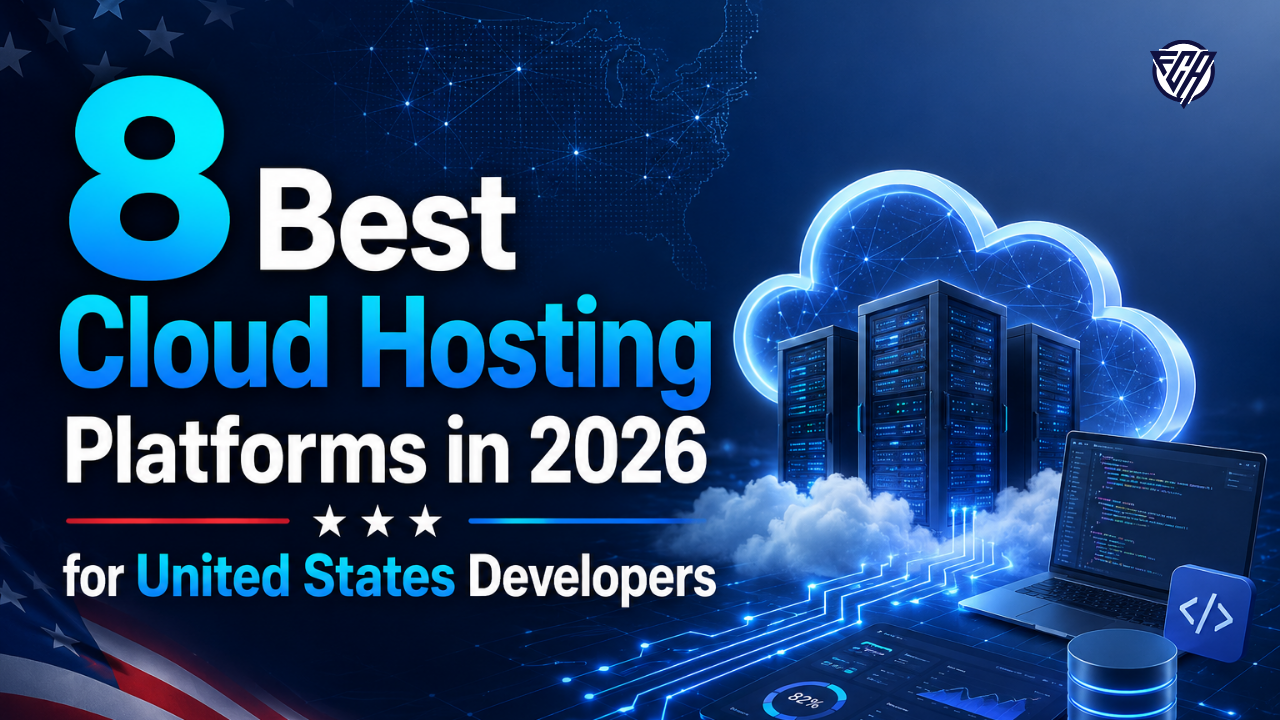
Cloud hosting now covers several very different products. A developer can rent a simple virtual server, deploy an application through a managed platform, run containers, buy managed databases, or build on a hyperscale cloud with hundreds of services. Comparing every provider as if it sells the same thing produces poor buying decisions. The right platform depends on how much infrastructure control the team wants to own.
Developers can connect hosting decisions with the full stack developer roadmap, full stack Python resource, full stack Java roadmap, and .NET full stack resource. Deployment, databases, caching, environment configuration, security, and observability are part of real application delivery.
Cloud infrastructure is also expanding rapidly. Synergy Research Group reported that enterprise cloud infrastructure spending reached $129 billion in the first quarter of 2026, an increase of 35 percent from the same period a year earlier. Amazon, Microsoft, and Google held worldwide shares of 28 percent, 21 percent, and 14 percent respectively. For buyers, that growth creates more services and options, but it also makes architecture and cost discipline more important.
Best Options at a Glance
- AWS Lightsail: Developers that want a simpler entry into the AWS ecosystem
- Google Cloud: Data, AI, analytics, and application teams that want a hyperscale cloud platform
- Microsoft Azure: Enterprises that use Microsoft identity, Windows, .NET, and Microsoft business systems
- DigitalOcean: Developers and startups that want predictable cloud infrastructure with a simpler interface
- Akamai Cloud Computing: Developers that want straightforward Linux cloud servers and global Akamai infrastructure
- Hetzner Cloud: Cost sensitive technical teams that want strong compute value
- Cloudways: Agencies and businesses that want managed cloud hosting without managing servers directly
- Railway: Developers that want fast application deployment from code
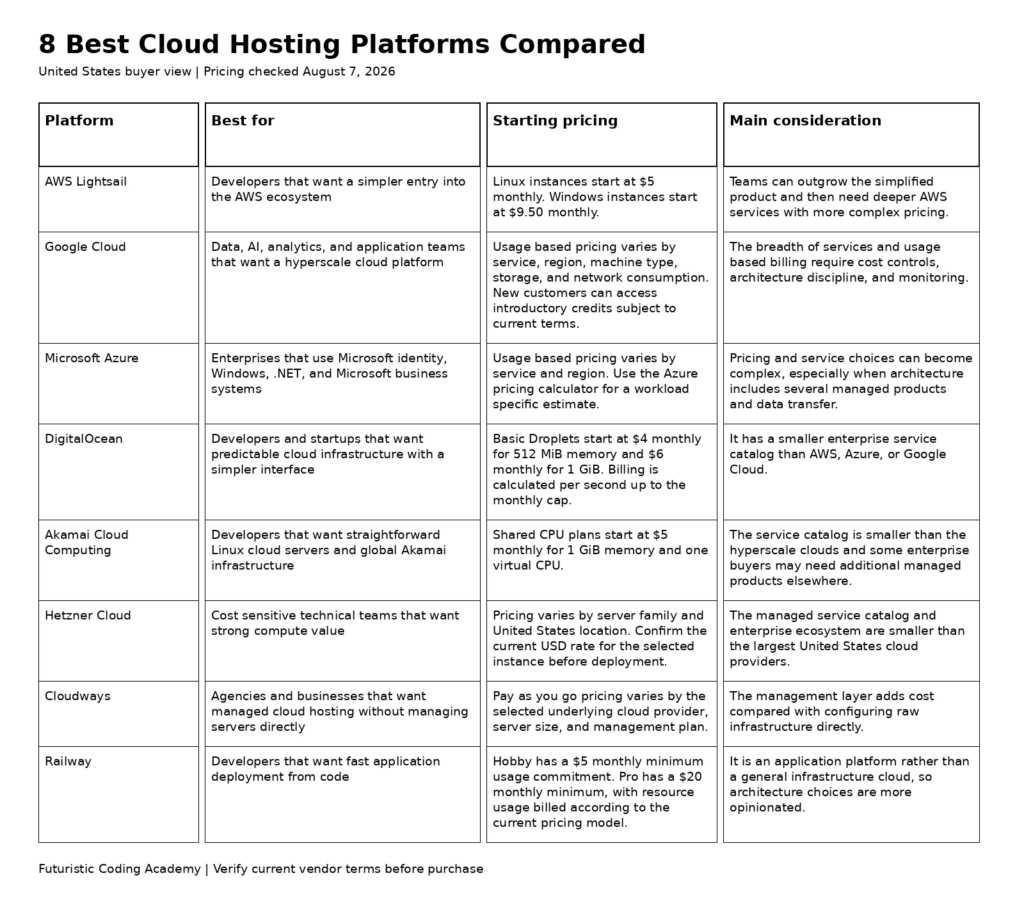
| Platform | Best for | Starting pricing | Core coverage | Main consideration |
|---|---|---|---|---|
| AWS Lightsail | Developers that want a simpler entry into the AWS ecosystem | Linux instances start at $5 monthly. Windows instances start at $9.50 monthly. | Virtual servers, containers, databases, storage, networking, and managed WordPress options | Teams can outgrow the simplified product and then need deeper AWS services with more complex pricing. |
| Google Cloud | Data, AI, analytics, and application teams that want a hyperscale cloud platform | Usage based pricing varies by service, region, machine type, storage, and network consumption. New customers can access introductory credits subject to current terms. | Compute, containers, serverless, databases, data platforms, AI, networking, and security | The breadth of services and usage based billing require cost controls, architecture discipline, and monitoring. |
| Microsoft Azure | Enterprises that use Microsoft identity, Windows, .NET, and Microsoft business systems | Usage based pricing varies by service and region. Use the Azure pricing calculator for a workload specific estimate. | Compute, containers, databases, AI, networking, security, hybrid cloud, and Microsoft integrations | Pricing and service choices can become complex, especially when architecture includes several managed products and data transfer. |
| DigitalOcean | Developers and startups that want predictable cloud infrastructure with a simpler interface | Basic Droplets start at $4 monthly for 512 MiB memory and $6 monthly for 1 GiB. Billing is calculated per second up to the monthly cap. | Virtual machines, Kubernetes, databases, app platform, storage, networking, and developer services | It has a smaller enterprise service catalog than AWS, Azure, or Google Cloud. |
| Akamai Cloud Computing | Developers that want straightforward Linux cloud servers and global Akamai infrastructure | Shared CPU plans start at $5 monthly for 1 GiB memory and one virtual CPU. | Compute, Kubernetes, storage, databases, networking, and Akamai cloud services | The service catalog is smaller than the hyperscale clouds and some enterprise buyers may need additional managed products elsewhere. |
| Hetzner Cloud | Cost sensitive technical teams that want strong compute value | Pricing varies by server family and United States location. Confirm the current USD rate for the selected instance before deployment. | Cloud servers, dedicated resources, volumes, networking, load balancers, and related infrastructure | The managed service catalog and enterprise ecosystem are smaller than the largest United States cloud providers. |
| Cloudways | Agencies and businesses that want managed cloud hosting without managing servers directly | Pay as you go pricing varies by the selected underlying cloud provider, server size, and management plan. | Managed application and WordPress hosting on cloud infrastructure | The management layer adds cost compared with configuring raw infrastructure directly. |
| Railway | Developers that want fast application deployment from code | Hobby has a $5 monthly minimum usage commitment. Pro has a $20 monthly minimum, with resource usage billed according to the current pricing model. | Developer platform for applications, services, databases, deployments, and environments | It is an application platform rather than a general infrastructure cloud, so architecture choices are more opinionated. |
How We Evaluated the Platforms
We reviewed recurring first page comparison patterns for the target United States search intent, then verified current product capabilities and public pricing on official vendor pages. The evaluation does not claim hands on testing where none was performed. It focuses on information a buyer can verify before running a structured trial.
- Infrastructure fit: Whether the platform provides raw servers, managed hosting, application deployment, or a full cloud service catalog.
- Developer experience: Deployment speed, documentation, interfaces, APIs, tooling, and operational complexity.
- Scalability and reliability: Regions, managed services, networking, redundancy, and the ability to grow with the workload.
- Cost model: Compute, storage, bandwidth, databases, support, and management overhead.
- Security and governance: Identity, access, logging, backups, network controls, and organizational administration.
1. AWS Lightsail
Best for: Developers that want a simpler entry into the AWS ecosystem
AWS Lightsail packages common cloud resources into simpler monthly bundles. Developers can launch virtual servers, managed databases, containers, storage, and network services without starting with the full complexity of EC2, VPC, and dozens of separate AWS pricing dimensions. It is a practical first cloud for a small application when the team wants an upgrade path into the wider AWS ecosystem later.
Why It Stands Out
- Simple monthly bundles
- Low cost entry point
- Connection to the wider AWS ecosystem
- Virtual servers and managed services
- Global AWS infrastructure
Pricing and Plan Structure
Linux instances start at $5 monthly. Windows instances start at $9.50 monthly. Check the official AWS Lightsail pricing page for current billing terms, usage limits, and promotional conditions.
Important Limitation
Teams can outgrow the simplified product and then need deeper AWS services with more complex pricing.
Who Should Choose It
Choose AWS Lightsail when the team wants a straightforward cloud server now but expects that some workloads may later move deeper into AWS.
2. Google Cloud
Best for: Data, AI, analytics, and application teams that want a hyperscale cloud platform
Google Cloud is a full hyperscale platform rather than a simple hosting vendor. It is especially strong for data, analytics, Kubernetes, AI, and applications that benefit from managed cloud services. Teams can start with virtual machines or serverless products and expand into databases, warehouses, observability, machine learning, and global networking. The tradeoff is complexity. A successful implementation needs architecture and cost management, not only a server choice.
Why It Stands Out
- Strong data and AI services
- Mature Kubernetes and serverless options
- Global cloud infrastructure
- Broad managed database portfolio
- Enterprise identity and security
Pricing and Plan Structure
Usage based pricing varies by service, region, machine type, storage, and network consumption. New customers can access introductory credits subject to current terms. Check the official Google Cloud pricing page for current billing terms, usage limits, and promotional conditions.
Important Limitation
The breadth of services and usage based billing require cost controls, architecture discipline, and monitoring.
Who Should Choose It
Choose Google Cloud when the application roadmap includes data, AI, containers, or managed services that go well beyond basic website hosting.
3. Microsoft Azure
Best for: Enterprises that use Microsoft identity, Windows, .NET, and Microsoft business systems
Azure is a natural cloud choice for organizations that already use Microsoft identity, Windows Server, .NET, SQL Server, Microsoft 365, and enterprise management tools. It supports virtual machines, containers, serverless applications, databases, AI, hybrid infrastructure, and a large catalog of managed services. The platform is most compelling when cloud workloads need to fit into an existing Microsoft enterprise architecture.
Why It Stands Out
- Strong Microsoft ecosystem integration
- Broad enterprise service catalog
- Hybrid cloud capabilities
- Good support for .NET and Windows workloads
- Large identity and governance toolset
Pricing and Plan Structure
Usage based pricing varies by service and region. Use the Azure pricing calculator for a workload specific estimate. Check the official Microsoft Azure pricing page for current billing terms, usage limits, and promotional conditions.
Important Limitation
Pricing and service choices can become complex, especially when architecture includes several managed products and data transfer.
Who Should Choose It
Choose Azure when Microsoft technologies and enterprise identity are already central to the organization and cloud services must integrate with that environment.
4. DigitalOcean
Best for: Developers and startups that want predictable cloud infrastructure with a simpler interface
DigitalOcean is popular with developers because it keeps common infrastructure choices understandable. Droplets, managed databases, Kubernetes, object storage, and an application platform cover many startup and SaaS workloads without presenting the same breadth as a hyperscale provider. Clear entry pricing also makes early cost estimates easier for small teams.
Why It Stands Out
- Simple developer experience
- Low entry price
- Predictable virtual server tiers
- Managed databases and Kubernetes
- Good documentation for smaller teams
Pricing and Plan Structure
Basic Droplets start at $4 monthly for 512 MiB memory and $6 monthly for 1 GiB. Billing is calculated per second up to the monthly cap. Check the official DigitalOcean pricing page for current billing terms, usage limits, and promotional conditions.
Important Limitation
It has a smaller enterprise service catalog than AWS, Azure, or Google Cloud.
Who Should Choose It
Choose DigitalOcean when a startup or development team wants capable cloud infrastructure without the service and billing complexity of a hyperscale platform.
5. Akamai Cloud Computing
Best for: Developers that want straightforward Linux cloud servers and global Akamai infrastructure
Akamai Cloud Computing, built from the Linode platform, offers straightforward compute pricing and a developer friendly infrastructure experience while connecting to Akamai network capabilities. It suits Linux workloads, application servers, smaller Kubernetes environments, and teams that want a simpler bill than a large hyperscale cloud. Long time Linode users will recognize the emphasis on understandable virtual machine plans.
Why It Stands Out
- Simple shared CPU plans
- Developer friendly Linux hosting
- Global Akamai network connection
- Kubernetes and managed services
- Clear resource based pricing
Pricing and Plan Structure
Shared CPU plans start at $5 monthly for 1 GiB memory and one virtual CPU. Check the official Akamai Cloud Computing pricing page for current billing terms, usage limits, and promotional conditions.
Important Limitation
The service catalog is smaller than the hyperscale clouds and some enterprise buyers may need additional managed products elsewhere.
Who Should Choose It
Choose Akamai Cloud Computing when the team wants straightforward Linux infrastructure and values Akamai network reach without a huge service catalog.
6. Hetzner Cloud
Best for: Cost sensitive technical teams that want strong compute value
Hetzner Cloud is often evaluated by technical teams that want strong compute and storage value without paying for a large managed service ecosystem. United States locations make it relevant for domestic workloads, while the platform remains more infrastructure focused than a hyperscale cloud. It is a good fit when engineers are comfortable managing the operating system, deployment stack, observability, and database architecture themselves.
Why It Stands Out
- Competitive infrastructure value
- Straightforward cloud server model
- United States locations available
- Useful networking and storage features
- Good fit for technically managed workloads
Pricing and Plan Structure
Pricing varies by server family and United States location. Confirm the current USD rate for the selected instance before deployment. Check the official Hetzner Cloud pricing page for current billing terms, usage limits, and promotional conditions.
Important Limitation
The managed service catalog and enterprise ecosystem are smaller than the largest United States cloud providers.
Who Should Choose It
Choose Hetzner Cloud when infrastructure cost is a major factor and the engineering team does not require a broad catalog of managed enterprise services.
7. Cloudways
Best for: Agencies and businesses that want managed cloud hosting without managing servers directly
Cloudways sits between raw cloud infrastructure and traditional managed hosting. It handles much of the server setup, caching, backups, security tooling, staging, and application management while using cloud infrastructure underneath. That makes it useful for agencies, WordPress professionals, and small teams that want cloud flexibility without hiring someone to manage every server detail.
Why It Stands Out
- Managed server experience
- Good fit for WordPress and PHP applications
- Backups and staging tools
- Choice of infrastructure options
- Useful agency workflow
Pricing and Plan Structure
Pay as you go pricing varies by the selected underlying cloud provider, server size, and management plan. Check the official Cloudways pricing page for current billing terms, usage limits, and promotional conditions.
Important Limitation
The management layer adds cost compared with configuring raw infrastructure directly.
Who Should Choose It
Choose Cloudways when the business wants managed application hosting and values operational convenience more than the lowest raw server cost.
8. Railway
Best for: Developers that want fast application deployment from code
Railway reduces the infrastructure work required to deploy an application. Developers can connect a repository, create services and databases, manage environment variables, and deploy without assembling a large cloud stack manually. It is particularly effective for prototypes, internal tools, startups, and web applications where developer speed matters more than direct control over every infrastructure component.
Why It Stands Out
- Fast deployment workflow
- Good developer experience
- Built in service and database management
- Simple environment handling
- Useful for startups and small engineering teams
Pricing and Plan Structure
Hobby has a $5 monthly minimum usage commitment. Pro has a $20 monthly minimum, with resource usage billed according to the current pricing model. Check the official Railway pricing page for current billing terms, usage limits, and promotional conditions.
Important Limitation
It is an application platform rather than a general infrastructure cloud, so architecture choices are more opinionated.
Who Should Choose It
Choose Railway when the team wants to deploy applications quickly and prefers a developer platform over direct virtual machine management.
How to Choose a Cloud Hosting Platform
Decide which layer the team wants to manage. Raw virtual servers provide control but require operating system updates, firewall configuration, backups, monitoring, and deployment tooling. Managed application platforms remove much of that work but impose stronger opinions and usually a higher unit price. Hyperscale clouds provide the widest service catalogs but require architecture and cost expertise.
Model the entire workload. Include compute, storage, backups, database capacity, outbound bandwidth, load balancers, observability, staging environments, support, and redundancy. A cheap server can become an expensive platform once surrounding services are added.
Choose regions according to users and obligations. United States traffic often benefits from a domestic region, but national companies may need several regions or a content delivery network. Disaster recovery should not be confused with routine scaling. Define recovery point and recovery time requirements before paying for duplicate infrastructure.
Implementation Checklist Before You Commit
- Start with a small production architecture that can be measured. Avoid adding managed services only because they are available.
- Use infrastructure as code or at least documented configuration. Manual cloud setup becomes difficult to reproduce during incidents or team changes.
- Set budgets, alerts, and resource ownership from the first month. Cost optimization is easier when every environment and resource has an owner.
- Back up application data independently and test restoration. A backup policy is not complete until the team has verified that it can restore service.
Evidence and Current Market Context
Synergy Research Group reported that enterprise spending on cloud infrastructure services reached $129 billion in the first quarter of 2026, up 35 percent year over year. AWS, Microsoft, and Google held worldwide shares of 28 percent, 21 percent, and 14 percent respectively.
Cloud decisions become easier when developers understand the application stack being deployed. Related FCA resources include the full stack Java roadmap, .NET full stack resource, full stack PHP resource, and technology blog library.
The Cybersecurity and Infrastructure Security Agency cloud security reference material is a useful external source when architecture decisions involve identity, security controls, and cloud governance.
Frequently Asked Questions
What is the best cloud hosting platform overall?
There is no single best platform. AWS Lightsail and DigitalOcean are easy starting points, Google Cloud and Azure suit broad enterprise workloads, Hetzner can be attractive for infrastructure value, Cloudways is stronger for managed hosting, and Railway focuses on fast application deployment.
What is the cheapest cloud hosting platform?
Entry virtual servers can begin near $4 to $5 monthly on providers such as DigitalOcean, AWS Lightsail, and Akamai Cloud Computing. The cheapest provider changes once storage, backups, bandwidth, databases, support, and management time are included.
What is the best cloud hosting for developers?
DigitalOcean and Railway are strong developer friendly choices. AWS Lightsail is useful for developers that want an easier path into AWS. Technical teams focused on infrastructure value may also consider Hetzner or Akamai Cloud Computing.
What is the best cloud hosting for WordPress?
Cloudways is a practical managed option for WordPress because it handles much of the server administration. AWS Lightsail also offers WordPress oriented deployment options for teams comfortable managing more of the environment.
Is cloud hosting better than shared hosting?
Cloud hosting usually provides more control, scalability, isolation, and infrastructure choices. Shared hosting can still be simpler and less expensive for small websites that do not need custom server configuration.
What is the difference between cloud hosting and VPS hosting?
A VPS describes a virtual server environment. Cloud hosting is broader and may include virtual machines, managed databases, object storage, containers, serverless services, networking, and distributed infrastructure. Many cloud providers sell virtual servers as one product inside the platform.
How much should a startup budget for cloud hosting?
A small application can begin with a low monthly infrastructure bill, but production cost depends on traffic, databases, backups, logs, observability, bandwidth, managed services, redundancy, and support. Budget for the complete architecture rather than one server.
How can a company avoid unexpected cloud bills?
Set budgets and alerts, use resource tags, shut down unused environments, cap autoscaling where appropriate, review bandwidth and storage, choose reserved or committed pricing only after usage stabilizes, and give cost ownership to the engineering team.
Should a United States company choose a United States data center?
A domestic region can reduce latency for United States users and may simplify some contractual requirements, but the correct location depends on customers, resilience, data obligations, disaster recovery, and application architecture.
Which cloud platform is best for AI workloads?
AWS, Azure, and Google Cloud all offer broad AI infrastructure and managed AI services. The correct choice depends on model requirements, accelerators, data location, existing cloud commitments, and the surrounding application stack.
How fast is the cloud market growing in 2026?
Synergy Research Group reported that enterprise spending on cloud infrastructure services reached $129 billion in the first quarter of 2026, up 35 percent year over year. The scale of that market makes cost governance and workload fit more important, not less.
How should developers compare cloud hosting performance?
Test the application in the actual target region using realistic traffic, storage, database, and network patterns. Compare latency, deployment time, failure recovery, observability, support, and total monthly cost rather than relying only on synthetic server benchmarks.
Final Recommendation
AWS Lightsail and DigitalOcean are strong starting points for developers that want understandable cloud infrastructure. Google Cloud and Azure are better suited to broad enterprise service needs. Akamai Cloud Computing and Hetzner appeal to infrastructure focused teams, Cloudways simplifies managed application hosting, and Railway prioritizes deployment speed. Compare the complete workload cost and operational responsibility rather than choosing a provider from server price alone.
Related Futuristic Coding Academy Resources
- Full stack developer roadmap
- Full stack Python resource
- Full stack Java developer roadmap
- .NET full stack developer resource
- Full stack PHP resource
- Futuristic Coding Academy technology blogs