
This comparison is based on current public documentation, official pricing pages, product capabilities, buyer fit, and independent research. Futuristic Coding Academy did not accept payment for placement in this article. Prices and features can change, so confirm current terms on the vendor website before purchasing.
Web analytics software should answer business questions, not merely produce dashboards. Marketing teams need to know which channels create qualified visits and conversions. Product teams need to understand activation, retention, and feature usage. Website teams need evidence about friction. Privacy and security teams need to know what data is collected and where it goes. No single analytics platform is best at all four jobs.
Futuristic Coding Academy readers can connect measurement with the digital marketing resource and the full stack development roadmap. Analytics becomes more reliable when marketers define useful business events and developers implement those events consistently.
Privacy deserves particular attention in the United States. A 2026 international study of web tracking found that California and Australia, both opt out jurisdictions in the study, showed among the highest tracker connection levels. That does not mean every tracker is unlawful. It does reinforce the need to understand what the analytics stack collects, which vendors receive data, and how consent and retention are configured.
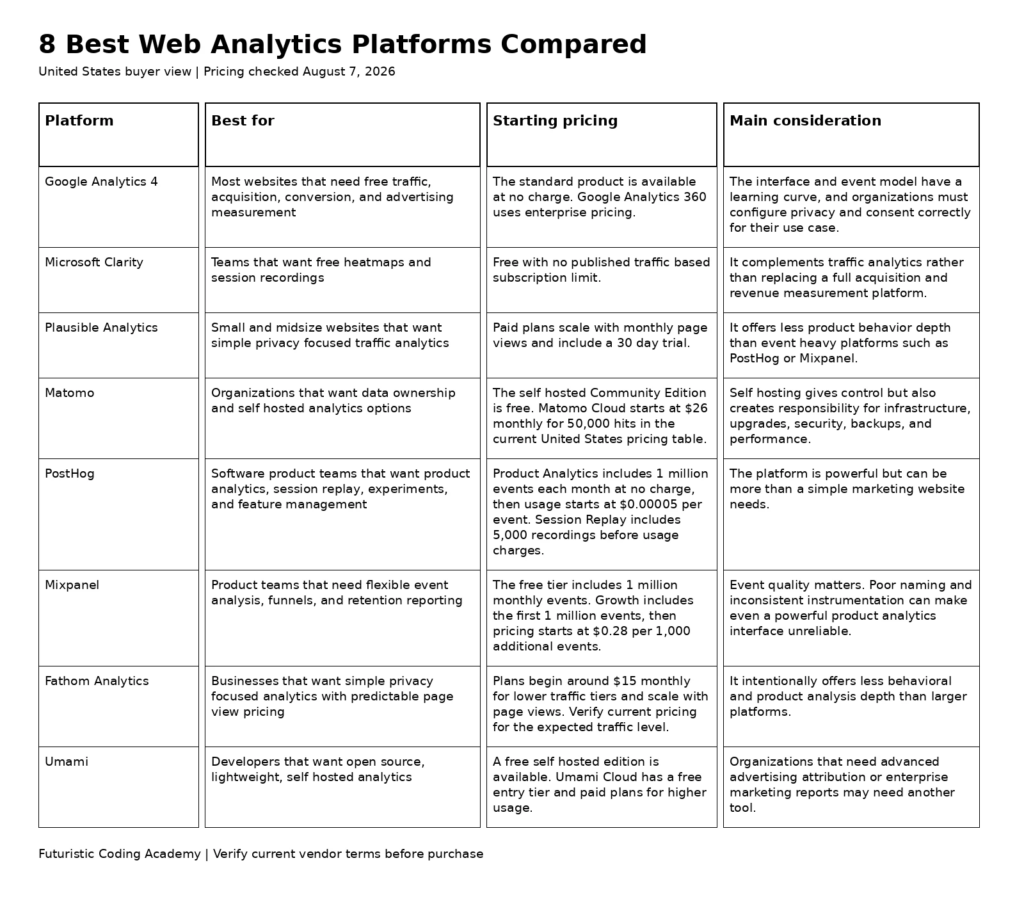
Best Options at a Glance
- Google Analytics 4: Most websites that need free traffic, acquisition, conversion, and advertising measurement
- Microsoft Clarity: Teams that want free heatmaps and session recordings
- Plausible Analytics: Small and midsize websites that want simple privacy focused traffic analytics
- Matomo: Organizations that want data ownership and self hosted analytics options
- PostHog: Software product teams that want product analytics, session replay, experiments, and feature management
- Mixpanel: Product teams that need flexible event analysis, funnels, and retention reporting
- Fathom Analytics: Businesses that want simple privacy focused analytics with predictable page view pricing
- Umami: Developers that want open source, lightweight, self hosted analytics
| Platform | Best for | Starting pricing | Core coverage | Main consideration |
|---|---|---|---|---|
| Google Analytics 4 | Most websites that need free traffic, acquisition, conversion, and advertising measurement | The standard product is available at no charge. Google Analytics 360 uses enterprise pricing. | Event based web and app analytics with Google advertising integrations | The interface and event model have a learning curve, and organizations must configure privacy and consent correctly for their use case. |
| Microsoft Clarity | Teams that want free heatmaps and session recordings | Free with no published traffic based subscription limit. | Behavior analytics with session recordings, heatmaps, and Copilot summaries | It complements traffic analytics rather than replacing a full acquisition and revenue measurement platform. |
| Plausible Analytics | Small and midsize websites that want simple privacy focused traffic analytics | Paid plans scale with monthly page views and include a 30 day trial. | Lightweight web analytics with simple dashboards and privacy focused measurement | It offers less product behavior depth than event heavy platforms such as PostHog or Mixpanel. |
| Matomo | Organizations that want data ownership and self hosted analytics options | The self hosted Community Edition is free. Matomo Cloud starts at $26 monthly for 50,000 hits in the current United States pricing table. | Web analytics with cloud and self hosted deployment | Self hosting gives control but also creates responsibility for infrastructure, upgrades, security, backups, and performance. |
| PostHog | Software product teams that want product analytics, session replay, experiments, and feature management | Product Analytics includes 1 million events each month at no charge, then usage starts at $0.00005 per event. Session Replay includes 5,000 recordings before usage charges. | Product analytics suite with events, replay, feature flags, experiments, and data tools | The platform is powerful but can be more than a simple marketing website needs. |
| Mixpanel | Product teams that need flexible event analysis, funnels, and retention reporting | The free tier includes 1 million monthly events. Growth includes the first 1 million events, then pricing starts at $0.28 per 1,000 additional events. | Event based product analytics for web and mobile applications | Event quality matters. Poor naming and inconsistent instrumentation can make even a powerful product analytics interface unreliable. |
| Fathom Analytics | Businesses that want simple privacy focused analytics with predictable page view pricing | Plans begin around $15 monthly for lower traffic tiers and scale with page views. Verify current pricing for the expected traffic level. | Privacy focused website analytics with simple reporting | It intentionally offers less behavioral and product analysis depth than larger platforms. |
| Umami | Developers that want open source, lightweight, self hosted analytics | A free self hosted edition is available. Umami Cloud has a free entry tier and paid plans for higher usage. | Open source web analytics with cloud and self hosted deployment | Organizations that need advanced advertising attribution or enterprise marketing reports may need another tool. |
How We Evaluated the Platforms
We reviewed recurring first page comparison patterns for the target United States search intent, then verified current product capabilities and public pricing on official vendor pages. The evaluation does not claim hands on testing where none was performed. It focuses on information a buyer can verify before running a structured trial.
- Measurement fit: Whether the product answers the acquisition, behavior, product, or conversion questions the team actually has.
- Implementation effort: Tagging, event design, SDK work, self hosting, and ongoing maintenance.
- Privacy and control: Data collection, deployment, retention, access, and consent considerations.
- Analysis depth: Traffic reports, funnels, retention, replay, experiments, cohorts, and custom events.
- Commercial fit: Free allowances, usage pricing, expected traffic, and cost as data volume grows.
1. Google Analytics 4
Best for: Most websites that need free traffic, acquisition, conversion, and advertising measurement
Google Analytics 4 is still the default measurement platform for many United States websites because it is free at normal usage levels and connects closely with Google Ads, Search Console, BigQuery, and the wider Google marketing ecosystem. It uses an event based model that can track page views, interactions, ecommerce, and custom business events across web and app properties. The main challenge is configuration. Useful reporting depends on a clean event plan, reliable consent settings, and clearly defined conversions.
Why It Stands Out
- No cost standard product
- Strong Google advertising integration
- Web and app measurement
- Custom events and conversions
- BigQuery connection and broad ecosystem
Pricing and Plan Structure
The standard product is available at no charge. Google Analytics 360 uses enterprise pricing. Check the official Google Analytics 4 pricing page for current billing terms, usage limits, and promotional conditions.
Important Limitation
The interface and event model have a learning curve, and organizations must configure privacy and consent correctly for their use case.
Who Should Choose It
Choose Google Analytics 4 when the business wants broad marketing measurement, Google Ads integration, and a free standard analytics platform.
2. Microsoft Clarity
Best for: Teams that want free heatmaps and session recordings
Microsoft Clarity helps teams understand what visitors actually do on pages. Session recordings, heatmaps, rage click indicators, dead click signals, and filters can reveal where users hesitate or fail. It is particularly useful beside Google Analytics because the two tools answer different questions. Analytics can show that a landing page converts poorly, while Clarity can help the team inspect behavior that may explain why.
Why It Stands Out
- Free session recordings
- Heatmaps and behavior signals
- No published traffic based pricing
- Simple installation
- Useful companion to traffic analytics
Pricing and Plan Structure
Free with no published traffic based subscription limit. Check the official Microsoft Clarity pricing page for current billing terms, usage limits, and promotional conditions.
Important Limitation
It complements traffic analytics rather than replacing a full acquisition and revenue measurement platform.
Who Should Choose It
Choose Microsoft Clarity when the website team needs qualitative behavior evidence without adding another paid analytics subscription.
3. Plausible Analytics
Best for: Small and midsize websites that want simple privacy focused traffic analytics
Plausible focuses on a concise dashboard rather than hundreds of reports. It tracks traffic sources, pages, countries, devices, goals, campaigns, and revenue oriented events without asking teams to manage a complex analytics workspace. That simplicity is attractive to publishers, agencies, SaaS marketing sites, and small businesses that want useful website measurement with a lighter data footprint.
Why It Stands Out
- Simple reporting interface
- Lightweight tracking script
- Privacy focused design
- Goal and campaign tracking
- Good fit for marketing websites
Pricing and Plan Structure
Paid plans scale with monthly page views and include a 30 day trial. Check the official Plausible Analytics pricing page for current billing terms, usage limits, and promotional conditions.
Important Limitation
It offers less product behavior depth than event heavy platforms such as PostHog or Mixpanel.
Who Should Choose It
Choose Plausible when the team wants understandable website metrics and a lighter privacy model instead of a broad product analytics suite.
4. Matomo
Best for: Organizations that want data ownership and self hosted analytics options
Matomo is one of the strongest alternatives for organizations that want more control over analytics data. The Community Edition can run on infrastructure the organization manages, while Matomo Cloud removes much of the operational burden. The platform includes traffic analytics, goals, ecommerce, campaign tracking, and optional behavior features. It is a serious choice for teams that need a mature analytics product without defaulting to Google.
Why It Stands Out
- Free self hosted Community Edition
- Strong data ownership position
- Cloud option for managed deployment
- Mature web analytics features
- Useful privacy and compliance controls
Pricing and Plan Structure
The self hosted Community Edition is free. Matomo Cloud starts at $26 monthly for 50,000 hits in the current United States pricing table. Check the official Matomo pricing page for current billing terms, usage limits, and promotional conditions.
Important Limitation
Self hosting gives control but also creates responsibility for infrastructure, upgrades, security, backups, and performance.
Who Should Choose It
Choose Matomo when control over analytics data and deployment is a core requirement and the team can manage either the infrastructure or the cloud subscription.
5. PostHog
Best for: Software product teams that want product analytics, session replay, experiments, and feature management
PostHog is designed for product teams that need to understand user behavior inside an application, not only visits to marketing pages. Events, funnels, retention, paths, session replay, experiments, feature flags, surveys, and data pipelines can live in one product stack. Its generous free usage allowances make it easy for a smaller software company to begin measuring product behavior before committing to a larger bill.
Why It Stands Out
- Strong product analytics
- Session replay and experiments
- Feature flags and surveys
- Generous free allowances
- Cloud regions in the United States and Europe
Pricing and Plan Structure
Product Analytics includes 1 million events each month at no charge, then usage starts at $0.00005 per event. Session Replay includes 5,000 recordings before usage charges. Check the official PostHog pricing page for current billing terms, usage limits, and promotional conditions.
Important Limitation
The platform is powerful but can be more than a simple marketing website needs.
Who Should Choose It
Choose PostHog when engineers and product managers need behavioral analytics tied directly to product development and experimentation.
6. Mixpanel
Best for: Product teams that need flexible event analysis, funnels, and retention reporting
Mixpanel remains a strong option for product managers and growth teams that want to analyze events, funnels, retention, cohorts, and user behavior without building every analysis in a data warehouse. Its reporting is more product focused than a traditional website analytics platform. Teams should invest in an event taxonomy before rollout so product questions can be answered consistently across releases.
Why It Stands Out
- Flexible event analysis
- Strong funnels and retention reports
- Useful cohorting
- Generous free event allowance
- Good fit for product led growth teams
Pricing and Plan Structure
The free tier includes 1 million monthly events. Growth includes the first 1 million events, then pricing starts at $0.28 per 1,000 additional events. Check the official Mixpanel pricing page for current billing terms, usage limits, and promotional conditions.
Important Limitation
Event quality matters. Poor naming and inconsistent instrumentation can make even a powerful product analytics interface unreliable.
Who Should Choose It
Choose Mixpanel when the core questions concern product behavior, activation, retention, and conversion between events.
7. Fathom Analytics
Best for: Businesses that want simple privacy focused analytics with predictable page view pricing
Fathom is built around a clean dashboard, privacy focused measurement, and straightforward website reporting. It is a good fit for professional services firms, publishers, and small businesses that care about traffic sources, content performance, campaigns, and conversions but do not need a large analytics implementation. The value comes from making the important numbers easy to understand rather than adding more reports.
Why It Stands Out
- Simple dashboard
- Privacy focused approach
- Lightweight tracking
- Clear page view based plans
- Good fit for content and business websites
Pricing and Plan Structure
Plans begin around $15 monthly for lower traffic tiers and scale with page views. Verify current pricing for the expected traffic level. Check the official Fathom Analytics pricing page for current billing terms, usage limits, and promotional conditions.
Important Limitation
It intentionally offers less behavioral and product analysis depth than larger platforms.
Who Should Choose It
Choose Fathom when a small team wants low maintenance analytics and prefers clarity over a large set of advanced reports.
8. Umami
Best for: Developers that want open source, lightweight, self hosted analytics
Umami gives developers a straightforward open source analytics option that can be self hosted or consumed as a cloud service. It tracks visits, sources, pages, devices, countries, events, and goals without the complexity of a full marketing analytics suite. The self hosted route is particularly attractive to technical teams that already manage infrastructure and want direct control over the application and data.
Why It Stands Out
- Open source and self hosted option
- Simple interface
- Lightweight tracking
- Event and goal support
- Low barrier for technical teams
Pricing and Plan Structure
A free self hosted edition is available. Umami Cloud has a free entry tier and paid plans for higher usage. Check the official Umami pricing page for current billing terms, usage limits, and promotional conditions.
Important Limitation
Organizations that need advanced advertising attribution or enterprise marketing reports may need another tool.
Who Should Choose It
Choose Umami when the team wants a lightweight open source analytics product and is comfortable managing its own deployment or using a simple cloud plan.
How to Choose a Web Analytics Platform
Write down the decisions analytics must support. A marketing website may care about acquisition, landing pages, campaigns, forms, and revenue. A SaaS product may care about activation, retention, feature adoption, and experiments. A publisher may care about content performance and subscriber conversion. The correct tool follows those questions.
Decide how much implementation and maintenance the team can support. Google Analytics 4, PostHog, and Mixpanel can answer sophisticated questions, but only when events and properties are designed carefully. Plausible, Fathom, and Umami are easier to maintain because they intentionally expose fewer dimensions.
Review privacy as an architecture choice. Understand cookies, identifiers, data residency, retention, advertising connections, access controls, and whether self hosting actually improves governance for your team. Self hosting creates control only when the organization can secure and maintain the system.
Implementation Checklist Before You Commit
- Create a measurement plan before installing tags. Define each business event, when it fires, which properties are attached, and which team owns the metric.
- Separate reporting metrics from diagnostic events. A dashboard becomes hard to trust when every click is treated as an important conversion.
- Validate events in a staging environment and again after production releases. Check duplicates, missing properties, incorrect currency, and unexpected referral sources.
- Keep a data dictionary. Document event names, property definitions, conversion rules, attribution assumptions, and changes over time.
Evidence and Current Market Context
A 2026 international study called Global Web, Local Privacy? compared tracker connections across ten countries and found that California was among the locations with higher tracking levels in the study. The result reinforces the importance of understanding the tracking architecture behind an analytics setup instead of treating every analytics script as a neutral implementation detail.
Developers implementing events can use the full stack Python resource and the broader FCA technology blog library as related technical learning material.
The Federal Trade Commission provides United States business guidance on privacy and information security. Analytics implementation should be reviewed with the legal and security requirements that apply to the specific organization.
Frequently Asked Questions
What is the best web analytics platform overall?
Google Analytics 4 is the broadest free choice for marketing measurement. Plausible and Fathom are simpler privacy focused alternatives, while PostHog and Mixpanel are better for product analytics. The right choice depends on the questions the team needs to answer.
Is Google Analytics 4 free?
The standard Google Analytics product is available at no charge for most websites. Google Analytics 360 is the enterprise version with additional capacity and commercial support.
What is the best Google Analytics alternative?
Matomo is one of the most complete alternatives, especially for organizations that value data ownership. Plausible, Fathom, and Umami are simpler options, while PostHog and Mixpanel are better when product behavior is the main focus.
What is the difference between web analytics and product analytics?
Web analytics usually focuses on traffic sources, pages, campaigns, and website conversions. Product analytics focuses on user events inside an application, funnels, retention, cohorts, feature usage, and experiments.
Do small businesses need more than one analytics tool?
Often two complementary tools are enough. A traffic analytics platform can measure acquisition and conversion, while a behavior tool such as Microsoft Clarity can show recordings and heatmaps that help explain user friction.
What analytics platform is best for privacy focused websites?
Plausible, Fathom, Matomo, and Umami are common privacy focused choices. The correct setup still depends on the data collected, cookies used, configured integrations, and the laws that apply to the business.
Can analytics work without cookies?
Yes. Several modern analytics products can measure aggregate traffic and events without traditional advertising cookies. The exact implementation and legal obligations depend on the tool, configuration, location, and purpose of processing.
What metrics should a business website track?
Track qualified sessions, source and campaign performance, landing page engagement, lead or purchase conversions, conversion rate, revenue or lead value, important form events, and technical issues that affect completion.
What should a SaaS product track?
SaaS teams should define activation events, feature adoption, conversion from trial to paid, retention, expansion, churn signals, and the user actions that correlate with long term value.
How accurate are web analytics tools?
No analytics platform records a perfect version of reality. Consent choices, blockers, browser restrictions, cross device behavior, implementation errors, bots, and identity rules can all change the numbers. Teams should focus on consistent measurement and decision quality rather than treating every count as exact.
Why does privacy matter for United States analytics?
A 2026 international tracking study found high tracker connection levels for California traffic relative to many opt in jurisdictions. United States businesses should understand what their analytics stack collects and configure consent, retention, and data sharing according to applicable laws and company policy.
How often should analytics implementation be audited?
Review the implementation after major website releases and at least quarterly. Check event names, duplicate tags, conversion definitions, campaign parameters, consent behavior, referral exclusions, and dashboards that depend on the data.
Final Recommendation
Google Analytics 4 remains the most broadly useful free marketing analytics platform, while Microsoft Clarity adds valuable behavior evidence. Plausible, Fathom, Matomo, and Umami are strong alternatives when simplicity or control matter. PostHog and Mixpanel are better for product behavior. Start with the questions the team needs to answer, then choose the smallest measurement stack that can answer them reliably.
Related Futuristic Coding Academy Resources
- Digital marketing learning resource
- Full stack developer roadmap
- Full stack Python resource
- Futuristic Coding Academy technology blogs