This comparison is based on public product documentation, current public pricing, platform coverage, workflow fit, and independent research. Futuristic Coding Academy did not accept payment for placement. Prices and features can change, so confirm current terms on the vendor website.
An all in one SEO platform should reduce the need to maintain separate tools for keyword research, rank tracking, technical audits, competitor analysis, backlinks, content planning, and reporting. The category is changing quickly because buyers now expect traditional search data and visibility signals from answer engines and generative search experiences in the same workspace.
This guide compares ten platforms for United States businesses, consultants, agencies, and in house marketing teams. It is designed to complement a practical digital marketing learning path by showing how professional teams organize research, optimization, monitoring, and client reporting.
The evaluation emphasizes useful coverage rather than the longest feature list. A small business may gain more from a clear workflow and manageable limits, while an agency may need several projects, white label reports, historical data, and additional user seats. Current Google guidance also reinforces that tools do not replace original, people first content and technical accessibility.
Best Options at a Glance
- Best broad suite: Semrush
- Best backlink and organic research: Ahrefs
- Best value for growing teams: SE Ranking
- Best established beginner workflow: Moz Pro
- Best budget suite: Serpstat
- Best accessible keyword ideation: Ubersuggest
- Best streamlined toolkit: Mangools
- Best agency reporting: WebCEO
- Best content optimization workflow: Surfer
- Best technical audit specialist: Sitebulb
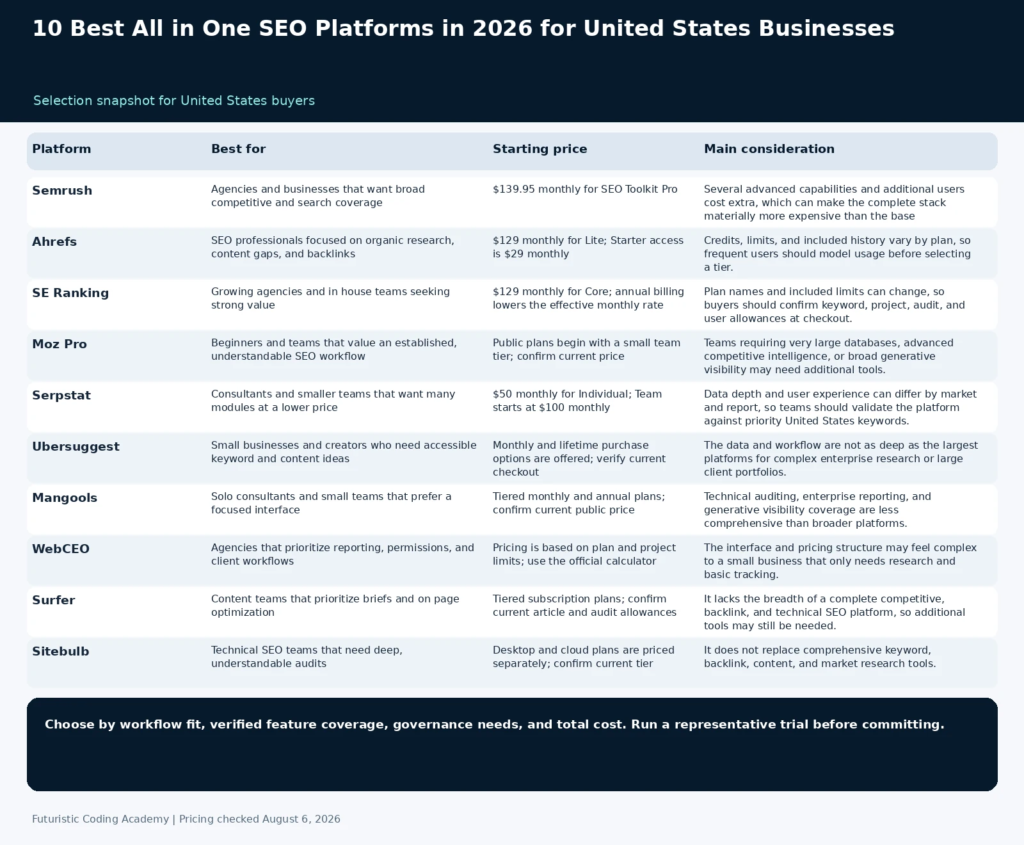
| Platform | Best for | Starting price | Core coverage | Main consideration |
|---|---|---|---|---|
| Semrush | Agencies and businesses that want broad competitive and search coverage | $139.95 monthly for SEO Toolkit Pro | Keywords, competitors, backlinks, audits, rank tracking, reporting | Several advanced capabilities and additional users cost extra, which can make the complete stack materially more expensive than the base subscription. |
| Ahrefs | SEO professionals focused on organic research, content gaps, and backlinks | $129 monthly for Lite; Starter access is $29 monthly | Keywords, backlinks, competitor research, audits, rank tracking | Credits, limits, and included history vary by plan, so frequent users should model usage before selecting a tier. |
| SE Ranking | Growing agencies and in house teams seeking strong value | $129 monthly for Core; annual billing lowers the effective monthly rate | SEO and GEO tracking, audits, research, reporting | Plan names and included limits can change, so buyers should confirm keyword, project, audit, and user allowances at checkout. |
| Moz Pro | Beginners and teams that value an established, understandable SEO workflow | Public plans begin with a small team tier; confirm current price | Keywords, links, site crawl, rank tracking, recommendations | Teams requiring very large databases, advanced competitive intelligence, or broad generative visibility may need additional tools. |
| Serpstat | Consultants and smaller teams that want many modules at a lower price | $50 monthly for Individual; Team starts at $100 monthly | Keywords, competitors, audits, backlinks, rank tracking | Data depth and user experience can differ by market and report, so teams should validate the platform against priority United States keywords. |
| Ubersuggest | Small businesses and creators who need accessible keyword and content ideas | Monthly and lifetime purchase options are offered; verify current checkout | Keywords, content ideas, competitor pages, audits, rank tracking | The data and workflow are not as deep as the largest platforms for complex enterprise research or large client portfolios. |
| Mangools | Solo consultants and small teams that prefer a focused interface | Tiered monthly and annual plans; confirm current public price | Keywords, search results analysis, rank tracking, backlinks, site metrics | Technical auditing, enterprise reporting, and generative visibility coverage are less comprehensive than broader platforms. |
| WebCEO | Agencies that prioritize reporting, permissions, and client workflows | Pricing is based on plan and project limits; use the official calculator | Rank tracking, audits, backlinks, reporting, collaboration | The interface and pricing structure may feel complex to a small business that only needs research and basic tracking. |
| Surfer | Content teams that prioritize briefs and on page optimization | Tiered subscription plans; confirm current article and audit allowances | Content briefs, on page optimization, audits, collaboration | It lacks the breadth of a complete competitive, backlink, and technical SEO platform, so additional tools may still be needed. |
| Sitebulb | Technical SEO teams that need deep, understandable audits | Desktop and cloud plans are priced separately; confirm current tier | Technical crawling, prioritization, visualization, audit reporting | It does not replace comprehensive keyword, backlink, content, and market research tools. |
How We Evaluated the Platforms
We analyzed current commercial comparison pages and then checked official product documentation and public pricing. Platforms were assessed as operating systems for search work, not simply as keyword databases. Current Google documentation on helpful content, review quality, crawlable links, image optimization, and generative search shaped the evaluation criteria. We did not assign arbitrary numerical ratings because public plan information does not support that level of precision.
- Research coverage: Keyword, competitor, backlink, traffic, and search result data.
- Technical SEO: Crawl depth, prioritization, issue explanation, and monitoring.
- Tracking: Rank tracking, local or device segments, search feature monitoring, and generative visibility where available.
- Content workflow: Briefs, optimization, topic discovery, and collaboration.
- Reporting: Dashboards, exports, scheduled reports, client controls, and additional users.
- Cost efficiency: Project limits, tracked keywords, crawl allowances, users, and add on pricing.
1. Semrush
Best for: Agencies and businesses that want broad competitive and search coverage
Semrush offers one of the broadest suites in the category. Its SEO Toolkit combines keyword research, competitor analysis, backlinks, site auditing, position tracking, and reporting. The company also offers separate toolkits for artificial intelligence visibility, traffic and market analysis, content, local search, and social media. This breadth makes Semrush useful for teams that want one vendor across several marketing workflows. It also means buyers must understand which capabilities are included in the selected plan and which require a separate toolkit, extra user, or add on.
Why It Stands Out
- Broad competitive research and keyword data
- Strong project based audits and position tracking
- Agency reporting and additional user options
- Separate visibility products for generative search monitoring
Pricing and Plan Structure
$139.95 monthly for SEO Toolkit Pro. Check the official pricing page for current limits, billing terms, and promotional conditions.
Important Limitation
Several advanced capabilities and additional users cost extra, which can make the complete stack materially more expensive than the base subscription.
Who Should Choose It
Choose Semrush when the team wants broad research, monitoring, and reporting in one ecosystem and can budget for the required toolkits and seats.
2. Ahrefs
Best for: SEO professionals focused on organic research, content gaps, and backlinks
Ahrefs is widely used for backlink analysis, organic competitor research, keyword discovery, content gaps, and technical auditing. Its interface encourages analysts to move from a competitor domain to pages, keywords, links, and opportunities quickly. Ahrefs also publishes extensive educational material and maintains its own crawler and search data infrastructure. The platform is especially attractive when link research and organic page analysis are central to the workflow. Teams should still compare project, history, export, and credit allowances because the practical value depends on normal research volume.
Why It Stands Out
- Strong backlink and organic competitor research
- Clear site and page exploration workflows
- Useful content gap and keyword analysis
- Technical audit and rank tracking in the same suite
Pricing and Plan Structure
$129 monthly for Lite; Starter access is $29 monthly. Check the official pricing page for current limits, billing terms, and promotional conditions.
Important Limitation
Credits, limits, and included history vary by plan, so frequent users should model usage before selecting a tier.
Who Should Choose It
Choose Ahrefs when backlink intelligence and organic competitor research matter more than having the broadest multi channel marketing suite.
3. SE Ranking
Best for: Growing agencies and in house teams seeking strong value
SE Ranking combines rank tracking, keyword research, competitor analysis, backlink monitoring, website auditing, reporting, and visibility features for generative search. Its current plan structure is designed around agencies and teams, with project and usage allowances that can be easier to scale than enterprise priced alternatives. It is a strong candidate for buyers who want broad capability without paying for every marketing channel. The trial should test United States rank tracking accuracy, audit prioritization, report usability, and how much of the required visibility coverage is included.
Why It Stands Out
- Strong balance of features and cost
- Rank tracking and project management for agencies
- Traditional SEO and generative visibility coverage
- Reporting and collaboration options
Pricing and Plan Structure
$129 monthly for Core; annual billing lowers the effective monthly rate. Check the official pricing page for current limits, billing terms, and promotional conditions.
Important Limitation
Plan names and included limits can change, so buyers should confirm keyword, project, audit, and user allowances at checkout.
Who Should Choose It
Choose SE Ranking when a growing team wants a broad SEO workspace with agency friendly reporting and a lower entry point than the largest suites.
4. Moz Pro
Best for: Beginners and teams that value an established, understandable SEO workflow
Moz Pro provides keyword research, rank tracking, site crawl, backlink analysis, and on page recommendations in a comparatively approachable interface. Its educational ecosystem and familiar metrics can help less experienced teams establish a repeatable process. The platform is not always the deepest option in every module, but its balance can be useful for organizations that want clear prioritization rather than a very large set of specialized reports. A trial should focus on the target keyword market, crawl recommendations, and whether reports are clear enough for the people who will act on them.
Why It Stands Out
- Approachable workflow for newer teams
- Established link and authority metrics
- Site crawl and ranking tools in one product
- Extensive educational resources
Pricing and Plan Structure
Public plans begin with a small team tier; confirm current price. Check the official pricing page for current limits, billing terms, and promotional conditions.
Important Limitation
Teams requiring very large databases, advanced competitive intelligence, or broad generative visibility may need additional tools.
Who Should Choose It
Choose Moz Pro when ease of adoption and a structured core SEO workflow are more important than the deepest specialist data set.
5. Serpstat
Best for: Consultants and smaller teams that want many modules at a lower price
Serpstat packages keyword research, competitor analysis, rank tracking, site auditing, backlink tools, and content features into a relatively affordable suite. It can be a practical option for consultants and small agencies that need broad coverage but cannot justify the price of a larger enterprise platform. The interface contains many reports, so the best results come from defining a consistent workflow rather than using every module at once. Compare data coverage for the actual industry and location before relying on the lower subscription cost.
Why It Stands Out
- Low entry price for broad coverage
- Competitor and keyword research modules
- Audits and rank tracking included
- Team and agency tiers available
Pricing and Plan Structure
$50 monthly for Individual; Team starts at $100 monthly. Check the official pricing page for current limits, billing terms, and promotional conditions.
Important Limitation
Data depth and user experience can differ by market and report, so teams should validate the platform against priority United States keywords.
Who Should Choose It
Choose Serpstat when budget matters and the team wants a wide toolkit for research, tracking, audits, and reporting.
6. Ubersuggest
Best for: Small businesses and creators who need accessible keyword and content ideas
Ubersuggest focuses on accessible keyword research, content ideas, competitor pages, backlink snapshots, site auditing, and rank tracking. It is less complex than large agency platforms and can help a small business move from a topic to an initial content plan quickly. Lifetime pricing options can be attractive to buyers who dislike recurring subscriptions, although limits and included features should be compared carefully. It is best treated as an accessible operating tool for smaller sites rather than a complete replacement for enterprise competitive intelligence.
Why It Stands Out
- Easy entry for smaller businesses
- Keyword and content ideation
- Competitor page discovery
- Monthly and lifetime purchase choices
Pricing and Plan Structure
Monthly and lifetime purchase options are offered; verify current checkout. Check the official pricing page for current limits, billing terms, and promotional conditions.
Important Limitation
The data and workflow are not as deep as the largest platforms for complex enterprise research or large client portfolios.
Who Should Choose It
Choose Ubersuggest when the team needs a straightforward starting point for keyword planning and basic monitoring at a manageable cost.
7. Mangools
Best for: Solo consultants and small teams that prefer a focused interface
Mangools is a collection of focused products for keyword discovery, search results analysis, rank tracking, backlink review, and site metrics. Its interface is less overwhelming than many broad suites, which can make it a good fit for consultants and small teams that want clear core tasks. It does not attempt to cover every technical, content, local, and generative visibility workflow. That narrower scope can be an advantage when the user needs a simple research process, but it may require a separate crawler or reporting product as the website and client portfolio grow.
Why It Stands Out
- Simple and focused user experience
- Useful keyword and search result research
- Rank tracking and backlink modules
- Suitable for solo users and smaller teams
Pricing and Plan Structure
Tiered monthly and annual plans; confirm current public price. Check the official pricing page for current limits, billing terms, and promotional conditions.
Important Limitation
Technical auditing, enterprise reporting, and generative visibility coverage are less comprehensive than broader platforms.
Who Should Choose It
Choose Mangools when simplicity and core research are more valuable than a large enterprise feature set.
8. WebCEO
Best for: Agencies that prioritize reporting, permissions, and client workflows
WebCEO is built around agency and multi project workflows. It combines rank tracking, auditing, keyword research, backlink analysis, social analytics, reporting, and team access. White label and client reporting capabilities are a major reason to consider it. Agencies should compare the cost of projects, keywords, scans, and users against the exact structure of their client portfolio. The right plan is the one that covers client reporting and collaboration without forcing the agency to pay for unused capacity or maintain spreadsheets outside the platform.
Why It Stands Out
- Agency oriented reporting
- Team roles and client access
- Broad project management coverage
- White label options on relevant plans
Pricing and Plan Structure
Pricing is based on plan and project limits; use the official calculator. Check the official pricing page for current limits, billing terms, and promotional conditions.
Important Limitation
The interface and pricing structure may feel complex to a small business that only needs research and basic tracking.
Who Should Choose It
Choose WebCEO when client reporting, team permissions, and managing many projects are central requirements.
9. Surfer
Best for: Content teams that prioritize briefs and on page optimization
Surfer is not a full replacement for a traditional backlink and rank tracking suite, but it is an important content workflow for teams whose primary challenge is planning and optimizing pages. It analyzes competing content, builds briefs, scores drafts, and supports collaborative production. Many organizations use it alongside a broader research platform rather than as their only SEO product. The value depends on editors using recommendations as decision support rather than mechanically matching terms and lengths at the expense of originality, expertise, and user value.
Why It Stands Out
- Strong content brief and optimization workflow
- Useful for repeatable editorial production
- Collaboration features for content teams
- Clear page level recommendations
Pricing and Plan Structure
Tiered subscription plans; confirm current article and audit allowances. Check the official pricing page for current limits, billing terms, and promotional conditions.
Important Limitation
It lacks the breadth of a complete competitive, backlink, and technical SEO platform, so additional tools may still be needed.
Who Should Choose It
Choose Surfer when content production and on page optimization are the main bottlenecks and the team already has separate research or tracking coverage.
10. Sitebulb
Best for: Technical SEO teams that need deep, understandable audits
Sitebulb is a technical auditing platform rather than a broad marketing suite. It stands out for detailed crawl analysis, visualizations, prioritization, and explanations that help teams understand why an issue matters. For businesses with complex websites, the quality of technical diagnosis can be more valuable than having another general keyword module. It can also help consultants communicate technical problems to developers and stakeholders. Buyers should decide whether a specialist crawler plus a research platform is more effective than forcing every task into one suite.
Why It Stands Out
- Deep technical crawl analysis
- Clear issue prioritization and explanations
- Visualizations for complex site structures
- Desktop and cloud workflow options
Pricing and Plan Structure
Desktop and cloud plans are priced separately; confirm current tier. Check the official pricing page for current limits, billing terms, and promotional conditions.
Important Limitation
It does not replace comprehensive keyword, backlink, content, and market research tools.
Who Should Choose It
Choose Sitebulb when technical auditing is the priority and the team is comfortable pairing it with a separate research platform.
What Google Current Guidance Means for Platform Buyers
Google states that the same SEO fundamentals continue to apply to generative search experiences. Pages still need to be crawlable, useful, original, and easy to understand. A platform can reveal opportunities and technical problems, but it cannot create genuine first hand value for the business.
Google also advises publishers to explain who created content, how it was produced, and why it exists when those details help readers evaluate trust. For a software comparison, that means a transparent method, current sources, real limitations, and no invented testing claims.
Teams can build these habits into a digital marketing training guide by separating research, editorial judgment, technical quality, and performance measurement. The platform should support that process rather than dictate it.
The same principle applies to artificial intelligence visibility reports. A platform can show mentions, citations, prompts, or brand coverage, but businesses still need authoritative pages that answer real questions and can be crawled, understood, and trusted.
How to Choose an All in One SEO Platform
List the decisions the team makes every week. A content team may need keyword discovery, briefs, internal linking opportunities, and page monitoring. A technical team may need large crawls, rendering, log analysis, and issue prioritization. An agency may need projects, white label reporting, permissions, and predictable additional user costs.
Compare limits, not just features. Two platforms may both offer rank tracking, but one plan might include five hundred keywords while another supports several thousand. The same principle applies to crawl pages, projects, reports, history, competitor domains, and generative visibility.
Run a trial using one real website and one competitor set. Measure how quickly the team can answer actual questions, find an actionable issue, create a report, and monitor improvement. A lower priced platform becomes expensive if analysts must export and reconcile data manually.
Review the annual cost after users and add ons. Some platforms split traditional SEO, content, traffic intelligence, local search, and generative visibility into separate products. That can be useful, but only when the team knows which workspace is the system of record.
A Practical Platform Selection Process
- Define the five most important recurring SEO decisions for the business.
- Estimate required projects, users, tracked keywords, crawl pages, reports, and locations.
- Shortlist three platforms that meet those limits without relying on expensive add ons.
- Use the same website, keywords, and competitors during each trial.
- Compare actionability, data freshness, workflow speed, reporting, and total annual cost.
- Document which product is the system of record and which specialist tools remain necessary.
Frequently Asked Questions
What is an all in one SEO platform?
It is a software suite that combines several search optimization functions, such as keyword research, competitor analysis, rank tracking, technical auditing, backlinks, content planning, and reporting.
Which all in one SEO platform is best overall?
Semrush is the broadest overall suite for many businesses and agencies. Ahrefs is especially strong for organic and backlink research. SE Ranking offers an attractive balance of capability and price for growing teams.
What is the best SEO platform for a small business?
SE Ranking, Ubersuggest, Mangools, and Serpstat are practical options for smaller businesses. The right choice depends on required locations, tracked keywords, projects, reports, and technical depth.
Which SEO platform is best for an agency?
Semrush, SE Ranking, and WebCEO are strong agency candidates because they support several projects, reporting, team access, and client workflows. Additional user and reporting costs should be modeled before purchase.
Is Ahrefs better than Semrush?
Ahrefs is often preferred for backlink and organic page research. Semrush provides broader marketing toolkits and project workflows. The better choice depends on whether research depth or suite breadth matters more.
Do SEO platforms track generative search visibility?
Several platforms now offer visibility features for generative search and answer engines. Coverage, prompt limits, tracked systems, and whether the feature is included or sold separately vary significantly.
Can an SEO tool guarantee rankings?
No. A platform can provide data, audits, and recommendations, but rankings depend on relevance, quality, competition, technical access, authority, user needs, and search engine systems.
How much does all in one SEO software cost?
Entry plans can begin near fifty dollars monthly, while agency and enterprise suites can cost several hundred dollars monthly before additional users and toolkits. Evaluate annual total cost against actual limits.
What features should an SEO platform include?
Core requirements usually include keyword research, competitor analysis, rank tracking, site auditing, backlinks, reporting, and exports. Content, local search, generative visibility, and agency controls depend on the business model.
Do I still need Google Search Console and Google Analytics?
Yes. Third party platforms estimate and organize data, while first party tools provide direct information about website performance and search visibility. Most professional workflows use both.
How often should an SEO platform crawl a website?
Frequency depends on site size and change rate. A frequently updated commerce or publishing site may need regular crawls, while a stable small business site can use a less frequent schedule.
Is one SEO platform enough?
It can be enough for a smaller team with standard needs. Larger teams often pair an all in one suite with first party analytics and specialist products for crawling, content, local search, or enterprise reporting.
Related Futuristic Coding Academy Resources
- Digital Marketing Learning Path
- Digital Marketing Training Guide
- Digital Marketing Internship Guide
- Digital Marketing Institute Comparison
Final Recommendation
Semrush is the strongest broad suite for businesses that want competitive research, audits, tracking, reporting, and optional visibility toolkits in one ecosystem. Ahrefs is the best fit when organic and backlink research are the central activities. SE Ranking is the most compelling value choice for many growing teams.
Choose from the workflow and limits, not brand recognition. The right platform should help the team reach a sound decision faster, maintain reliable reporting, and support original content and technical quality without creating an expensive collection of unused modules.
This comparison is based on public product documentation, current public pricing, platform coverage, workflow fit, and independent research. Futuristic Coding Academy did not accept payment for placement. Prices and features can change, so confirm current terms on the vendor website.
An all in one SEO platform should reduce the need to maintain separate tools for keyword research, rank tracking, technical audits, competitor analysis, backlinks, content planning, and reporting. The category is changing quickly because buyers now expect traditional search data and visibility signals from answer engines and generative search experiences in the same workspace.
This guide compares ten platforms for United States businesses, consultants, agencies, and in house marketing teams. It is designed to complement a practical digital marketing learning path by showing how professional teams organize research, optimization, monitoring, and client reporting.
The evaluation emphasizes useful coverage rather than the longest feature list. A small business may gain more from a clear workflow and manageable limits, while an agency may need several projects, white label reports, historical data, and additional user seats. Current Google guidance also reinforces that tools do not replace original, people first content and technical accessibility.
Best Options at a Glance
- Best broad suite: Semrush
- Best backlink and organic research: Ahrefs
- Best value for growing teams: SE Ranking
- Best established beginner workflow: Moz Pro
- Best budget suite: Serpstat
- Best accessible keyword ideation: Ubersuggest
- Best streamlined toolkit: Mangools
- Best agency reporting: WebCEO
- Best content optimization workflow: Surfer
- Best technical audit specialist: Sitebulb
| Platform | Best for | Starting price | Core coverage | Main consideration |
|---|---|---|---|---|
| Semrush | Agencies and businesses that want broad competitive and search coverage | $139.95 monthly for SEO Toolkit Pro | Keywords, competitors, backlinks, audits, rank tracking, reporting | Several advanced capabilities and additional users cost extra, which can make the complete stack materially more expensive than the base subscription. |
| Ahrefs | SEO professionals focused on organic research, content gaps, and backlinks | $129 monthly for Lite; Starter access is $29 monthly | Keywords, backlinks, competitor research, audits, rank tracking | Credits, limits, and included history vary by plan, so frequent users should model usage before selecting a tier. |
| SE Ranking | Growing agencies and in house teams seeking strong value | $129 monthly for Core; annual billing lowers the effective monthly rate | SEO and GEO tracking, audits, research, reporting | Plan names and included limits can change, so buyers should confirm keyword, project, audit, and user allowances at checkout. |
| Moz Pro | Beginners and teams that value an established, understandable SEO workflow | Public plans begin with a small team tier; confirm current price | Keywords, links, site crawl, rank tracking, recommendations | Teams requiring very large databases, advanced competitive intelligence, or broad generative visibility may need additional tools. |
| Serpstat | Consultants and smaller teams that want many modules at a lower price | $50 monthly for Individual; Team starts at $100 monthly | Keywords, competitors, audits, backlinks, rank tracking | Data depth and user experience can differ by market and report, so teams should validate the platform against priority United States keywords. |
| Ubersuggest | Small businesses and creators who need accessible keyword and content ideas | Monthly and lifetime purchase options are offered; verify current checkout | Keywords, content ideas, competitor pages, audits, rank tracking | The data and workflow are not as deep as the largest platforms for complex enterprise research or large client portfolios. |
| Mangools | Solo consultants and small teams that prefer a focused interface | Tiered monthly and annual plans; confirm current public price | Keywords, search results analysis, rank tracking, backlinks, site metrics | Technical auditing, enterprise reporting, and generative visibility coverage are less comprehensive than broader platforms. |
| WebCEO | Agencies that prioritize reporting, permissions, and client workflows | Pricing is based on plan and project limits; use the official calculator | Rank tracking, audits, backlinks, reporting, collaboration | The interface and pricing structure may feel complex to a small business that only needs research and basic tracking. |
| Surfer | Content teams that prioritize briefs and on page optimization | Tiered subscription plans; confirm current article and audit allowances | Content briefs, on page optimization, audits, collaboration | It lacks the breadth of a complete competitive, backlink, and technical SEO platform, so additional tools may still be needed. |
| Sitebulb | Technical SEO teams that need deep, understandable audits | Desktop and cloud plans are priced separately; confirm current tier | Technical crawling, prioritization, visualization, audit reporting | It does not replace comprehensive keyword, backlink, content, and market research tools. |
How We Evaluated the Platforms
We analyzed current commercial comparison pages and then checked official product documentation and public pricing. Platforms were assessed as operating systems for search work, not simply as keyword databases. Current Google documentation on helpful content, review quality, crawlable links, image optimization, and generative search shaped the evaluation criteria. We did not assign arbitrary numerical ratings because public plan information does not support that level of precision.
- Research coverage: Keyword, competitor, backlink, traffic, and search result data.
- Technical SEO: Crawl depth, prioritization, issue explanation, and monitoring.
- Tracking: Rank tracking, local or device segments, search feature monitoring, and generative visibility where available.
- Content workflow: Briefs, optimization, topic discovery, and collaboration.
- Reporting: Dashboards, exports, scheduled reports, client controls, and additional users.
- Cost efficiency: Project limits, tracked keywords, crawl allowances, users, and add on pricing.
1. Semrush
Best for: Agencies and businesses that want broad competitive and search coverage
Semrush offers one of the broadest suites in the category. Its SEO Toolkit combines keyword research, competitor analysis, backlinks, site auditing, position tracking, and reporting. The company also offers separate toolkits for artificial intelligence visibility, traffic and market analysis, content, local search, and social media. This breadth makes Semrush useful for teams that want one vendor across several marketing workflows. It also means buyers must understand which capabilities are included in the selected plan and which require a separate toolkit, extra user, or add on.
Why It Stands Out
- Broad competitive research and keyword data
- Strong project based audits and position tracking
- Agency reporting and additional user options
- Separate visibility products for generative search monitoring
Pricing and Plan Structure
$139.95 monthly for SEO Toolkit Pro. Check the official pricing page for current limits, billing terms, and promotional conditions.
Important Limitation
Several advanced capabilities and additional users cost extra, which can make the complete stack materially more expensive than the base subscription.
Who Should Choose It
Choose Semrush when the team wants broad research, monitoring, and reporting in one ecosystem and can budget for the required toolkits and seats.
2. Ahrefs
Best for: SEO professionals focused on organic research, content gaps, and backlinks
Ahrefs is widely used for backlink analysis, organic competitor research, keyword discovery, content gaps, and technical auditing. Its interface encourages analysts to move from a competitor domain to pages, keywords, links, and opportunities quickly. Ahrefs also publishes extensive educational material and maintains its own crawler and search data infrastructure. The platform is especially attractive when link research and organic page analysis are central to the workflow. Teams should still compare project, history, export, and credit allowances because the practical value depends on normal research volume.
Why It Stands Out
- Strong backlink and organic competitor research
- Clear site and page exploration workflows
- Useful content gap and keyword analysis
- Technical audit and rank tracking in the same suite
Pricing and Plan Structure
$129 monthly for Lite; Starter access is $29 monthly. Check the official pricing page for current limits, billing terms, and promotional conditions.
Important Limitation
Credits, limits, and included history vary by plan, so frequent users should model usage before selecting a tier.
Who Should Choose It
Choose Ahrefs when backlink intelligence and organic competitor research matter more than having the broadest multi channel marketing suite.
3. SE Ranking
Best for: Growing agencies and in house teams seeking strong value
SE Ranking combines rank tracking, keyword research, competitor analysis, backlink monitoring, website auditing, reporting, and visibility features for generative search. Its current plan structure is designed around agencies and teams, with project and usage allowances that can be easier to scale than enterprise priced alternatives. It is a strong candidate for buyers who want broad capability without paying for every marketing channel. The trial should test United States rank tracking accuracy, audit prioritization, report usability, and how much of the required visibility coverage is included.
Why It Stands Out
- Strong balance of features and cost
- Rank tracking and project management for agencies
- Traditional SEO and generative visibility coverage
- Reporting and collaboration options
Pricing and Plan Structure
$129 monthly for Core; annual billing lowers the effective monthly rate. Check the official pricing page for current limits, billing terms, and promotional conditions.
Important Limitation
Plan names and included limits can change, so buyers should confirm keyword, project, audit, and user allowances at checkout.
Who Should Choose It
Choose SE Ranking when a growing team wants a broad SEO workspace with agency friendly reporting and a lower entry point than the largest suites.
4. Moz Pro
Best for: Beginners and teams that value an established, understandable SEO workflow
Moz Pro provides keyword research, rank tracking, site crawl, backlink analysis, and on page recommendations in a comparatively approachable interface. Its educational ecosystem and familiar metrics can help less experienced teams establish a repeatable process. The platform is not always the deepest option in every module, but its balance can be useful for organizations that want clear prioritization rather than a very large set of specialized reports. A trial should focus on the target keyword market, crawl recommendations, and whether reports are clear enough for the people who will act on them.
Why It Stands Out
- Approachable workflow for newer teams
- Established link and authority metrics
- Site crawl and ranking tools in one product
- Extensive educational resources
Pricing and Plan Structure
Public plans begin with a small team tier; confirm current price. Check the official pricing page for current limits, billing terms, and promotional conditions.
Important Limitation
Teams requiring very large databases, advanced competitive intelligence, or broad generative visibility may need additional tools.
Who Should Choose It
Choose Moz Pro when ease of adoption and a structured core SEO workflow are more important than the deepest specialist data set.
5. Serpstat
Best for: Consultants and smaller teams that want many modules at a lower price
Serpstat packages keyword research, competitor analysis, rank tracking, site auditing, backlink tools, and content features into a relatively affordable suite. It can be a practical option for consultants and small agencies that need broad coverage but cannot justify the price of a larger enterprise platform. The interface contains many reports, so the best results come from defining a consistent workflow rather than using every module at once. Compare data coverage for the actual industry and location before relying on the lower subscription cost.
Why It Stands Out
- Low entry price for broad coverage
- Competitor and keyword research modules
- Audits and rank tracking included
- Team and agency tiers available
Pricing and Plan Structure
$50 monthly for Individual; Team starts at $100 monthly. Check the official pricing page for current limits, billing terms, and promotional conditions.
Important Limitation
Data depth and user experience can differ by market and report, so teams should validate the platform against priority United States keywords.
Who Should Choose It
Choose Serpstat when budget matters and the team wants a wide toolkit for research, tracking, audits, and reporting.
6. Ubersuggest
Best for: Small businesses and creators who need accessible keyword and content ideas
Ubersuggest focuses on accessible keyword research, content ideas, competitor pages, backlink snapshots, site auditing, and rank tracking. It is less complex than large agency platforms and can help a small business move from a topic to an initial content plan quickly. Lifetime pricing options can be attractive to buyers who dislike recurring subscriptions, although limits and included features should be compared carefully. It is best treated as an accessible operating tool for smaller sites rather than a complete replacement for enterprise competitive intelligence.
Why It Stands Out
- Easy entry for smaller businesses
- Keyword and content ideation
- Competitor page discovery
- Monthly and lifetime purchase choices
Pricing and Plan Structure
Monthly and lifetime purchase options are offered; verify current checkout. Check the official pricing page for current limits, billing terms, and promotional conditions.
Important Limitation
The data and workflow are not as deep as the largest platforms for complex enterprise research or large client portfolios.
Who Should Choose It
Choose Ubersuggest when the team needs a straightforward starting point for keyword planning and basic monitoring at a manageable cost.
7. Mangools
Best for: Solo consultants and small teams that prefer a focused interface
Mangools is a collection of focused products for keyword discovery, search results analysis, rank tracking, backlink review, and site metrics. Its interface is less overwhelming than many broad suites, which can make it a good fit for consultants and small teams that want clear core tasks. It does not attempt to cover every technical, content, local, and generative visibility workflow. That narrower scope can be an advantage when the user needs a simple research process, but it may require a separate crawler or reporting product as the website and client portfolio grow.
Why It Stands Out
- Simple and focused user experience
- Useful keyword and search result research
- Rank tracking and backlink modules
- Suitable for solo users and smaller teams
Pricing and Plan Structure
Tiered monthly and annual plans; confirm current public price. Check the official pricing page for current limits, billing terms, and promotional conditions.
Important Limitation
Technical auditing, enterprise reporting, and generative visibility coverage are less comprehensive than broader platforms.
Who Should Choose It
Choose Mangools when simplicity and core research are more valuable than a large enterprise feature set.
8. WebCEO
Best for: Agencies that prioritize reporting, permissions, and client workflows
WebCEO is built around agency and multi project workflows. It combines rank tracking, auditing, keyword research, backlink analysis, social analytics, reporting, and team access. White label and client reporting capabilities are a major reason to consider it. Agencies should compare the cost of projects, keywords, scans, and users against the exact structure of their client portfolio. The right plan is the one that covers client reporting and collaboration without forcing the agency to pay for unused capacity or maintain spreadsheets outside the platform.
Why It Stands Out
- Agency oriented reporting
- Team roles and client access
- Broad project management coverage
- White label options on relevant plans
Pricing and Plan Structure
Pricing is based on plan and project limits; use the official calculator. Check the official pricing page for current limits, billing terms, and promotional conditions.
Important Limitation
The interface and pricing structure may feel complex to a small business that only needs research and basic tracking.
Who Should Choose It
Choose WebCEO when client reporting, team permissions, and managing many projects are central requirements.
9. Surfer
Best for: Content teams that prioritize briefs and on page optimization
Surfer is not a full replacement for a traditional backlink and rank tracking suite, but it is an important content workflow for teams whose primary challenge is planning and optimizing pages. It analyzes competing content, builds briefs, scores drafts, and supports collaborative production. Many organizations use it alongside a broader research platform rather than as their only SEO product. The value depends on editors using recommendations as decision support rather than mechanically matching terms and lengths at the expense of originality, expertise, and user value.
Why It Stands Out
- Strong content brief and optimization workflow
- Useful for repeatable editorial production
- Collaboration features for content teams
- Clear page level recommendations
Pricing and Plan Structure
Tiered subscription plans; confirm current article and audit allowances. Check the official pricing page for current limits, billing terms, and promotional conditions.
Important Limitation
It lacks the breadth of a complete competitive, backlink, and technical SEO platform, so additional tools may still be needed.
Who Should Choose It
Choose Surfer when content production and on page optimization are the main bottlenecks and the team already has separate research or tracking coverage.
10. Sitebulb
Best for: Technical SEO teams that need deep, understandable audits
Sitebulb is a technical auditing platform rather than a broad marketing suite. It stands out for detailed crawl analysis, visualizations, prioritization, and explanations that help teams understand why an issue matters. For businesses with complex websites, the quality of technical diagnosis can be more valuable than having another general keyword module. It can also help consultants communicate technical problems to developers and stakeholders. Buyers should decide whether a specialist crawler plus a research platform is more effective than forcing every task into one suite.
Why It Stands Out
- Deep technical crawl analysis
- Clear issue prioritization and explanations
- Visualizations for complex site structures
- Desktop and cloud workflow options
Pricing and Plan Structure
Desktop and cloud plans are priced separately; confirm current tier. Check the official pricing page for current limits, billing terms, and promotional conditions.
Important Limitation
It does not replace comprehensive keyword, backlink, content, and market research tools.
Who Should Choose It
Choose Sitebulb when technical auditing is the priority and the team is comfortable pairing it with a separate research platform.
What Google Current Guidance Means for Platform Buyers
Google states that the same SEO fundamentals continue to apply to generative search experiences. Pages still need to be crawlable, useful, original, and easy to understand. A platform can reveal opportunities and technical problems, but it cannot create genuine first hand value for the business.
Google also advises publishers to explain who created content, how it was produced, and why it exists when those details help readers evaluate trust. For a software comparison, that means a transparent method, current sources, real limitations, and no invented testing claims.
Teams can build these habits into a digital marketing training guide by separating research, editorial judgment, technical quality, and performance measurement. The platform should support that process rather than dictate it.
The same principle applies to artificial intelligence visibility reports. A platform can show mentions, citations, prompts, or brand coverage, but businesses still need authoritative pages that answer real questions and can be crawled, understood, and trusted.
How to Choose an All in One SEO Platform
List the decisions the team makes every week. A content team may need keyword discovery, briefs, internal linking opportunities, and page monitoring. A technical team may need large crawls, rendering, log analysis, and issue prioritization. An agency may need projects, white label reporting, permissions, and predictable additional user costs.
Compare limits, not just features. Two platforms may both offer rank tracking, but one plan might include five hundred keywords while another supports several thousand. The same principle applies to crawl pages, projects, reports, history, competitor domains, and generative visibility.
Run a trial using one real website and one competitor set. Measure how quickly the team can answer actual questions, find an actionable issue, create a report, and monitor improvement. A lower priced platform becomes expensive if analysts must export and reconcile data manually.
Review the annual cost after users and add ons. Some platforms split traditional SEO, content, traffic intelligence, local search, and generative visibility into separate products. That can be useful, but only when the team knows which workspace is the system of record.
A Practical Platform Selection Process
- Define the five most important recurring SEO decisions for the business.
- Estimate required projects, users, tracked keywords, crawl pages, reports, and locations.
- Shortlist three platforms that meet those limits without relying on expensive add ons.
- Use the same website, keywords, and competitors during each trial.
- Compare actionability, data freshness, workflow speed, reporting, and total annual cost.
- Document which product is the system of record and which specialist tools remain necessary.
Frequently Asked Questions
What is an all in one SEO platform?
It is a software suite that combines several search optimization functions, such as keyword research, competitor analysis, rank tracking, technical auditing, backlinks, content planning, and reporting.
Which all in one SEO platform is best overall?
Semrush is the broadest overall suite for many businesses and agencies. Ahrefs is especially strong for organic and backlink research. SE Ranking offers an attractive balance of capability and price for growing teams.
What is the best SEO platform for a small business?
SE Ranking, Ubersuggest, Mangools, and Serpstat are practical options for smaller businesses. The right choice depends on required locations, tracked keywords, projects, reports, and technical depth.
Which SEO platform is best for an agency?
Semrush, SE Ranking, and WebCEO are strong agency candidates because they support several projects, reporting, team access, and client workflows. Additional user and reporting costs should be modeled before purchase.
Is Ahrefs better than Semrush?
Ahrefs is often preferred for backlink and organic page research. Semrush provides broader marketing toolkits and project workflows. The better choice depends on whether research depth or suite breadth matters more.
Do SEO platforms track generative search visibility?
Several platforms now offer visibility features for generative search and answer engines. Coverage, prompt limits, tracked systems, and whether the feature is included or sold separately vary significantly.
Can an SEO tool guarantee rankings?
No. A platform can provide data, audits, and recommendations, but rankings depend on relevance, quality, competition, technical access, authority, user needs, and search engine systems.
How much does all in one SEO software cost?
Entry plans can begin near fifty dollars monthly, while agency and enterprise suites can cost several hundred dollars monthly before additional users and toolkits. Evaluate annual total cost against actual limits.
What features should an SEO platform include?
Core requirements usually include keyword research, competitor analysis, rank tracking, site auditing, backlinks, reporting, and exports. Content, local search, generative visibility, and agency controls depend on the business model.
Do I still need Google Search Console and Google Analytics?
Yes. Third party platforms estimate and organize data, while first party tools provide direct information about website performance and search visibility. Most professional workflows use both.
How often should an SEO platform crawl a website?
Frequency depends on site size and change rate. A frequently updated commerce or publishing site may need regular crawls, while a stable small business site can use a less frequent schedule.
Is one SEO platform enough?
It can be enough for a smaller team with standard needs. Larger teams often pair an all in one suite with first party analytics and specialist products for crawling, content, local search, or enterprise reporting.
Related Futuristic Coding Academy Resources
- Digital Marketing Learning Path
- Digital Marketing Training Guide
- Digital Marketing Internship Guide
- Digital Marketing Institute Comparison
Final Recommendation
Semrush is the strongest broad suite for businesses that want competitive research, audits, tracking, reporting, and optional visibility toolkits in one ecosystem. Ahrefs is the best fit when organic and backlink research are the central activities. SE Ranking is the most compelling value choice for many growing teams.
Choose from the workflow and limits, not brand recognition. The right platform should help the team reach a sound decision faster, maintain reliable reporting, and support original content and technical quality without creating an expensive collection of unused modules.