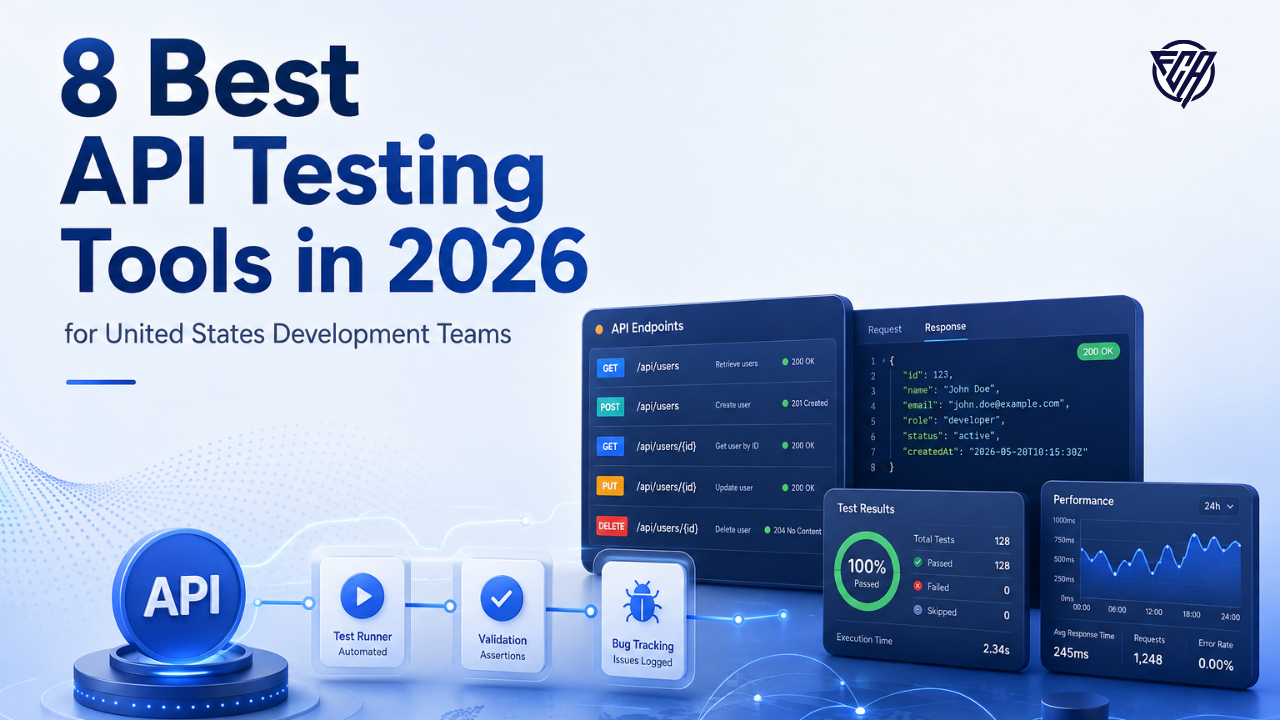
API testing has moved well beyond manually sending a few REST requests. Modern development teams need a mix of exploratory request testing, repeatable regression checks, contract validation, command line automation, performance checks and security awareness. A team building services from the patterns covered in the MERN stack guide or the Python full stack guide needs a testing workflow that can move from local development into CI without forcing every engineer into the same interface.
The current US search results for this topic consistently separate polished API clients from code based automation tools and enterprise quality platforms. That distinction matters. Postman, Bruno and Insomnia are excellent for interactive work, while Hurl and REST Assured fit pipeline driven testing. ReadyAPI and Katalon offer broader governance and automation capabilities for larger QA organizations.
This guide compares eight tools by protocol coverage, collaboration, automation, CI support, pricing model and the type of team each product fits. Public pricing was checked on official vendor pages during this review. Where a vendor uses custom pricing, the table says so instead of estimating a number.
- The shortlist is built for best API testing tools intent in the United States.
- Each tool is matched to a specific workflow instead of receiving an artificial universal score.
- Public pricing is sourced from official vendor pages and custom pricing is labeled rather than estimated.
- A proof of concept with real workloads is more useful than choosing from feature counts alone.
Best options at a glance
| Tool | Best for | Starting price or model | Main consideration |
|---|---|---|---|
| Postman | Teams that want a broad API lifecycle workspace | Free, Solo $9 monthly annually, Team $19 per user monthly annually | The platform can feel heavier than local first clients, and collaboration moves teams toward per user pricing. Teams that want plain text collections stored directly in Git may prefer Bruno or Hurl. |
| Bruno | Git centered teams that prefer local files | Open source free tier, Pro from $6 per user monthly on annual billing | Teams that need a large enterprise API catalog, extensive hosted governance or a mature marketplace of integrations may find Postman or ReadyAPI broader. |
| Hoppscotch | Fast browser based request testing | Free open source client, organization plan from about $6 per user monthly annually | It is not a full enterprise quality engineering suite. Teams that need advanced regression reporting, test case management or deep governance should pair it with code based tests or a broader testing platform. |
| Insomnia | Developers working across REST, GraphQL and gRPC | Essentials free, Pro about $12 per user monthly, Enterprise about $45 per user monthly | Its cloud and local workflow has changed over time, so teams with strict offline requirements should validate the current storage model during a trial. |
| ReadyAPI | Enterprise API quality and complex protocol testing | Custom quote with free trial | The platform is broader and more expensive than lightweight developer clients. Small teams that mainly need request exploration and pipeline checks may pay for capability they rarely use. |
| Katalon | QA teams combining API, web and mobile automation | True Platform from about $59 per user monthly on annual billing | Developers who only need API regression tests may find the platform too broad. Pricing also rises as teams add advanced execution and governance products. |
| REST Assured | Java teams that want code based API tests | Free open source | It is not an interactive request client and has no hosted collaboration workspace. Non Java teams will usually choose a different code library or a language neutral CLI tool. |
| Hurl | Command line API checks inside CI pipelines | Free open source | Hurl is intentionally focused. It does not replace an API design workspace, enterprise test management system or load testing platform. |
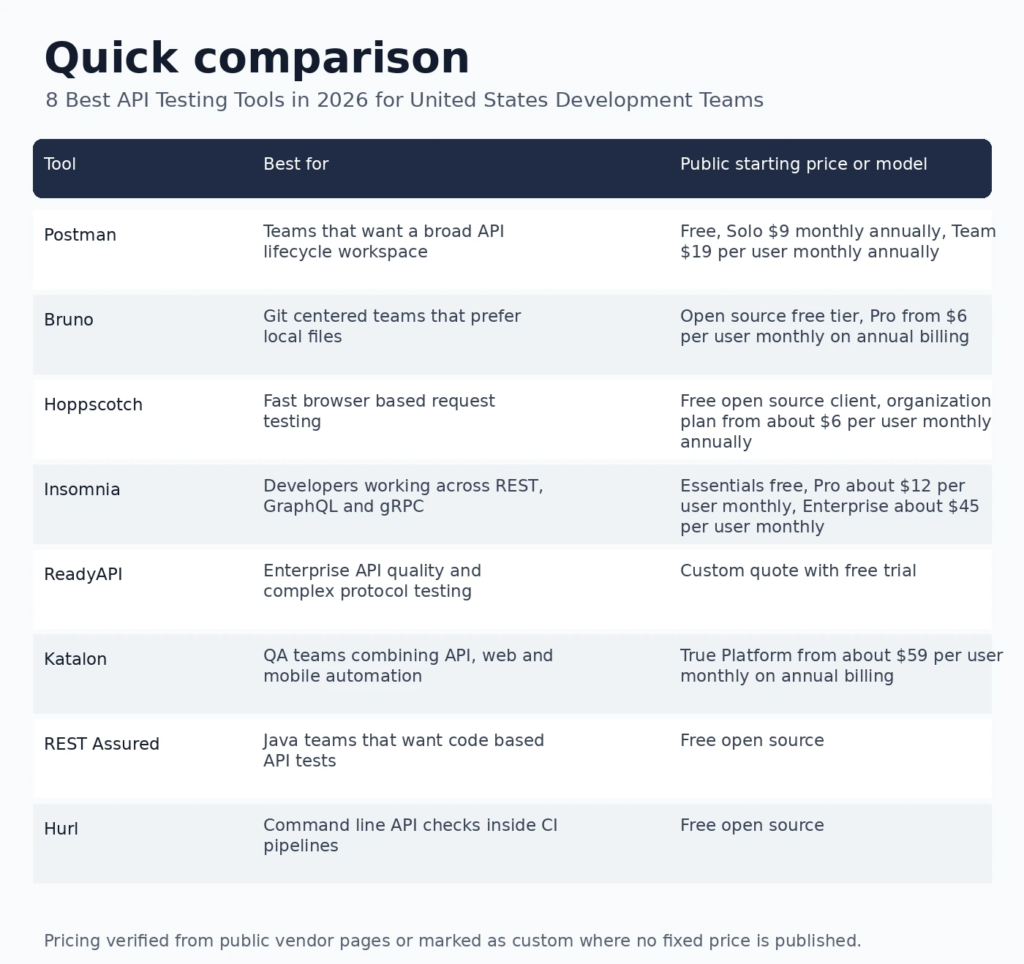
Infographic: Best options at a glance
How we evaluated these tools
We reviewed current ranking pages for the primary keyword and compared their recurring evaluation criteria. The strongest pages organize tools by workflow instead of pretending every product solves the same problem. We followed that pattern while writing an original comparison and verified product information against official documentation.
Security is part of the evaluation because an API test plan should not stop at status codes. The OWASP API Security Project maintains a dedicated set of common API risks, including authorization, authentication, resource consumption and inventory issues. That is a useful reminder that functional testing and security testing should connect, even when different tools own each step.
For teams learning how APIs fit into application delivery, FCA resources on RESTful APIs and authentication and the full stack development roadmap provide useful supporting context.
1. Postman
Best for: Teams that want a broad API lifecycle workspace
Postman remains the broadest general purpose choice because it combines an API client with collections, environments, mocks, documentation, monitors, runners and collaboration. Its March plan changes made the Solo tier more useful for individual developers while keeping team governance in paid plans.
Why it stands out
- Strong request builder for REST, GraphQL, gRPC and WebSocket workflows
- Collection Runner, scripting and automation options
- Mature collaboration, mock and documentation capabilities
- Native Git features and team governance on paid plans
Pricing
Free, Solo $9 monthly annually, Team $19 per user monthly annually. Confirm the current quote or calculator before purchase because usage and plan terms can change.
Limitations to consider
The platform can feel heavier than local first clients, and collaboration moves teams toward per user pricing. Teams that want plain text collections stored directly in Git may prefer Bruno or Hurl.
2. Bruno
Best for: Git centered teams that prefer local files
Bruno stores collections as files that live with the project, which makes reviews and version history feel natural to software teams already using Git. It is especially appealing when developers want an offline friendly desktop client without making a hosted workspace the center of the workflow.
Why it stands out
- Collections are easy to version with application code
- Open source core and local first workflow
- Script support and environment management
- Lower paid entry price than many collaborative clients
Pricing
Open source free tier, Pro from $6 per user monthly on annual billing. Confirm the current quote or calculator before purchase because usage and plan terms can change.
Limitations to consider
Teams that need a large enterprise API catalog, extensive hosted governance or a mature marketplace of integrations may find Postman or ReadyAPI broader.
3. Hoppscotch
Best for: Fast browser based request testing
Hoppscotch is a fast browser based API client with an installable application experience. It works well for developers who want to inspect or reproduce requests quickly without a large desktop suite. The open source option also gives teams more deployment flexibility.
Why it stands out
- Very fast browser experience
- Open source and self hosted options
- REST, GraphQL and realtime protocol support
- Useful for lightweight team request collections
Pricing
Free open source client, organization plan from about $6 per user monthly annually. Confirm the current quote or calculator before purchase because usage and plan terms can change.
Limitations to consider
It is not a full enterprise quality engineering suite. Teams that need advanced regression reporting, test case management or deep governance should pair it with code based tests or a broader testing platform.
4. Insomnia
Best for: Developers working across REST, GraphQL and gRPC
Insomnia combines a clean desktop request client with API design and test capabilities backed by Kong. It is a good middle ground for engineers who want more protocol depth than a basic REST client but do not need the entire Postman ecosystem.
Why it stands out
- REST, GraphQL, gRPC and WebSocket workflows
- Good developer focused interface
- Environment and scripting support
- Enterprise collaboration and governance options
Pricing
Essentials free, Pro about $12 per user monthly, Enterprise about $45 per user monthly. Confirm the current quote or calculator before purchase because usage and plan terms can change.
Limitations to consider
Its cloud and local workflow has changed over time, so teams with strict offline requirements should validate the current storage model during a trial.
5. ReadyAPI
Best for: Enterprise API quality and complex protocol testing
ReadyAPI is aimed at organizations that treat API testing as a formal quality engineering discipline. It extends the long established SoapUI lineage with functional, performance and service virtualization capabilities that can fit regulated or complex integration environments.
Why it stands out
- Deep SOAP and REST support
- Data driven functional testing
- Performance and service virtualization options
- Designed for enterprise test governance
Pricing
Custom quote with free trial. Confirm the current quote or calculator before purchase because usage and plan terms can change.
Limitations to consider
The platform is broader and more expensive than lightweight developer clients. Small teams that mainly need request exploration and pipeline checks may pay for capability they rarely use.
6. Katalon
Best for: QA teams combining API, web and mobile automation
Katalon is useful when API tests are part of a wider automation program that also covers browser and mobile journeys. It brings test management, execution and reporting into one environment, which can reduce tool switching for dedicated QA teams.
Why it stands out
- API tests can live beside web and mobile automation
- Centralized execution and reporting
- Useful for mixed skill QA teams
- Cloud execution and enterprise controls available
Pricing
True Platform from about $59 per user monthly on annual billing. Confirm the current quote or calculator before purchase because usage and plan terms can change.
Limitations to consider
Developers who only need API regression tests may find the platform too broad. Pricing also rises as teams add advanced execution and governance products.
7. REST Assured
Best for: Java teams that want code based API tests
REST Assured is a Java library for writing readable HTTP API tests directly in code. It fits teams that want tests reviewed in pull requests, executed with the normal test framework and maintained alongside service code.
Why it stands out
- Excellent fit for Java and JVM test suites
- Free and open source
- Works naturally with JUnit and CI systems
- Tests stay close to application code
Pricing
Free open source. Confirm the current quote or calculator before purchase because usage and plan terms can change.
Limitations to consider
It is not an interactive request client and has no hosted collaboration workspace. Non Java teams will usually choose a different code library or a language neutral CLI tool.
8. Hurl
Best for: Command line API checks inside CI pipelines
Hurl turns HTTP requests and assertions into plain text files that are easy to run locally or in CI. It is a strong choice for teams that want simple, reviewable API checks without introducing a large test platform or a language specific framework.
Why it stands out
- Plain text test files are easy to review
- Fast command line execution
- Good fit for smoke and regression checks in CI
- Free and open source
Pricing
Free open source. Confirm the current quote or calculator before purchase because usage and plan terms can change.
Limitations to consider
Hurl is intentionally focused. It does not replace an API design workspace, enterprise test management system or load testing platform.
How to choose the right platform
Start by identifying the job your team is trying to improve. If the problem is request exploration and collaboration, choose a polished client. If the problem is repeatable regression coverage in CI, prioritize code or command line execution. If the problem is enterprise QA governance, focus on reporting, role controls, environment management and integrations.
Protocol support matters more than a long feature list. REST may cover most business APIs, but GraphQL, gRPC, SOAP and WebSocket workloads can quickly narrow the shortlist. The full stack web development roadmap shows why modern teams often combine several backend patterns, and your API tool should not become a blocker as the architecture evolves.
Also test version control behavior. Collections and tests that can be reviewed with source code are easier to maintain when APIs change frequently. Finally, run the same representative test suite through the product before buying. Measure setup time, false failures, reporting clarity, CI execution time and how easily another developer can understand the test six weeks later.
Questions to ask before you buy
- Which workflows will this product replace or improve?
- What usage metric actually determines the monthly bill?
- Which features require a higher plan or an add on?
- How will the platform fit existing source control, identity, analytics or security systems?
- What data leaves your environment and how long is it retained?
- Can the team export configuration and data if it later changes vendors?
Frequently asked questions
What is the best API testing tool overall?
Postman is the broadest general purpose choice for teams that want request testing, collaboration, mocks and lifecycle features in one platform. Bruno is a strong alternative for teams that prefer local files and Git centered workflows.
Is there a good free API testing tool?
Yes. Bruno, Hoppscotch, REST Assured and Hurl all have strong free open source options. Postman and Insomnia also provide free plans with usage or collaboration limits.
Is Bruno better than Postman?
Bruno can be better when local storage, Git review and a lightweight workflow are priorities. Postman is stronger when a team needs a broad hosted workspace, enterprise governance, API catalogs, mocks and larger collaboration features.
Can API tests run inside CI/CD?
Yes. Most serious API testing tools provide a command line runner, library or automation interface. Hurl and REST Assured are particularly natural in pipelines, while Postman collections can run through automated runners.
What should an API regression suite test?
A useful regression suite checks successful paths, validation failures, authorization rules, authentication, idempotency where relevant, rate behavior, data contracts and error responses. Security focused checks should be planned alongside functional assertions.
Do API testing tools support GraphQL and gRPC?
Many do, but support depth varies. Postman and Insomnia cover both GraphQL and gRPC, while some lightweight tools focus primarily on HTTP request workflows. Verify the exact protocols your services use before choosing.
What is the difference between an API client and an API automation tool?
An API client is optimized for interactive requests, debugging and exploration. An automation tool emphasizes repeatable assertions, unattended execution, reports and integration with build pipelines. Many products combine both roles.
Can API testing catch security vulnerabilities?
API testing can reveal authorization mistakes, unsafe error handling and other weaknesses, but a normal functional test suite is not a substitute for dedicated security testing. OWASP guidance is useful when building a security focused API test plan.
Should API tests be stored in Git?
For engineering teams, storing tests or collection definitions in version control usually improves reviewability, change history and coordination with application releases. The best storage format depends on the tool and team workflow.
How many API tests should a team automate?
There is no useful universal number. Prioritize critical business paths, common failures, authentication, permissions and contracts first. Add tests where a failure would create meaningful customer or operational risk.
Which API testing tool is best for Java developers?
REST Assured is a natural choice for Java teams because tests live in the codebase and integrate with common Java test frameworks. A graphical client can still be useful for exploration and debugging.
How should a US development team evaluate API testing pricing?
Compare the full monthly cost of collaboration seats, cloud execution, monitoring, AI usage, enterprise controls and any runner limits. Free local tools may still require separate reporting or infrastructure, so evaluate total workflow cost rather than list price alone.
Final verdict
There is no single winner for every organization. The best choice is the product that fits the existing workflow, produces useful outcomes with manageable operational effort and has a pricing model the team can forecast. Start with two or three candidates, test them on representative work and document the decision criteria before committing to a long contract.
For more software and development research, explore the Futuristic Coding Academy blog and the full stack developer roadmap.