Dedicated server hosting gives one customer exclusive access to a physical server. That isolation can be valuable for high traffic applications, databases, regulated workloads, game servers, data intensive services, and teams that need predictable CPU, memory, storage, or network performance. The tradeoff is responsibility: hardware selection, operating system management, backups, security, scaling, and support can matter as much as the monthly price.
This guide compares eight providers that serve United States workloads with different operating models, from managed dedicated hosting to self managed bare metal and cloud connected physical servers. We checked current vendor pages, public configuration details, United States data center availability, support models, bandwidth terms, and pricing approaches. Promotional prices change frequently, so the comparison emphasizes durable buying factors rather than treating a temporary discount as the main reason to choose a provider.
For developers planning application deployment, FCA guides to full stack Python hosting and deployment, MERN application deployment, and Java full stack cloud and DevOps concepts provide useful context before you size a physical server.
Best dedicated server hosting providers at a glance
| Platform | Best for | Current pricing approach | Primary strength | Main consideration |
|---|---|---|---|---|
| Liquid Web | Businesses that want managed dedicated infrastructure and strong support | Current dedicated offers start around $44 monthly during promotions, standard configurations cost more | Managed service, support, and business focused hosting | Managed service carries a premium after promotions |
| Hivelocity | Teams that need fast bare metal deployment across multiple locations | Instant dedicated inventory can start around $65 monthly | Large inventory, rapid deployment, and network reach | Inventory and promotional pricing change frequently |
| OVHcloud | Technical teams that want strong price to hardware value and configurable bare metal | United States ranges currently start around $79 monthly for selected game servers and about $115 for Advance | Wide hardware range, strong network, and transparent configurations | Best fit for teams comfortable managing infrastructure |
| InterServer | Budget conscious teams that want straightforward US dedicated inventory | Current inventory often starts under $100 monthly | Competitive US inventory and simple monthly pricing | Hardware availability changes with inventory |
| InMotion Hosting | Businesses that want US hosting with managed options and familiar control panels | Pricing varies by term and configuration, entry systems are generally below many enterprise managed hosts | Managed hosting options and established support workflow | Promotional and renewal prices vary by billing term |
| IONOS | Small and mid sized US businesses that want dedicated hardware with provider support | Configuration based pricing on current US server catalog | US based server options, support, and Intel or AMD choices | Exact value depends heavily on chosen generation and contract |
| Atlantic.Net | Regulated and business workloads that need custom US infrastructure | Dedicated plans are quote based, bare metal published configurations start around $315 monthly on one year terms | US data centers, custom systems, and regulated workload experience | Higher cost than budget dedicated inventory |
| phoenixNAP | Developers that want API driven bare metal with cloud style provisioning | Usage based bare metal with monthly and term pricing by instance | Cloud automation model on physical infrastructure | Best value requires matching an instance family to a steady workload |
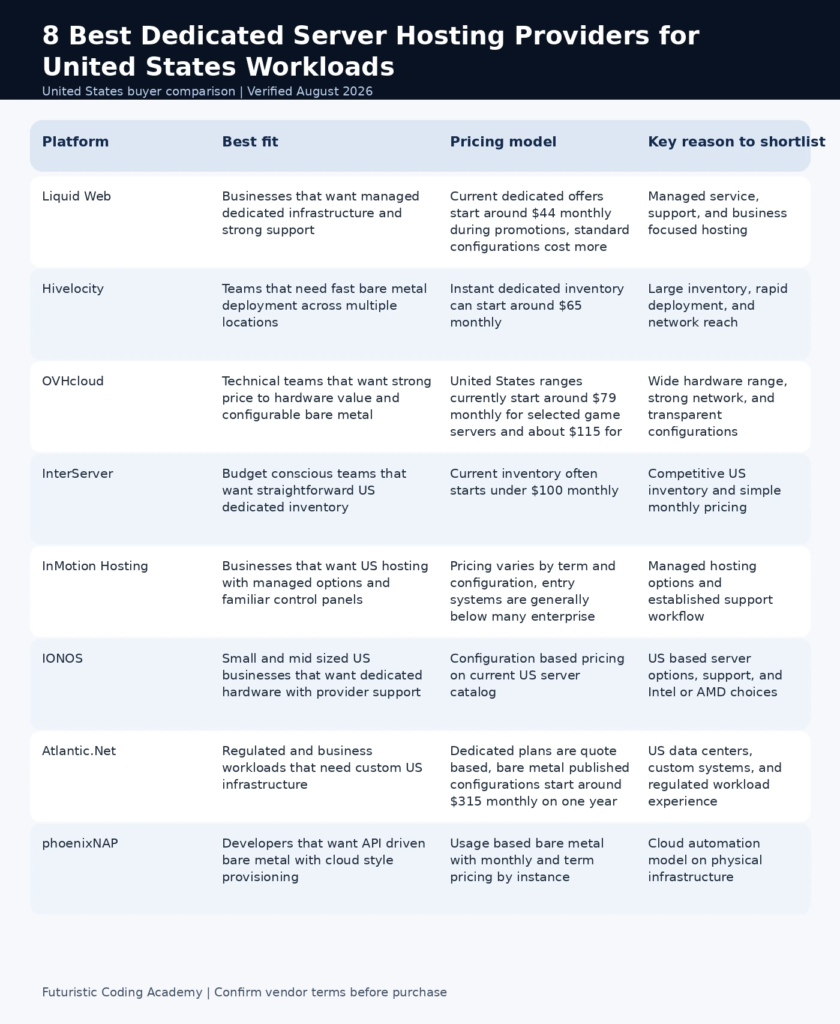
Infographic: Best dedicated server hosting providers at a glance
How we evaluated these options
Current ranking pages for dedicated hosting consistently compare CPU generation, RAM, storage type, network allowance, management level, uptime commitments, data center locations, and renewal pricing. We used those factors and added a workload fit test: a good server is not simply the cheapest configuration, but the configuration that matches the application and leaves a safe path for growth.
We prioritized providers with clear United States availability or strong North American infrastructure and public technical information. Where pricing depends on inventory, configuration, term length, or a sales quote, we say so rather than inventing a fixed monthly number.
- United States data center availability
- CPU, memory, storage, and network configuration depth
- Managed versus self managed service options
- Bandwidth and port speed
- Deployment speed and inventory transparency
- Support availability and service commitments
- Backup, security, and control panel options
- Pricing clarity, renewal terms, and upgrade flexibility
A dedicated server can be a poor value if the workload would scale more efficiently on cloud instances, containers, or managed platform services. Before buying, model utilization, redundancy, recovery objectives, and expected growth. Physical isolation is useful only when it solves a real technical or operational requirement.
All public prices below were checked in August 2026 and may vary by inventory, region, billing term, licensing, and promotional status.
1. Liquid Web
Best for: Businesses that want managed dedicated infrastructure and strong support
Liquid Web is best known for managed hosting rather than bargain bare metal. Its dedicated server products are designed for businesses that want exclusive physical resources while still having an experienced hosting team handle infrastructure support, monitoring, and common server operations. This can reduce the operational burden for ecommerce, SaaS, agency, and business application teams that do not want to staff every system administration task internally.
Why it stands out
- Managed dedicated server options
- Business focused support availability
- SSD based storage options
- Backup and security add ons
- Network and power service commitments
Pricing and buying considerations
Liquid Web currently advertises entry dedicated hosting promotions from about $44 per month, with the promoted rate applying for a limited initial period and higher standard pricing afterward. Exact cost depends on CPU, RAM, storage, management, licensing, backups, and contract term. Compare the post promotion rate, not only the first invoice.
Limitations to consider
This is not the cheapest way to rent raw hardware. Teams that already have strong Linux operations may prefer a lower cost self managed bare metal provider.
Bottom line: Choose Liquid Web when managed operations and support are more important than minimizing raw server cost.
2. Hivelocity
Best for: Teams that need fast bare metal deployment across multiple locations
Hivelocity combines instant dedicated servers, custom bare metal, a wide location footprint, networking services, and 24 hour support. Its public inventory makes it easier to compare actual processor, memory, storage, bandwidth, and location combinations before ordering. For United States users, current inventory includes locations such as Dallas, Los Angeles, Ashburn, Tampa, and Orangeburg depending on configuration.
Why it stands out
- Instant dedicated servers with fast deployment
- Multiple United States facilities
- Custom bare metal configurations
- Network and private connectivity options
- 24 hour support
Pricing and buying considerations
Current public inventory includes dedicated configurations starting around $65 per month, with higher performance systems scaling substantially above that level. Some machines carry temporary sale pricing or location surcharges. Treat the live inventory page as the source of truth when budgeting.
Limitations to consider
Because inventory is hardware specific, the exact server you want may not be available in the preferred location at the same price. Managed services and software licenses can also add cost.
Bottom line: Choose Hivelocity when you want broad bare metal choice, fast deployment, and location flexibility.
3. OVHcloud
Best for: Technical teams that want strong price to hardware value and configurable bare metal
OVHcloud offers a broad bare metal catalog with United States regions including Hillsboro and Vint Hill. Its ranges cover game workloads, general business servers, scale systems, high grade hardware, storage focused machines, and configurations with substantial private and public network capacity. The platform is attractive when a technical team wants a lot of hardware choice without paying for a heavily managed service layer.
Why it stands out
- Multiple dedicated server ranges
- United States region availability
- NVMe and high capacity storage options
- Private networking and higher bandwidth on advanced ranges
- Large scale CPU and memory configurations
Pricing and buying considerations
The current US catalog shows selected Game servers from about $79 per month and Advance configurations from about $115 per month, while higher Scale systems cost several hundred dollars per month. Installation fees can be waived with qualifying commitments, and exact pricing varies by server family and region.
Limitations to consider
Support and management expectations differ from a fully managed host. Teams should confirm backup strategy, operating system administration, and recovery responsibilities before migration.
Bottom line: Choose OVHcloud when hardware choice, network capacity, and self managed value are priorities.
4. InterServer
Best for: Budget conscious teams that want straightforward US dedicated inventory
InterServer operates United States infrastructure and publishes live dedicated server inventory with processor, memory, storage, network, and location details. It can be a good fit for developers, hosting resellers, or small businesses that need a real physical server without enterprise managed hosting prices.
Why it stands out
- Live dedicated inventory
- United States server locations
- Root access and configuration flexibility
- Options across Intel and AMD hardware
- Simple monthly purchasing
Pricing and buying considerations
Current inventory can include systems below $100 per month, with exact prices depending on processor generation, RAM, storage, and location. Because inventory changes daily, record the selected configuration and expected replacement path before making it a production dependency.
Limitations to consider
Older low cost inventory can be attractive on price but may deliver less performance per watt or weaker future upgrade options than newer hardware. Management requirements also need to be understood before purchase.
Bottom line: Choose InterServer when price sensitivity is high and the team is comfortable selecting and managing its own server.
5. InMotion Hosting
Best for: Businesses that want US hosting with managed options and familiar control panels
InMotion Hosting offers dedicated servers with US data center options, managed support, cPanel availability, SSD storage, and configurations intended for websites and business applications. It is a practical middle ground for companies that want more help than a raw bare metal provider gives but do not require a highly customized enterprise hosting engagement.
Why it stands out
- Managed dedicated hosting options
- United States data centers
- Control panel and migration support
- SSD storage configurations
- Business hosting support
Pricing and buying considerations
InMotion pricing changes by contract length and promotion, and current public pages show different effective monthly rates across terms. Compare the full contract cost and renewal rate for the exact configuration rather than quoting a short lived introductory number.
Limitations to consider
A fixed dedicated configuration does not scale as instantly as public cloud. Teams should also compare management scope carefully because software licensing and premium support can affect total cost.
Bottom line: Choose InMotion when a familiar managed hosting model is more important than building a custom bare metal stack.
6. IONOS
Best for: Small and mid sized US businesses that want dedicated hardware with provider support
IONOS offers United States dedicated servers with Intel and AMD options, full root access, storage focused configurations, and 24 hour support. It is suitable for businesses that want a mainstream provider and a relatively simple path from smaller hosting products into dedicated hardware.
Why it stands out
- US based dedicated server options
- Intel and AMD hardware families
- Full root access
- High capacity storage configurations
- 24 hour support
Pricing and buying considerations
IONOS prices depend on the selected server family, contract, and current promotion. Use the official US dedicated server configurator for the current checkout figure and compare renewal terms before committing.
Limitations to consider
The product catalog is broad, so buyers still need to understand processor generation, storage layout, and network requirements. A low starting price can be misleading if the workload needs additional storage, licenses, or backup services.
Bottom line: Choose IONOS when you want mainstream support and flexible dedicated hardware choices in US facilities.
7. Atlantic.Net
Best for: Regulated and business workloads that need custom US infrastructure
Atlantic.Net provides custom dedicated servers, bare metal, dedicated hosts, and cloud infrastructure from United States data centers. Its positioning is stronger for organizations that care about compliance, custom hardware, hybrid architecture, and support for business applications than for hobby projects.
Why it stands out
- US based data centers
- Custom dedicated server builds
- Bare metal and dedicated host options
- Hardware RAID and high transfer allowances
- Options for regulated workloads
Pricing and buying considerations
Atlantic.Net dedicated server plans are commonly quoted to specification. Its current bare metal page lists BM.C1 at $315.84 per month for a one year term, with lower rates for longer commitments. Dedicated host pricing is higher because it targets larger virtualized and licensed workloads.
Limitations to consider
This is generally a higher budget option than instant commodity bare metal. Buyers should also distinguish between a dedicated server, bare metal product, and dedicated cloud host because the billing and use case differ.
Bottom line: Choose Atlantic.Net when custom US infrastructure, compliance context, and support are more important than the lowest monthly price.
8. phoenixNAP
Best for: Developers that want API driven bare metal with cloud style provisioning
phoenixNAP Bare Metal Cloud treats physical servers more like programmable cloud resources. Developers can provision standardized bare metal instances, use APIs and infrastructure tooling, and combine predictable hardware performance with automation. This is useful for databases, data processing, CI workloads, and applications that need isolation without giving up modern infrastructure workflows.
Why it stands out
- API driven bare metal provisioning
- Hourly and monthly billing options
- Multiple standardized instance families
- High speed networking options
- Infrastructure automation support
Pricing and buying considerations
phoenixNAP publishes instance pricing by configuration and billing model. Small bare metal cloud instances can be priced below traditional managed dedicated systems, while larger compute, memory, and storage families cost more. Term commitments reduce effective monthly cost for steady workloads.
Limitations to consider
The service assumes more infrastructure knowledge than a traditional managed host. Teams need their own monitoring, operating system, backup, and application management plan.
Bottom line: Choose phoenixNAP when your team wants physical isolation but prefers cloud style automation and infrastructure as code workflows.
How to choose a dedicated server without overbuying
Start with measured workload data. CPU utilization, memory pressure, storage latency, database growth, egress, backup windows, and traffic peaks are more useful than generic labels such as business or enterprise. A server with many cores can still perform poorly if the application needs faster single core performance or storage latency.
- Measure current peak CPU and memory before sizing
- Choose storage layout based on IOPS, durability, and recovery requirements
- Confirm monthly transfer and port speed
- Decide whether management is included or your team owns the operating system
- Plan redundancy because one dedicated server is still one failure domain
- Budget for backups, licenses, security tooling, and monitoring
Managed dedicated hosting versus self managed bare metal
Managed hosting shifts more operating responsibility to the provider, which can be valuable when the business lacks system administration coverage. Self managed bare metal costs less at comparable hardware levels but assumes the customer can patch, monitor, secure, troubleshoot, and recover the operating system and application stack.
Choose managed hosting when operations capacity is limited
If a production incident at 2 AM would require an external expert anyway, a managed service may be cheaper than pretending the business has in house coverage.
Choose self managed bare metal when infrastructure is a core competency
Experienced platform teams can often save money and gain flexibility by owning the operating system and automation layer themselves.
Dedicated hosting for modern application stacks
A dedicated server can host containers, databases, APIs, caching layers, and application runtimes. Developers working through the FCA full stack integration and DevOps syllabus or the Java full stack guide should pay particular attention to deployment automation, authentication, databases, and recovery, because moving to dedicated hardware does not remove those application level responsibilities.
Frequently Asked Questions
What is dedicated server hosting?
Dedicated server hosting gives one customer exclusive access to a physical server instead of sharing the same operating hardware with unrelated tenants.
Is dedicated hosting faster than VPS hosting?
It can provide more predictable performance because CPU, memory, and storage are not shared at the hypervisor level. Actual speed still depends on hardware generation, storage, network, and application design.
What is the difference between bare metal and dedicated hosting?
The terms often overlap. Bare metal usually emphasizes direct physical hardware and cloud style provisioning, while dedicated hosting can also include managed services, control panels, and traditional hosting support.
How much does a dedicated server cost in the United States?
Entry commodity systems can cost under $100 per month, while managed, high memory, storage heavy, GPU, and enterprise configurations can cost hundreds or thousands per month.
Do I need a managed dedicated server?
Choose managed service if your team does not have reliable operating system, security, monitoring, and incident response coverage. Technical teams with strong operations skills may prefer self managed hardware.
Which dedicated host is best for ecommerce?
A managed provider such as Liquid Web can be attractive for ecommerce because support and operations matter, but the right choice depends on traffic, platform, database, compliance, and recovery requirements.
Which dedicated hosting provider is best for developers?
OVHcloud, Hivelocity, phoenixNAP, and InterServer are strong candidates for developers who want control and infrastructure flexibility. Evaluate APIs, network, location, and hardware before choosing.
How much RAM does a dedicated server need?
The answer depends on measured application and database usage. Leave headroom for traffic spikes, caching, background jobs, and operating system processes rather than sizing exactly to average consumption.
Should I choose NVMe storage?
NVMe is a strong choice for databases and workloads sensitive to storage latency. High capacity archival or media workloads may still benefit from larger HDD or mixed storage configurations.
Is one dedicated server enough for production?
Not if the application requires high availability. One physical server remains a single failure domain, so critical systems should include backup, replication, failover, or a second environment.
Can dedicated servers run Docker and Kubernetes?
Yes. Dedicated hardware can run containers and orchestration platforms, although Kubernetes usually makes more sense across multiple nodes when resilience is required.
What should I check before signing a dedicated hosting contract?
Confirm hardware model, region, bandwidth, port speed, management scope, support SLA, backups, DDoS protection, licensing, setup fees, renewal pricing, migration support, and cancellation terms.
Final recommendation
Liquid Web is the strongest fit for businesses that want managed dedicated infrastructure, while Hivelocity and OVHcloud stand out for broader bare metal choice. InterServer can suit cost conscious self managed teams, Atlantic.Net is better aligned with custom and regulated workloads, and phoenixNAP is compelling for developers who want cloud style automation on physical servers.
Do not choose a dedicated server from a price table alone. Start with workload measurements, decide who owns operations, design recovery before migration, and compare the full cost of hardware, bandwidth, management, licenses, backups, and engineering time.