
Influencer marketing software now covers much more than creator search. A serious platform can manage discovery, outreach, campaign briefs, approvals, contracts, product seeding, affiliate links, creator payments, usage rights, performance data, and reporting. The right choice depends on whether a brand wants a marketplace for a few collaborations, a self service program for hundreds of creators, or an enterprise system that coordinates global teams and agencies.
This guide compares eight platforms for United States brands using current product pages, current pricing where public, live search result research, creator discovery depth, workflow automation, ecommerce support, analytics, payment tools, and compliance considerations. No platform is ranked simply because it has the largest creator database. Quality of discovery, creator fit, operational workload, measurement, and total program cost matter more than a headline profile count.
Influencer programs also sit inside a broader marketing system. FCA resources on social media, content, analytics, and digital marketing and the digital marketing overview provide context for connecting creator activity with paid media, content, search, and conversion measurement.
Best influencer marketing platforms at a glance
| Platform | Best for | Current pricing approach | Primary strength | Main consideration |
|---|---|---|---|---|
| Modash | Ecommerce and growth teams that want deep creator search plus campaign tracking | Essentials from $399 monthly or about $299 monthly on annual billing | Large discovery database with practical tracking and outreach workflow | Usage limits rise by opened profiles, emails, and tracked creators |
| Later Influence | Brands that want end to end influencer operations with reporting and services options | Custom quote | Campaign operations, incentive management, social commerce, and performance reporting | No public self service subscription price |
| Upfluence | Ecommerce brands that want creator discovery, affiliate sales, and program automation | Modular custom quote | Creator activation, ecommerce connections, and sales oriented workflows | Custom pricing and module selection require careful scope definition |
| GRIN | Brands that want creator relationship management with self service entry | Current self service plans begin around $200 monthly | Creator program management with newer self service access | Pricing scales with active creator volume and package |
| Collabstr | Small brands and teams that want a transparent creator marketplace | Free to start, Pro $249 monthly on annual billing | Marketplace buying with visible creator prices and secure transactions | Less suitable than enterprise systems for complex global programs |
| Aspire | Ecommerce brands building creator, affiliate, ambassador, and UGC programs | Custom quote through demo process | Creator marketplace, workflows, ecommerce, affiliate, and paid media rights | No public subscription price |
| CreatorIQ | Large enterprises and global brands that need governance and scale | Custom enterprise pricing | Enterprise creator intelligence, governance, and large program management | Enterprise buying motion and cost are excessive for small teams |
| Traackr | Global brands that need influencer relationship management and measurement | Custom quote | Program governance, creator intelligence, and measurement | Enterprise focus and quote based pricing |
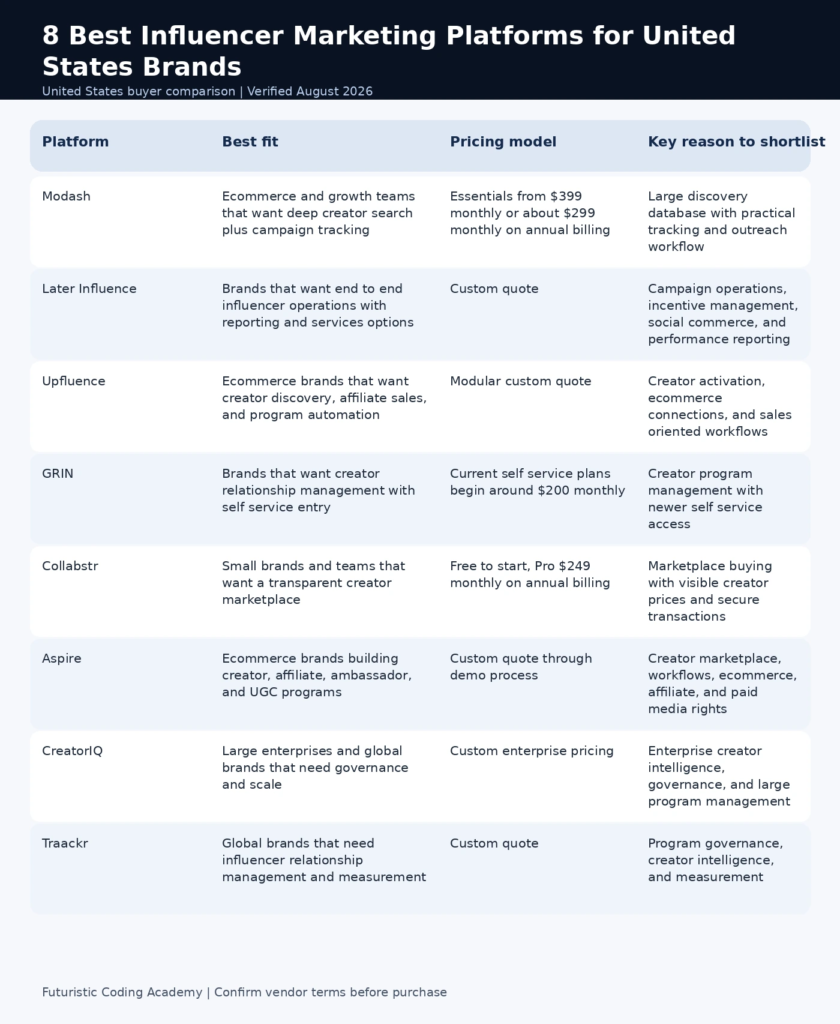
Infographic: Best influencer marketing platforms at a glance
How we evaluated these options
Current ranking articles repeatedly separate creator marketplaces from full campaign management platforms and enterprise creator relationship systems. We therefore evaluated not only discovery, but what happens after a creator is found: communication, contracting, content approval, product or cash incentives, affiliate attribution, paid media rights, performance reporting, and finance workflows.
United States brands must also consider endorsement disclosure. The Federal Trade Commission disclosure guidance states that material relationships between an advertiser and endorser should be disclosed clearly and conspicuously, and the disclosure should be difficult to miss. A platform can help manage workflows, but the brand remains responsible for a compliant program.
- Creator discovery and audience quality data
- Campaign workflow and content approval
- Communication and creator relationship management
- Payments, product seeding, and affiliate tracking
- Ecommerce and conversion integrations
- Reporting, ROI, and content performance
- Usage rights and paid media workflows
- Pricing transparency and fit for program scale
Creator pricing also varies widely by audience, platform, content format, usage rights, exclusivity, and niche. Later current 2026 benchmark guide shows that creator tier alone does not determine final cost, and Aspire current research is based on nearly 1,200 creator responses. The software subscription is therefore only one part of total influencer program spend.
Pricing below was checked in August 2026. Custom quote platforms should be compared using a documented use case and expected creator volume rather than a generic demo.
1. Modash
Best for: Ecommerce and growth teams that want deep creator search plus campaign tracking
Modash combines creator discovery, audience analysis, influencer CRM, content tracking, inbox integration, gifting, affiliate workflows, payments, and Shopify support. It is especially strong for teams that want a large discovery engine without moving immediately into a custom enterprise contract.
Why it stands out
- Creator search across a very large profile database
- Audience and authenticity analysis
- CRM and relationship management
- Automatic content tracking
- Shopify gifting, affiliate, and payment options
Pricing and buying considerations
Modash currently lists Essentials at $399 monthly, with the highlighted annual equivalent around $299 per month. Performance is listed at $699 monthly or about $599 on annual billing, while Enterprise starts at $14,700 yearly. Usage limits differ by profiles, emails, tracked creators, and team seats.
Limitations to consider
A fast growing program can outgrow profile, email, or tracking allowances and move into a higher tier. Brands should model creator volume rather than compare only the starting monthly price.
Bottom line: Choose Modash when creator discovery quality and an accessible path from search to program management are the main priorities.
2. Later Influence
Best for: Brands that want end to end influencer operations with reporting and services options
Later Influence provides creator discovery, campaign management, workflow automation, incentive management, content approvals, social commerce, link tracking, listening, and performance reporting. Its current platform is designed for brands that want to centralize recurring creator programs rather than book one off posts.
Why it stands out
- Creator discovery and vetting
- Unlimited users and campaigns on current platform package
- Workflow automation and content approval
- Incentive and payment management
- Clicks, conversions, ROI, and social commerce reporting
Pricing and buying considerations
Later Influence uses custom pricing for its platform and for platform plus services engagements. Buyers should request a quote based on creator volume, campaign complexity, services needs, and integrations.
Limitations to consider
The custom sales process is less convenient for a small business that wants to start immediately. Teams should also distinguish software costs from creator incentives, products, and managed services.
Bottom line: Choose Later Influence when a structured, repeatable creator program and campaign operations matter more than self service price transparency.
3. Upfluence
Best for: Ecommerce brands that want creator discovery, affiliate sales, and program automation
Upfluence focuses on finding creators, activating existing customers and fans, running programs, tracking affiliate sales, and connecting creator activity to ecommerce. Its pricing is modular, so brands can assemble the capabilities needed for discovery, scaling, or managed execution.
Why it stands out
- Creator search across major social networks
- Customer and fan creator identification
- Campaign and relationship workflows
- Affiliate tracking and sales measurement
- Ecommerce oriented integrations
Pricing and buying considerations
Upfluence uses modular custom pricing rather than a fixed public monthly plan. That can be useful for a brand that needs only selected capabilities, but procurement should request a written scope that defines modules, users, creator volume, integrations, and support.
Limitations to consider
It is harder to compare total cost without a sales quote. Teams should ensure the contract does not include unused modules simply because they are presented in a bundle.
Bottom line: Choose Upfluence when ecommerce attribution and scaling creator programs are core requirements.
4. GRIN
Best for: Brands that want creator relationship management with self service entry
GRIN is a creator management platform built for brands running ongoing influencer and ambassador programs. In 2026 the company expanded self service access, making the platform easier to evaluate without committing immediately to a long enterprise sales cycle. It covers recruitment, relationship management, workflows, product seeding, payments, content, and reporting.
Why it stands out
- Creator relationship management
- Program workflow and communication
- Product seeding and commerce workflows
- Content and performance tracking
- Self service access introduced in 2026
Pricing and buying considerations
GRIN current self service packaging starts around $200 per month and scales into larger plans based on creator program needs. Confirm active creator limits, payments, ecommerce, and enterprise capabilities in the current plan before purchase.
Limitations to consider
Teams running only a handful of occasional collaborations may get better value from a marketplace. Larger programs need to understand how active creator limits affect cost.
Bottom line: Choose GRIN when influencer marketing is a recurring relationship program rather than a series of isolated creator bookings.
5. Collabstr
Best for: Small brands and teams that want a transparent creator marketplace
Collabstr is a creator marketplace and campaign platform where brands can search creators, view posted pricing, book collaborations, use escrow, post campaigns, and monitor performance. It lowers the barrier for a small brand that wants to test creator marketing without buying a large software contract first.
Why it stands out
- Large searchable creator marketplace
- Visible creator rates on profiles
- Secure payment and escrow workflow
- Campaign posts and creator applications
- Live post analytics and audience reports
Pricing and buying considerations
Collabstr currently offers a free plan with a 10 percent hiring fee. Pro is $249 per month when billed annually and adds campaign, search, communication, and analytics capabilities. Premium options reduce fees further for larger programs.
Limitations to consider
A marketplace is excellent for transactions but may not replace the governance, rights, integration, and cross market controls required by a global enterprise creator program.
Bottom line: Choose Collabstr when transparent creator buying, speed, and low commitment are the main priorities.
6. Aspire
Best for: Ecommerce brands building creator, affiliate, ambassador, and UGC programs
Aspire provides creator discovery, an inbound Creator Marketplace, campaign workflows, relationship management, affiliate links, product seeding, content approval, payments, analytics, and creator content advertising workflows. It is designed for brands that want to build a system around creators rather than conduct one time transactions.
Why it stands out
- Creator discovery and inbound marketplace
- Relationship and campaign management
- Shopify and commerce integrations
- Affiliate links, promo codes, and payments
- Creator content rights and paid media workflows
Pricing and buying considerations
Aspire uses a demo and custom quote model. Buyers should ask for pricing by number of users, active creators, campaigns, ecommerce integrations, payment requirements, and any agency services.
Limitations to consider
The platform is more than a marketplace, so smaller brands may not use enough workflow depth to justify a custom platform contract.
Bottom line: Choose Aspire when creator marketing, affiliate activity, UGC, and ecommerce need to operate in one structured program.
7. CreatorIQ
Best for: Large enterprises and global brands that need governance and scale
CreatorIQ is positioned for enterprise creator marketing, with creator intelligence, program management, measurement, governance, and integrations designed for large brands and agencies. Its strengths are most relevant when many stakeholders, markets, creators, and reporting requirements must be coordinated consistently.
Why it stands out
- Enterprise creator intelligence
- Global program and workflow management
- Measurement and reporting
- Governance and brand safety workflows
- Enterprise integrations and services
Pricing and buying considerations
CreatorIQ does not publish a standard self service price. Its pricing request process is built around enterprise packages and team requirements, so buyers should run a structured evaluation with expected markets, creator count, user roles, integrations, and reporting needs.
Limitations to consider
It is not intended for a small team that wants to book a few creators quickly. Procurement and implementation effort should be justified by program scale.
Bottom line: Choose CreatorIQ when governance, scale, and enterprise creator intelligence matter more than self service simplicity.
8. Traackr
Best for: Global brands that need influencer relationship management and measurement
Traackr is an established influencer marketing platform focused on creator discovery, relationship management, campaign workflows, benchmarking, and measurement. It is particularly relevant for global organizations that need consistent program data across brands, regions, and agencies.
Why it stands out
- Creator discovery and audience data
- Influencer relationship management
- Campaign and content workflows
- Benchmarking and performance analytics
- Global program governance
Pricing and buying considerations
Traackr is sold through a custom enterprise quote rather than a public self service subscription. Ask for a commercial model tied to the number of users, brands, markets, creators, and data requirements.
Limitations to consider
Smaller teams can often move faster with a marketplace or self service discovery platform. Enterprise implementation only makes sense when the organization needs the governance layer.
Bottom line: Choose Traackr when cross market influencer program governance and measurement are the primary requirements.
How FTC disclosure rules affect influencer platform selection
The Federal Trade Commission says material connections between brands and endorsers should be disclosed clearly and conspicuously. The disclosure should be hard to miss and should appear with the endorsement rather than being buried on a profile page or after a long block of text. Software cannot transfer that legal responsibility away from the advertiser.
- Build disclosure requirements into campaign briefs
- Review captions and content before publication when possible
- Keep records of approved disclosures and final content
- Train creators on the required language for each campaign
- Monitor live posts instead of assuming the draft stayed unchanged
Marketplace versus creator management platform
A marketplace is ideal when a brand wants to find and buy creator work quickly. A creator management platform becomes more valuable when the same brand manages hundreds of relationships, recurring campaigns, product seeding, affiliate commissions, usage rights, and paid media activation.
Start with the workflow, not the database size
A huge creator database does not guarantee a better match. Evaluate search filters, audience data, contactability, creator response, and how much manual work remains after discovery.
Measure business outcomes, not only engagement
Clicks, conversions, sales, content reuse, customer acquisition, and paid media performance can matter more than likes. Choose a platform that connects creator activity to the outcomes the business actually funds.
How influencer marketing fits into a broader content program
Creator content can support social media, paid ads, landing pages, ecommerce, and brand search demand. FCA material on SEO, social media, PPC, content, and analytics can help teams plan creator campaigns as one part of the marketing mix rather than a disconnected channel.
How to run a platform trial before signing an annual contract
Do not evaluate influencer software with a polished vendor demo alone. Build a real campaign brief, discover a small creator set, contact them, negotiate compensation, collect a draft, approve content, generate tracking links, record usage rights, and produce a final performance report. The amount of work that remains outside the platform is often more important than the number of search filters shown in a demo.
For United States teams, include disclosure review in the test. Confirm whether the workflow can store campaign instructions, content approvals, final live links, and the evidence your team needs for compliance. If creator content will be reused in paid media, test permission and expiration workflows as well.
Marketing teams can connect this evaluation with the FCA overview of social media, SEO, and digital marketing skills and the FCA digital marketing training guide to keep creator activity connected to broader acquisition and analytics work.
Frequently Asked Questions
What is the best influencer marketing platform overall?
Modash is a strong overall choice for teams that want powerful discovery plus practical campaign management. Later Influence, Aspire, and CreatorIQ are better suited to more structured or enterprise programs.
What is the best influencer platform for small businesses?
Collabstr is one of the easiest places to start because brands can browse creators and pricing without buying a large enterprise contract.
What is the best platform for ecommerce brands?
Modash, Upfluence, Aspire, and GRIN are strong ecommerce candidates because they connect creator workflows with gifting, affiliates, sales, or store integrations.
How much does influencer marketing software cost?
Costs range from free marketplace access and a few hundred dollars per month for self service platforms to custom enterprise contracts. Creator compensation is separate from the software subscription.
What is the difference between an influencer marketplace and a management platform?
A marketplace focuses on finding and booking creators. A management platform adds relationship workflows, approvals, seeding, payments, rights, analytics, and governance for ongoing programs.
Do influencer platforms verify audience quality?
Many platforms provide audience demographics, engagement analysis, and authenticity indicators. Brands should still review creator content, audience fit, and campaign history before committing budget.
Can influencer software track sales?
Many ecommerce focused platforms use affiliate links, promo codes, tracking links, or store integrations to attribute clicks and conversions to creators.
Do influencer platforms handle payments?
Some platforms offer creator payments, escrow, or incentive fulfillment, while others integrate with external payment systems. Confirm fees, countries, currencies, and tax workflows.
How important is FTC disclosure for influencer campaigns?
It is essential for United States advertising. Material connections between a brand and creator should be disclosed clearly and conspicuously according to FTC guidance.
What should brands track besides engagement rate?
Track reach quality, clicks, conversions, sales, new customer revenue, content reuse, cost per asset, paid media performance, and the long term value of productive creator relationships.
How many creators should a brand manage before buying a platform?
There is no universal threshold. A platform becomes valuable when spreadsheets, email, approvals, payments, and reporting consume enough time or create enough risk to justify centralized workflow.
Can one influencer platform replace an agency?
Software can centralize operations, but strategy, creative direction, relationship management, negotiation, and campaign judgment still require people. Some platforms also sell managed services for teams that need both.
Final recommendation
Modash is the strongest starting point for many growth teams that want powerful discovery with transparent pricing. Collabstr is easier for small brands that want marketplace access, while Later Influence, Aspire, GRIN, Upfluence, CreatorIQ, and Traackr become more valuable as the program requires repeatable operations, ecommerce, governance, and measurement.
Before signing a contract, run one real campaign through discovery, outreach, approval, payment, tracking, and reporting. The best platform is the one that reduces manual work without weakening creator quality, compliance, or measurement.