A community platform should match the kind of relationship you are trying to build. A paid coaching membership needs different software from a product support forum. An association managing chapters needs different governance from a creator launching a simple course community. Calling all of these products community software hides the real purchasing decision.
For United States brands, the useful first question is whether community is primarily a revenue product, a customer success channel, a support channel, a professional network or an enterprise engagement program. Once that is clear, pricing, integrations, events, courses, moderation and branding become easier to compare.
Quick answer: Circle is the strongest general choice for polished professional communities. Mighty Networks is excellent for memberships that combine community, courses and events. Bettermode is a strong B2B customer community option. Discourse remains excellent for public discussion and technical communities. Hivebrite, Higher Logic Vanilla and Khoros target more complex organizations. Skool is the simplest low cost launch option in this group.
This comparison uses current vendor information checked in August 2026. Public prices are included where vendors publish them. Enterprise vendors with sales led pricing are labeled custom rather than assigned an estimated cost.
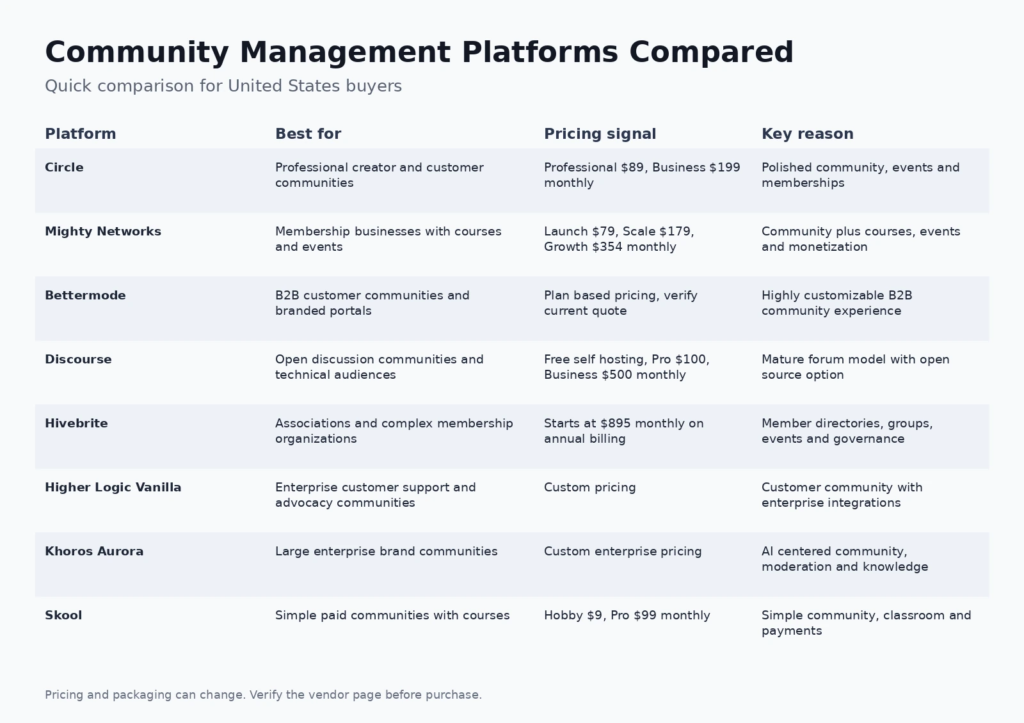
Best community management platforms at a glance
| Platform | Best for | Current pricing signal | Core strength |
|---|---|---|---|
| Circle | Professional creator and customer communities | Professional $89, Business $199 monthly | Polished community, events and memberships |
| Mighty Networks | Membership businesses with courses and events | Launch $79, Scale $179, Growth $354 monthly | Community plus courses, events and monetization |
| Bettermode | B2B customer communities and branded portals | Plan based pricing, verify current quote | Highly customizable B2B community experience |
| Discourse | Open discussion communities and technical audiences | Free self hosting, Pro $100, Business $500 monthly | Mature forum model with open source option |
| Hivebrite | Associations and complex membership organizations | Starts at $895 monthly on annual billing | Member directories, groups, events and governance |
| Higher Logic Vanilla | Enterprise customer support and advocacy communities | Custom pricing | Customer community with enterprise integrations |
| Khoros Aurora | Large enterprise brand communities | Custom enterprise pricing | AI centered community, moderation and knowledge |
| Skool | Simple paid communities with courses | Hobby $9, Pro $99 monthly | Simple community, classroom and payments |
Community strategy overlaps with content and social strategy. FCA resources on digital marketing channel fundamentals, practical social and content workflows and the broader FCA blog library can help teams connect community activity with acquisition and engagement work. Those internal pages reflect the site’s earlier training focus, so use them for channel concepts rather than current software recommendations.
How we evaluated community platforms
We evaluated each platform on community structure, moderation, events, learning or knowledge features, branding, integrations, member management, monetization and pricing transparency. We also looked at the operating model. A platform that is easy for a solo creator to launch may be the wrong choice for an enterprise that needs identity management, CRM integration and formal moderation workflows.
Current 2026 buyer guides consistently separate creator communities from B2B and enterprise communities. That is the right framing because the value model changes. A creator may measure recurring membership revenue. A customer success team may measure support deflection and adoption. An association may care about renewal, chapter engagement and event participation.
1. Circle: best for professional creator and customer communities
Circle combines community discussions, spaces, events, courses, memberships and creator oriented monetization in a polished hosted experience. It gives operators enough structure to build a branded home without forcing members into a workplace chat interface.
Where it fits: It is a strong default for paid communities, customer education programs and membership brands that want discussions, events and learning in one environment. The Business tier becomes more attractive as automation, workflows and administrative requirements grow.
Pricing: Professional $89, Business $199 monthly. Check the current Circle plan page because fees, annual discounts and enterprise packaging can change.
What to watch: Transaction fees and optional capabilities can matter as paid membership revenue grows. Model platform fees alongside payment volume rather than comparing only the monthly subscription.
2. Mighty Networks: best for membership businesses with courses and events
Mighty Networks is built around memberships, courses, events and community programming. It supports creators and organizations that want the community itself to be the product or a major part of the product experience.
Where it fits: It is especially useful for coaches, professional networks and education businesses that need recurring programming rather than a simple discussion board. Its higher tiers add more growth, automation and operational capabilities.
Pricing: Launch $79, Scale $179, Growth $354 monthly. Check the current Mighty Networks plan page because fees, annual discounts and enterprise packaging can change.
What to watch: Teams whose main goal is customer support or enterprise product feedback may prefer a platform designed around help content, ideation or deep CRM integration rather than membership monetization.
3. Bettermode: best for b2b customer communities and branded portals
Bettermode is a customizable community platform aimed strongly at B2B customer communities, product communities and customer portals. It supports structured spaces, discussions, knowledge, integrations and branded experiences that can sit close to a SaaS product or support program.
Where it fits: It fits B2B companies that want community to improve customer success, product feedback and peer support. The design flexibility is valuable when the community needs to look like part of the product brand rather than a separate generic forum.
Pricing: Plan based pricing, verify current quote. Check the current Bettermode plan page because fees, annual discounts and enterprise packaging can change.
What to watch: Customization creates implementation choices. A team should define information architecture, moderation, ownership and CRM or support integrations before attempting a large branded build.
4. Discourse: best for open discussion communities and technical audiences
Discourse is a mature discussion platform built around topics, replies, trust levels, moderation and searchable long form community knowledge. Organizations can self host the open source software or use official hosted plans.
Where it fits: It remains a strong choice for developer communities, open source projects, product forums and organizations that value public searchable discussion. The open source option also gives technical teams unusually high control over deployment and extensions.
Pricing: Free self hosting, Pro $100, Business $500 monthly. Check the current Discourse plan page because fees, annual discounts and enterprise packaging can change.
What to watch: Discourse is less focused on selling courses or running a creator membership business. Teams that need a polished learning and payments experience may need integrations or another platform.
5. Hivebrite: best for associations and complex membership organizations
Hivebrite is positioned as a community operating platform for associations, alumni networks, nonprofits and other organizations with complex member structures. It includes member directories, events, groups, messaging, content and monetization capabilities.
Where it fits: It is strongest when community administration involves formal memberships, chapters, subgroups, events and governance rather than only discussion engagement. The implementation and support model is designed for organizations with more operational complexity.
Pricing: Starts at $895 monthly on annual billing. Check the current Hivebrite plan page because fees, annual discounts and enterprise packaging can change.
What to watch: The entry price is materially higher than creator platforms. Smaller communities should confirm that they need the membership operations and governance depth before choosing an enterprise oriented product.
6. Higher Logic Vanilla: best for enterprise customer support and advocacy communities
Higher Logic Vanilla is designed for customer communities that connect support, product feedback, advocacy, learning and peer conversation. It emphasizes enterprise integrations and an architecture that can connect community activity with CRM, ticketing and other customer systems.
Where it fits: It is a serious option for software and enterprise brands that want community to reduce support demand and strengthen customer programs. Current platform development also includes MCP connectivity for supported AI workflows.
Pricing: Custom pricing. Check the current Higher Logic Vanilla plan page because fees, annual discounts and enterprise packaging can change.
What to watch: This is a sales led enterprise purchase. Buyers should define the business outcome and integration map first, then compare implementation effort and total service scope rather than seeking a simple per member price.
7. Khoros Aurora: best for large enterprise brand communities
Khoros Aurora is an enterprise community platform focused on large scale customer interaction, peer support, knowledge creation, moderation and analytics. Its current direction uses AI to synthesize community knowledge and support member engagement across a mature enterprise environment.
Where it fits: It fits large brands where community is part of customer care, support deflection, loyalty and product feedback. The platform is intended for programs that need governance and scale rather than a small paid membership launch.
Pricing: Custom enterprise pricing. Check the current Khoros Aurora plan page because fees, annual discounts and enterprise packaging can change.
What to watch: Enterprise power comes with implementation and change management. Teams need a community strategy, moderation model, content ownership and measurable support or retention goals before technology can create value.
8. Skool: best for simple paid communities with courses
Skool keeps the product intentionally simple: community discussion, classroom content, calendar, member profiles and gamification are packaged together with paid community support. The pricing structure is straightforward, with a low cost Hobby plan and a Pro plan with lower transaction fees.
Where it fits: It is a good fit for solo educators, coaches and small membership businesses that want to launch quickly without designing a complex software stack. Unlimited members and courses make the basic packaging easy to understand.
Pricing: Hobby $9, Pro $99 monthly. Check the current Skool plan page because fees, annual discounts and enterprise packaging can change.
What to watch: The simplicity that makes Skool easy can limit advanced branding, enterprise governance and deep customer system integration. Businesses should also model transaction fees when community revenue becomes meaningful.
How to choose a community management platform
Define the community job before comparing features
Write one sentence describing the outcome. Examples include helping customers solve problems with peers, selling a professional membership, connecting alumni, gathering product feedback or creating a learning community. That sentence should eliminate several platforms immediately. A product optimized for paid courses is not automatically good at enterprise support, and an enterprise forum may be unnecessarily heavy for a solo creator.
Decide whether the community should be public, private or mixed
Public communities can create searchable knowledge and discovery. Private communities can create stronger exclusivity and control. Many B2B programs need a mixture, with public help content and private customer spaces. Confirm how the platform handles guest access, member groups, private spaces and search engine visibility before designing the information architecture.
Model member economics, not only subscription price
Paid communities need to account for transaction fees, payment processing, branded apps, additional administrators and required integrations. Enterprise communities need to account for implementation, migration and service contracts. Build a twelve month cost model around your expected member count and revenue rather than choosing the lowest monthly plan.
Plan moderation and ownership before launch
Healthy communities require more than software. Define who welcomes new members, answers unanswered questions, handles conflict, removes abuse, escalates support issues and turns recurring discussions into durable knowledge. Automated moderation can assist, but responsibility still needs a human owner.
Connect community data to business systems only when it changes action
CRM, support and marketing integrations are useful when they help a team act. For example, a support team may need to see that an account is highly active in the community, or a customer success team may want to identify advocates. Avoid collecting community signals simply because a connector exists.
Community metrics that are more useful than member count
Total registered members is easy to report but often weak as a health metric. Track active contributors, unanswered questions, time to first useful response, returning member rate, event participation and the percentage of new members who complete a meaningful first action. For paid communities, add activation, renewal and recurring revenue. For support communities, track useful answer creation and the relationship between community activity and ticket demand.
Brands can connect these metrics with wider marketing work using FCA’s digital marketing overview. Community should not be treated as a social channel that only produces impressions. Its value often appears in retention, education, advocacy and support efficiency.
Frequently asked questions
What is the best community platform for a paid membership?
Circle and Mighty Networks are strong general choices for professional paid memberships. Skool is simpler and cheaper to start. The best option depends on how much you need courses, events, branding, payments and automation.
Which community platform is best for B2B SaaS?
Bettermode, Higher Logic Vanilla and Khoros are stronger fits for B2B or enterprise customer communities. They are designed around customer success, support, knowledge, integrations and governance rather than only creator monetization.
Is Discourse still a good community platform?
Yes. Discourse remains strong for searchable discussion communities, developer audiences, open source projects and product forums. Its open source option is also useful for technical teams that want deployment control.
What is the difference between Circle and Mighty Networks?
Both support community, learning and events. Circle emphasizes a polished flexible community workspace, while Mighty Networks is heavily oriented toward membership businesses and community led learning. Test the member experience for your specific program.
Is Skool good for business communities?
Skool works well for simple paid communities, education programs and coaching memberships. It is less suitable when a business needs deep enterprise governance, complex integrations or extensive brand customization.
How much does community software cost?
Costs range from single digit monthly creator plans to enterprise contracts worth many thousands of dollars each year. The relevant cost depends on member volume, transaction fees, administrators, branded apps, integrations and implementation.
Should a brand use Slack or Discord instead of a community platform?
Chat platforms can work for conversational communities, but structured community platforms generally provide better long term knowledge, discovery, moderation, member organization and content architecture. The choice depends on whether fast chat or durable community knowledge matters more.
What features matter most in community management software?
Core features include member profiles, structured spaces, moderation, search, notifications, analytics and administration. Depending on the use case, events, courses, payments, CRM integration, SSO, ideation and knowledge management may also be important.
How do you measure community engagement?
Measure meaningful actions rather than logins alone. Useful metrics include active contributors, response rate, returning members, first action completion, event participation, answered questions, renewal and community influenced support or retention outcomes.
Can an online community improve customer support?
Yes, when members can find trustworthy answers and experienced users help each other. Support value depends on search quality, moderation, expert participation and a process for turning strong answers into durable knowledge.
Should community content be indexed by Google?
Public support and discussion content can benefit from search visibility when it is useful and well moderated. Private customer discussions, paid memberships and sensitive content should remain protected. Many programs use a mixed model.
How long should a community platform pilot run?
A useful pilot should be long enough to observe onboarding, participation, moderation and recurring programming. Several weeks with a representative member group is usually more informative than a short administrator demo because the member behavior is the product.
Final recommendation
Choose Circle for a polished general community, Mighty Networks when memberships and learning are central, Bettermode for B2B customer communities and Discourse for open searchable discussion. Hivebrite is compelling for associations and structured membership organizations. Higher Logic Vanilla and Khoros are enterprise choices for customer programs with deep integrations. Skool is the simplest option for a creator or educator who wants to launch a paid community quickly.
The platform matters, but community operations matter more. A clear purpose, strong onboarding, useful programming and consistent moderation will outperform a feature rich platform with no owner.