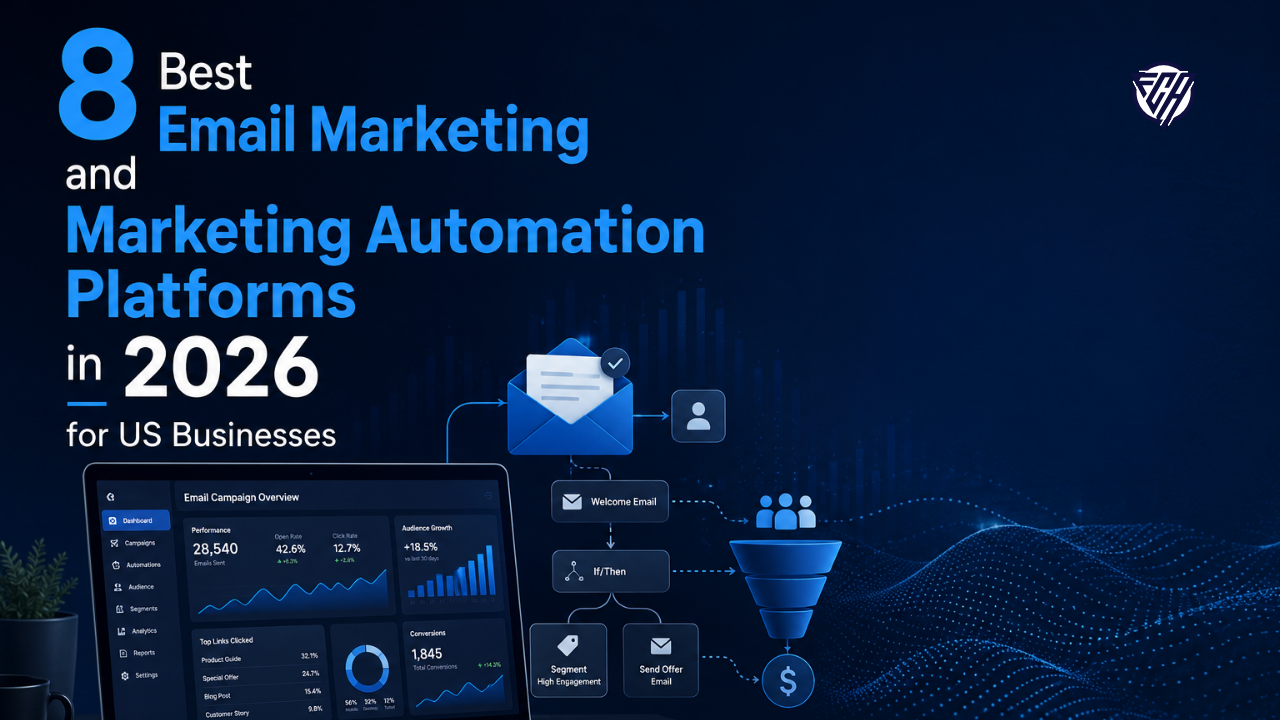
Email marketing platforms now compete on much more than newsletters. US businesses increasingly compare automation logic, segmentation, customer data, ecommerce events, SMS, forms, landing pages, reporting and CRM connections in the same buying decision. That is why the best platform for a simple newsletter is not always the best platform for a revenue team or an ecommerce brand.
FCA’s existing digital marketing guide and digital marketing course resource introduce email, analytics and broader channel planning. This article focuses on the software layer: which platforms help a business build audiences, trigger timely messages and measure what happens after the send.
Current US search results repeatedly surface Mailchimp, ActiveCampaign, Brevo, Klaviyo, HubSpot, Omnisend, MailerLite and GetResponse. We compared those eight by automation depth, pricing model, ecommerce fit, CRM capability, deliverability controls, team workflow and current public pricing.
- The shortlist is built for best email marketing and marketing automation intent in the United States.
- Each tool is matched to a specific workflow instead of receiving an artificial universal score.
- Public pricing is sourced from official vendor pages and custom pricing is labeled rather than estimated.
- A proof of concept with real workloads is more useful than choosing from feature counts alone.
Best options at a glance
| Tool | Best for | Starting price or model | Main consideration |
|---|---|---|---|
| Mailchimp | Small and growing businesses that want a familiar all purpose platform | Free up to 250 contacts, Essentials from $13 monthly, Standard from $20 monthly | Pricing rises with contact count and advanced features. Teams that need very sophisticated lifecycle automation or deep CRM workflows may prefer ActiveCampaign or HubSpot. |
| ActiveCampaign | Businesses that need advanced lifecycle automation | Contact based pricing, current exact plan total varies by contact count | Pricing changes with contact volume and current configuration, so teams should use the official calculator. The platform can also be more complex than necessary for simple broadcast email. |
| Brevo | Budget conscious businesses with high contact counts | Free, Starter from $9 monthly, Standard from $18 monthly | Some collaboration and enterprise features require higher plans or add ons. Businesses should calculate send volume carefully because that is a major pricing driver. |
| Klaviyo | Ecommerce brands with rich customer and purchase data | Free up to 250 active profiles and 500 emails monthly, paid pricing scales with active profiles and sends | Cost scales as active profiles grow, so list hygiene matters. Businesses without ecommerce data may not use the capabilities that justify the platform. |
| HubSpot Marketing Hub | B2B teams that want marketing connected directly to CRM | Free available, Starter list price from $20 per seat monthly before current discounts, Professional about $890 monthly on monthly billing | Professional automation requires a large budget compared with lightweight email tools, and onboarding or additional contact costs can materially increase total spend. |
| Omnisend | Ecommerce teams that want email, automation and optional SMS | Free up to 250 contacts, Standard starts at $16 monthly, Pro starts at $59 monthly | Billable contacts include some non subscribers who receive automated messages, so ecommerce brands should understand the billing definition before comparing costs. |
| MailerLite | Small teams that value simplicity and affordable automation | Free up to 250 subscribers, Comfort from $12 monthly, Power from $25 monthly | Large B2B teams may need deeper CRM and attribution, while sophisticated ecommerce brands may prefer a platform designed around purchase data. |
| GetResponse | Businesses that want email, automation, funnels and webinars in one suite | Starter $19 monthly for up to 1,000 subscribers, Marketer $59 monthly | The broad product set can be unnecessary for teams that only need email. Pricing also scales with list size, so larger databases should be modeled before migration. |
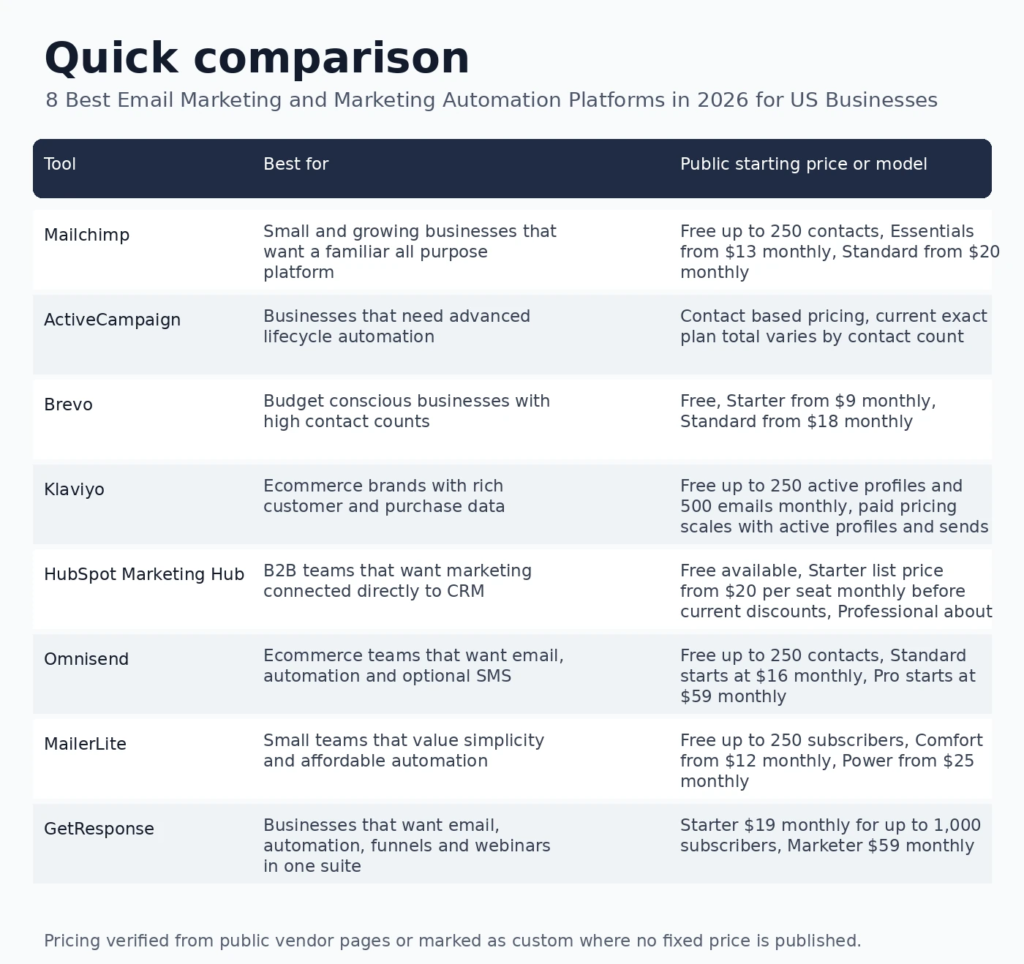
Infographic: Best options at a glance
How we evaluated these tools
Each product was checked against its official pricing and product pages. We also reviewed current ranking articles to identify the recurring buyer questions: contact based versus send based pricing, automation depth, ecommerce data, CRM integration, multichannel messaging and ease of migration.
US legal requirements are part of the buying decision. The FTC CAN SPAM compliance guide explains that commercial email must use accurate sender information, nondeceptive subject lines, a valid postal address and a clear opt out mechanism, and opt out requests must be honored promptly. A platform can provide tools for compliance, but the sender remains responsible for how campaigns are operated.
For supporting marketing context, FCA readers can also use the digital marketing learning guide and FCA blog library.
1. Mailchimp
Best for: Small and growing businesses that want a familiar all purpose platform
Mailchimp combines campaign creation, audience management, automations, forms, landing pages and ecommerce integrations in a widely recognized interface. It remains a practical starting point for businesses that value templates and ease of use more than complex journey logic.
Why it stands out
- Large integration ecosystem
- Strong template and campaign building experience
- Useful audience segmentation and basic automation
- Easy fit for many small business marketing stacks
Pricing
Free up to 250 contacts, Essentials from $13 monthly, Standard from $20 monthly. Confirm the current quote or calculator before purchase because usage and plan terms can change.
Limitations to consider
Pricing rises with contact count and advanced features. Teams that need very sophisticated lifecycle automation or deep CRM workflows may prefer ActiveCampaign or HubSpot.
2. ActiveCampaign
Best for: Businesses that need advanced lifecycle automation
ActiveCampaign is strongest when marketing depends on detailed triggers, branches, goals, segmentation and connected customer data. Its automation builder is more central to the product than a simple newsletter workflow.
Why it stands out
- Deep multi step automation
- Advanced segmentation and conditional content
- CRM and ecommerce integrations
- Attribution and conversion features on higher plans
Pricing
Contact based pricing, current exact plan total varies by contact count. Confirm the current quote or calculator before purchase because usage and plan terms can change.
Limitations to consider
Pricing changes with contact volume and current configuration, so teams should use the official calculator. The platform can also be more complex than necessary for simple broadcast email.
3. Brevo
Best for: Budget conscious businesses with high contact counts
Brevo differentiates itself with pricing that emphasizes email volume and multichannel messaging rather than only the number of stored contacts. Standard adds unlimited contact automation, testing and send time optimization, while higher tiers expand data and team features.
Why it stands out
- Low entry price
- Email, SMS and WhatsApp within one platform
- Automation and web event tracking on Standard
- Useful for large contact databases with moderate send volume
Pricing
Free, Starter from $9 monthly, Standard from $18 monthly. Confirm the current quote or calculator before purchase because usage and plan terms can change.
Limitations to consider
Some collaboration and enterprise features require higher plans or add ons. Businesses should calculate send volume carefully because that is a major pricing driver.
4. Klaviyo
Best for: Ecommerce brands with rich customer and purchase data
Klaviyo is built around customer profile data and ecommerce behavior. It is especially strong for Shopify and direct to consumer brands that want purchase events, product data, segments and automated flows tightly connected.
Why it stands out
- Deep ecommerce data model
- Strong segmentation and revenue attribution
- Email and mobile messaging in one customer platform
- Automation designed around lifecycle and purchase behavior
Pricing
Free up to 250 active profiles and 500 emails monthly, paid pricing scales with active profiles and sends. Confirm the current quote or calculator before purchase because usage and plan terms can change.
Limitations to consider
Cost scales as active profiles grow, so list hygiene matters. Businesses without ecommerce data may not use the capabilities that justify the platform.
5. HubSpot Marketing Hub
Best for: B2B teams that want marketing connected directly to CRM
HubSpot Marketing Hub connects email, forms, landing pages, automation, attribution and campaigns directly with the HubSpot CRM. This makes it particularly useful when sales and marketing need the same contact history and lifecycle definitions.
Why it stands out
- Native CRM and marketing data
- Strong lead capture and lifecycle workflows
- Reporting across marketing and sales context
- Broad ecosystem for B2B teams
Pricing
Free available, Starter list price from $20 per seat monthly before current discounts, Professional about $890 monthly on monthly billing. Confirm the current quote or calculator before purchase because usage and plan terms can change.
Limitations to consider
Professional automation requires a large budget compared with lightweight email tools, and onboarding or additional contact costs can materially increase total spend.
6. Omnisend
Best for: Ecommerce teams that want email, automation and optional SMS
Omnisend focuses on ecommerce campaigns and automated flows such as welcome, cart, order and customer lifecycle messaging. It offers a straightforward path from a free account into paid email automation and a Pro tier for higher volume messaging and SMS access.
Why it stands out
- Ecommerce focused automation templates
- Standard and Pro plans scale with billable contacts
- Push and advanced merchandising features
- 24 hour support across plans
Pricing
Free up to 250 contacts, Standard starts at $16 monthly, Pro starts at $59 monthly. Confirm the current quote or calculator before purchase because usage and plan terms can change.
Limitations to consider
Billable contacts include some non subscribers who receive automated messages, so ecommerce brands should understand the billing definition before comparing costs.
7. MailerLite
Best for: Small teams that value simplicity and affordable automation
MailerLite combines newsletters, automations, landing pages, websites and forms in a clean interface. It is a strong choice for small businesses and creators that want modern campaign features without the complexity of an enterprise marketing suite.
Why it stands out
- Simple interface and useful free plan
- Automation, landing pages and forms in one product
- Affordable paid tiers
- Unlimited email sending on Power subject to fair use
Pricing
Free up to 250 subscribers, Comfort from $12 monthly, Power from $25 monthly. Confirm the current quote or calculator before purchase because usage and plan terms can change.
Limitations to consider
Large B2B teams may need deeper CRM and attribution, while sophisticated ecommerce brands may prefer a platform designed around purchase data.
8. GetResponse
Best for: Businesses that want email, automation, funnels and webinars in one suite
GetResponse combines email campaigns with automation, landing pages, sales funnels and additional creator features. The Marketer tier is the more relevant option when a business needs unlimited automation workflows and ecommerce triggers.
Why it stands out
- Unlimited email sends on standard paid plans
- Marketing automation and segmentation
- Landing pages and funnel tools
- Webinar and creator capabilities on selected plans
Pricing
Starter $19 monthly for up to 1,000 subscribers, Marketer $59 monthly. Confirm the current quote or calculator before purchase because usage and plan terms can change.
Limitations to consider
The broad product set can be unnecessary for teams that only need email. Pricing also scales with list size, so larger databases should be modeled before migration.
How to choose the right platform
First decide whether your business is primarily broadcasting campaigns or orchestrating customer journeys. MailerLite, Brevo and Mailchimp are easier for straightforward campaigns. ActiveCampaign and HubSpot are stronger when lead stage and behavior drive complicated workflows. Klaviyo and Omnisend are designed around ecommerce data, while GetResponse combines marketing automation with funnels and creator tools.
Pricing model matters as much as starting price. Contact based tools can become expensive when the database grows, while send based products may be efficient for large lists that receive fewer campaigns. Calculate a realistic twelve month audience size and send volume rather than comparing only the smallest plan.
Deliverability requires operational discipline. Authenticate the sending domain, remove invalid addresses, manage consent, give subscribers a clear way to leave and monitor complaint signals. The FCA digital marketing resource is useful background, but your platform choice should also reflect the legal and technical responsibilities of sending commercial email in the United States.
Before migrating, rebuild one important automation and one normal campaign in the candidate platform. Compare setup time, segmentation, test workflow, reporting, integration behavior and the exact monthly bill at your real contact count.
Questions to ask before you buy
- Which workflows will this product replace or improve?
- What usage metric actually determines the monthly bill?
- Which features require a higher plan or an add on?
- How will the platform fit existing source control, identity, analytics or security systems?
- What data leaves your environment and how long is it retained?
- Can the team export configuration and data if it later changes vendors?
Frequently asked questions
What is the best email marketing platform overall?
Mailchimp is a strong general purpose choice, while ActiveCampaign is better for deep automation, Klaviyo for ecommerce, HubSpot for CRM centered B2B teams and Brevo for cost sensitive multichannel sending.
What is the best email marketing software for a small business?
MailerLite, Brevo and Mailchimp are good starting points because they combine easy campaign creation with affordable entry plans. The best choice depends on contact count, send volume and automation needs.
Which platform is best for ecommerce email marketing?
Klaviyo and Omnisend are the strongest choices in this list for ecommerce because product, purchase and customer behavior data are central to their automation and segmentation models.
Is there a free email marketing platform?
Yes. Mailchimp, Brevo, Klaviyo, Omnisend and MailerLite all offer free plans with different contact and sending limits. Free plans are useful for evaluation but may not include the automation depth a growing business needs.
Is ActiveCampaign better than Mailchimp?
ActiveCampaign is usually stronger for complex automation and lifecycle segmentation. Mailchimp can be easier for teams that prioritize campaign creation, templates and a familiar general purpose marketing interface.
How is email marketing software priced?
Common models include active contacts, stored contacts, email send volume, user seats and feature tiers. Some platforms combine several meters, so businesses should calculate cost at their expected audience size rather than only comparing entry prices.
Does email marketing software guarantee deliverability?
No. Platforms provide infrastructure and tools, but sender reputation, authentication, list quality, complaint rates, content and consent practices all influence deliverability.
What does the CAN SPAM Act require?
US commercial email rules require accurate sender information, nondeceptive subject lines, a valid postal address and a clear opt out mechanism. Businesses must also honor qualifying opt out requests within the required timeframe.
Should marketing automation connect to a CRM?
For B2B teams, CRM integration can improve lead routing, lifecycle reporting and sales follow up. HubSpot provides a native CRM model, while ActiveCampaign and other tools integrate with external CRM platforms.
How often should a business clean its email list?
List hygiene should be continuous. Remove invalid addresses, suppress persistent bounces, respect unsubscribes and review long term inactive contacts according to your retention and reengagement strategy.
Can I migrate automations between email platforms?
Contacts and some data can usually be imported, but complex workflows often need to be rebuilt. Plan the migration around forms, segments, triggers, templates, domain authentication and reporting continuity.
Which platform is best for US ecommerce teams that want SMS too?
Klaviyo and Omnisend are strong ecommerce options with mobile messaging, while Brevo provides email, SMS and WhatsApp in a broader multichannel platform. Compare current mobile pricing and consent workflow before choosing.
Final verdict
There is no single winner for every organization. The best choice is the product that fits the existing workflow, produces useful outcomes with manageable operational effort and has a pricing model the team can forecast. Start with two or three candidates, test them on representative work and document the decision criteria before committing to a long contract.
For more software and development research, explore the Futuristic Coding Academy blog and the full stack developer roadmap.