Product analytics tools help teams answer a different question from traditional web analytics: what do people actually do inside the product, which behaviors lead to activation and retention, and where do users struggle? In 2026, the category increasingly overlaps with session replay, experimentation, feature flags, AI analysis, in app guidance, and warehouse data. United States product teams should choose based on the decisions they need to make, not the number of dashboards a vendor can show in a demo.
Amplitude says its benchmark system analyzes behavioral data across thousands of digital products and more than one trillion data points processed each month. Its current benchmark interface reports activation, retention, engagement, and growth percentiles, which illustrates why product analytics is most useful when teams compare clearly defined behavioral outcomes rather than vanity metrics.
This guide is written for a United States audience. Prices are shown in United States dollars where a public price was available. Vendors can change pricing and packaging, so confirm current terms on the linked official page before purchasing.
8 Best Options at a Glance
| Tool | Best for | Pricing approach | Key strength |
|---|---|---|---|
| Amplitude | Broad behavioral analytics and experimentation | Free Starter plan with usage limits | Funnels, cohorts, retention, experiments, and AI |
| Mixpanel | Focused self serve behavioral analytics | Free plan with usage based growth pricing | Flexible funnels, cohorts, and event analysis |
| PostHog | Engineering led teams that value data ownership | Generous free tier with usage based cloud pricing | Analytics, replay, feature flags, and experimentation |
| Heap | Teams that want broad interaction capture | Free options and custom paid plans | Autocapture and retroactive analysis |
| Pendo | Product analytics plus in app guidance | Custom pricing for advanced plans | Analytics, guides, feedback, and adoption workflows |
| FullStory | Session replay and digital experience investigation | Custom pricing | High fidelity behavioral replay |
| LogRocket | Product analytics connected to frontend debugging | Paid plans from around $69 monthly | Replay plus errors and performance context |
| Contentsquare | Enterprise digital experience analytics | Custom enterprise pricing | Journey, experience, and interaction analysis |
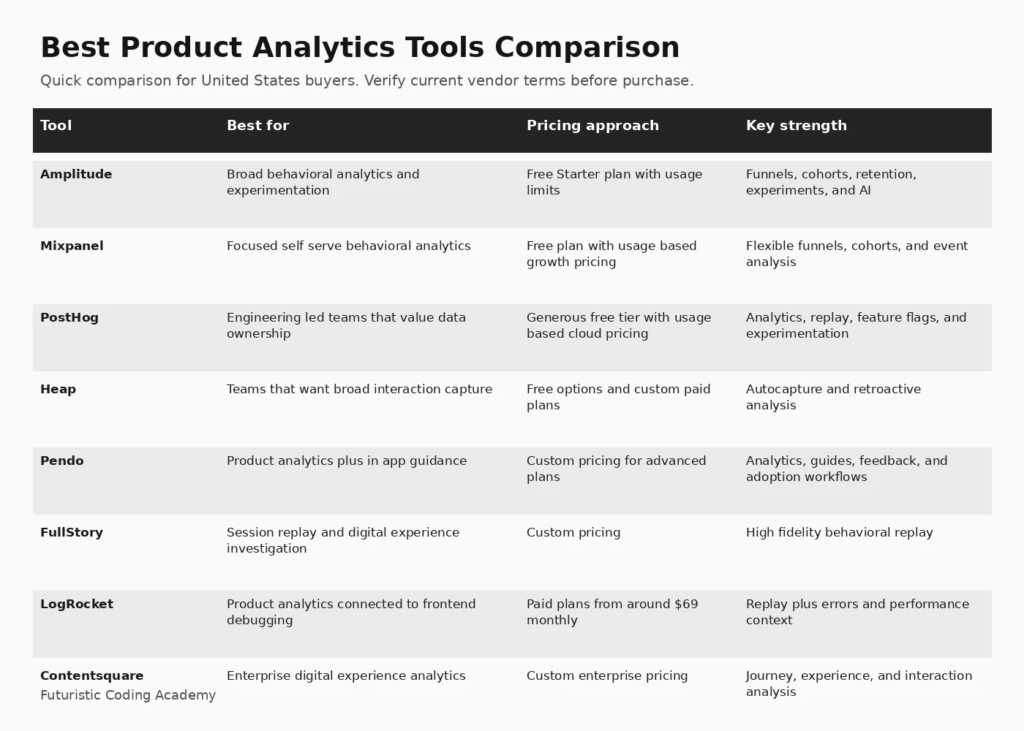
Infographic: 8 Best Options at a Glance
How We Evaluated Best Product Analytics Tools
We compared product analytics platforms using event analysis, funnels, retention, cohorts, journeys, session replay, experimentation, implementation effort, governance, data ownership, integrations, AI capabilities, and pricing approach. Current 2026 ranking pages from Amplitude and G2 repeatedly emphasize behavioral depth, experimentation, free tiers, session replay, AI, and team fit. We use those buyer dimensions while keeping the recommendations independent and linking to official platforms.
We also considered how clearly each platform explains limitations, deployment requirements, pricing, and the work required after the initial setup. A useful buyer guide should help a team eliminate poor fits, not simply list popular vendors.
1. Amplitude
Best for: Broad behavioral analytics and experimentation
Amplitude is a mature product analytics platform for teams that need event based analysis, funnels, retention, cohorts, journeys, experimentation, session replay, and increasingly AI assisted exploration. It is a strong fit for product, growth, data, and engineering teams that want a shared behavioral analytics system rather than a collection of separate tools.
Why it stands out
Funnels, cohorts, retention, experiments, and AI is the main reason to shortlist this platform. The value should still be tested against the workflows, integrations, governance requirements, and team skills in your organization.
Pricing and buying considerations
Pricing: Free Starter plan with usage limits. Review the official Amplitude website for current plan details, limits, and trial availability.
Limitations
Teams need a disciplined tracking plan to get reliable results. Event volume and advanced platform needs can also affect cost, so implementation quality should be evaluated alongside feature breadth.
2. Mixpanel
Best for: Focused self serve behavioral analytics
Mixpanel focuses on making event analytics accessible to product and growth teams. Funnels, retention, flows, cohorts, reports, and dashboards help teams answer how users move through a product and which behaviors correlate with conversion or retention. Its relatively focused interface can be attractive when a team wants deep analytics without a larger digital experience suite.
Why it stands out
Flexible funnels, cohorts, and event analysis is the main reason to shortlist this platform. The value should still be tested against the workflows, integrations, governance requirements, and team skills in your organization.
Pricing and buying considerations
Pricing: Free plan with usage based growth pricing. Review the official Mixpanel website for current plan details, limits, and trial availability.
Limitations
Accurate event design remains essential. Teams should model event volume, data governance, warehouse integration, and the need for experimentation or in app guidance before choosing a plan.
3. PostHog
Best for: Engineering led teams that value data ownership
PostHog combines product analytics, session replay, feature flags, experiments, surveys, and related developer tooling. Its transparent usage based pricing and open source roots appeal to engineering heavy teams that want a broad product stack and more control over data deployment choices.
Why it stands out
Analytics, replay, feature flags, and experimentation is the main reason to shortlist this platform. The value should still be tested against the workflows, integrations, governance requirements, and team skills in your organization.
Pricing and buying considerations
Pricing: Generous free tier with usage based cloud pricing. Review the official PostHog website for current plan details, limits, and trial availability.
Limitations
The breadth can create implementation decisions across many modules. Self hosting also shifts operational responsibility to the customer, so teams should compare control with the cost of maintaining infrastructure.
4. Heap
Best for: Teams that want broad interaction capture
Heap is known for automatically capturing a wide range of user interactions so teams can define events and investigate behavior after data has already been collected. This can reduce the risk of missing an important interaction because nobody instrumented it in advance.
Why it stands out
Autocapture and retroactive analysis is the main reason to shortlist this platform. The value should still be tested against the workflows, integrations, governance requirements, and team skills in your organization.
Pricing and buying considerations
Pricing: Free options and custom paid plans. Review the official Heap website for current plan details, limits, and trial availability.
Limitations
Autocapture does not eliminate the need for governance. Teams still need clear definitions, privacy controls, data quality checks, and a semantic layer so stakeholders analyze consistent events.
5. Pendo
Best for: Product analytics plus in app guidance
Pendo combines product analytics with in app guides, onboarding, feedback, roadmaps, and product adoption features. It is a natural fit for B2B software companies that want to measure usage and then act on those insights inside the product through targeted guidance.
Why it stands out
Analytics, guides, feedback, and adoption workflows is the main reason to shortlist this platform. The value should still be tested against the workflows, integrations, governance requirements, and team skills in your organization.
Pricing and buying considerations
Pricing: Custom pricing for advanced plans. Review the official Pendo website for current plan details, limits, and trial availability.
Limitations
Teams that only need deep event analytics may pay for capabilities they do not use. Buyers should evaluate whether guides, NPS, adoption, and account level workflows justify choosing a broader product experience suite.
6. FullStory
Best for: Session replay and digital experience investigation
FullStory is strongest when teams need to understand the experience behind metrics. Session replay, interaction data, search, funnels, and digital experience analysis help product and UX teams investigate friction that aggregate charts may not explain.
Why it stands out
High fidelity behavioral replay is the main reason to shortlist this platform. The value should still be tested against the workflows, integrations, governance requirements, and team skills in your organization.
Pricing and buying considerations
Pricing: Custom pricing. Review the official FullStory website for current plan details, limits, and trial availability.
Limitations
Replay creates privacy, governance, and data volume considerations. Organizations should configure masking carefully and decide how replay complements rather than duplicates their primary event analytics platform.
7. LogRocket
Best for: Product analytics connected to frontend debugging
LogRocket connects session replay and product behavior with frontend errors, network activity, performance signals, and developer debugging context. It is particularly useful when product and engineering teams want to move quickly from a user problem to technical evidence.
Why it stands out
Replay plus errors and performance context is the main reason to shortlist this platform. The value should still be tested against the workflows, integrations, governance requirements, and team skills in your organization.
Pricing and buying considerations
Pricing: Paid plans from around $69 monthly. Review the official LogRocket website for current plan details, limits, and trial availability.
Limitations
Teams primarily focused on large scale cohort and retention analysis may still prefer a dedicated behavioral analytics platform. Compare event analysis depth with debugging needs.
8. Contentsquare
Best for: Enterprise digital experience analytics
Contentsquare focuses on digital experience intelligence, including journey analysis, interaction behavior, experience monitoring, and visualization. It is relevant for large ecommerce, financial services, travel, and enterprise websites where understanding friction across high traffic experiences can have substantial commercial impact.
Why it stands out
Journey, experience, and interaction analysis is the main reason to shortlist this platform. The value should still be tested against the workflows, integrations, governance requirements, and team skills in your organization.
Pricing and buying considerations
Pricing: Custom enterprise pricing. Review the official Contentsquare website for current plan details, limits, and trial availability.
Limitations
The enterprise scope and pricing may be excessive for smaller product teams. Buyers should determine whether they need digital experience analytics at scale or a simpler event based product analytics tool.
How to Choose the Right Best Product Analytics Tools
Write the Questions Before the Tracking Plan
Start with business questions such as activation, retention, feature adoption, conversion, and churn. Instrumentation should support decisions rather than produce a large event catalog with no owner.
Choose Event Analytics or Experience Analytics Deliberately
Amplitude and Mixpanel emphasize structured behavioral analysis. FullStory and Contentsquare emphasize session level experience. PostHog combines several categories. The correct choice depends on whether you need to quantify behavior, diagnose experience, or both.
Model Event Volume and Cost
Product analytics pricing often depends on events, sessions, monthly tracked users, or other usage measures. Use real production estimates and include expected growth before comparing plans.
Protect Data Quality
Define event names, properties, identity rules, environments, and ownership. A sophisticated analytics platform cannot repair inconsistent instrumentation after teams begin making decisions from unreliable data.
Connect Insights to Experiments and Product Work
The most valuable analytics program closes the loop. Teams should be able to identify a behavior, form a hypothesis, run a change, and measure the result without losing definitions between systems.
Related FCA Resources
For broader technology context, see Data Science Course Guide, Full Stack Project Ideas, MERN Stack Full Course, Digital Marketing Course Guide, FCA Blog Library, Full Stack Web Development Roadmap. These resources cover development, data, marketing, and practical technology foundations that support better software buying decisions.
Frequently Asked Questions
What is the best product analytics tool overall?
Amplitude and Mixpanel are leading choices for behavioral analytics, while PostHog is attractive for engineering led teams and Pendo is strong when in app guidance is important. The best platform depends on the product workflow.
What is product analytics?
Product analytics measures how users interact with a digital product, including activation, feature adoption, funnels, retention, cohorts, journeys, and other behaviors tied to product outcomes.
How is product analytics different from web analytics?
Web analytics often emphasizes traffic sources, sessions, pages, and marketing attribution. Product analytics focuses more deeply on in product events, user behavior, feature use, cohorts, and retention.
Which product analytics tools have free plans?
Amplitude, Mixpanel, and PostHog provide meaningful free entry points, although usage limits and included features differ. Some other vendors also offer limited free or trial options.
Is PostHog a good alternative to Amplitude?
PostHog is a strong alternative for engineering led teams that value transparent usage pricing, feature flags, experiments, replay, and open source options. Amplitude is generally more focused on mature behavioral analytics workflows and broader product intelligence.
Do I need session replay with product analytics?
Not always. Event analytics can show where a funnel breaks, while replay can help explain what a user experienced. Many teams use both when diagnosing usability or technical friction.
How many events should a product track?
There is no universal number. Track events that answer defined product questions. A smaller, governed event taxonomy is usually more useful than hundreds of poorly defined events.
What is product activation?
Activation is the point at which a new user experiences meaningful product value or completes a behavior associated with continued use. The exact definition must be specific to the product.
How do product analytics tools measure retention?
They group users into cohorts based on a starting event or time period and measure how many return or perform a target behavior later. Definitions vary, so teams should document the retention method used.
Can product analytics replace a data warehouse?
No. Product analytics is optimized for behavioral exploration and product decisions. A warehouse supports broader organizational data integration, modeling, governance, and reporting across many systems.
What should a startup choose?
Startups often benefit from a free tier with fast implementation and enough flexibility to grow. Mixpanel, Amplitude, and PostHog are common shortlists. The best choice depends on team skills, event volume, and need for replay or experimentation.
How do I compare product analytics pricing?
Estimate monthly events, sessions, tracked users, replay volume, data retention, and expected growth. Include implementation and maintenance effort, not only subscription cost.
Final Recommendation
There is no universal winner for best product analytics tools. Start with the use case, asset or workflow requirements, team skills, and projected scale. Shortlist two or three platforms, run a realistic trial, and measure the quality of the decision support or operational improvement they create. That approach is more reliable than choosing the product with the longest feature list.
Editorial note: Futuristic Coding Academy may update this guide as products, pricing, and buyer requirements change. Inclusion does not guarantee a paid placement or ranking position.