Endpoint security has expanded from malware prevention into continuous detection, investigation and response. Modern XDR platforms add identity, cloud, email, network and other telemetry so security teams can understand attacks that cross more than one control point. That makes the category relevant not only to large security operations centers but also to smaller US organizations that need stronger automated response with limited staff.
FCA already introduces cybersecurity concepts in its computer courses guide and development security topics across the full stack roadmap. This comparison focuses specifically on business endpoint protection and XDR buying decisions.
Current ranking results consistently surface CrowdStrike, SentinelOne, Microsoft Defender, Palo Alto Cortex XDR, Sophos, Trend Vision One, Bitdefender and Cisco. We compare those eight by prevention, EDR and XDR coverage, investigation workflow, automation, deployment fit and public pricing where available.
- The shortlist is built for best endpoint security and XDR platforms intent in the United States.
- Each tool is matched to a specific workflow instead of receiving an artificial universal score.
- Public pricing is sourced from official vendor pages and custom pricing is labeled rather than estimated.
- A proof of concept with real workloads is more useful than choosing from feature counts alone.
Best options at a glance
| Tool | Best for | Starting price or model | Main consideration |
|---|---|---|---|
| CrowdStrike Falcon | Organizations that want a mature cloud endpoint platform and strong threat intelligence | Falcon Pro $14.99 per device monthly or $99.99 annually, Enterprise $19.99 monthly | Total platform cost can increase as organizations add identity, managed services, SIEM or other modules. Buyers should also validate update controls and recovery procedures as part of operational resilience. |
| SentinelOne Singularity | Teams that value autonomous endpoint response and flexible XDR | Singularity Complete $179.99 per endpoint annually, Commercial $229.99 annually | Advanced enterprise and security operations capabilities move into higher packages or custom pricing. Teams should test policy tuning and response actions against their own endpoint mix. |
| Microsoft Defender for Business and Defender for Endpoint | Microsoft centered organizations and smaller businesses | Defender for Business $3 per user monthly paid yearly for up to 300 users, enterprise licensing varies | Licensing becomes more complex in larger enterprises because capabilities are distributed across Defender products and Microsoft 365 suites. Organizations should map the exact licenses they already own. |
| Palo Alto Cortex XDR | Security teams already using Palo Alto network and cloud controls | Custom quote | Pricing is quote based and licensing includes plan and compute concepts that need careful sizing. Smaller teams may need more implementation help than with a simplified endpoint suite. |
| Sophos Endpoint | Midmarket organizations that want endpoint protection with optional managed response | Custom quote with trial options | Public list pricing is not simple, so buyers need a quote. Feature availability varies by package and managed service choice. |
| Trend Vision One Endpoint Security | Organizations that want endpoint security connected to broader XDR telemetry | Enterprise licensing is quote or credit based, selected cloud workload endpoint use has pay as you go rates | Pricing can be difficult to compare because enterprise licensing uses credits, packages and partner quotes. Buyers should request a scenario based estimate rather than rely on a single unit price. |
| Bitdefender GravityZone | Businesses that want layered endpoint security with EDR and XDR options | Online and partner pricing varies by product and device count, enterprise XDR uses quote based licensing | The product family includes many editions and add ons, so organizations should confirm which detection, retention and XDR features are included in the exact license quoted. |
| Cisco Secure Endpoint | Cisco centered enterprises that want endpoint telemetry in a broader security platform | Custom quote | Public pricing is quote based, and the platform is less compelling for organizations with no Cisco footprint. A proof of concept should validate agent performance and console workflow. |
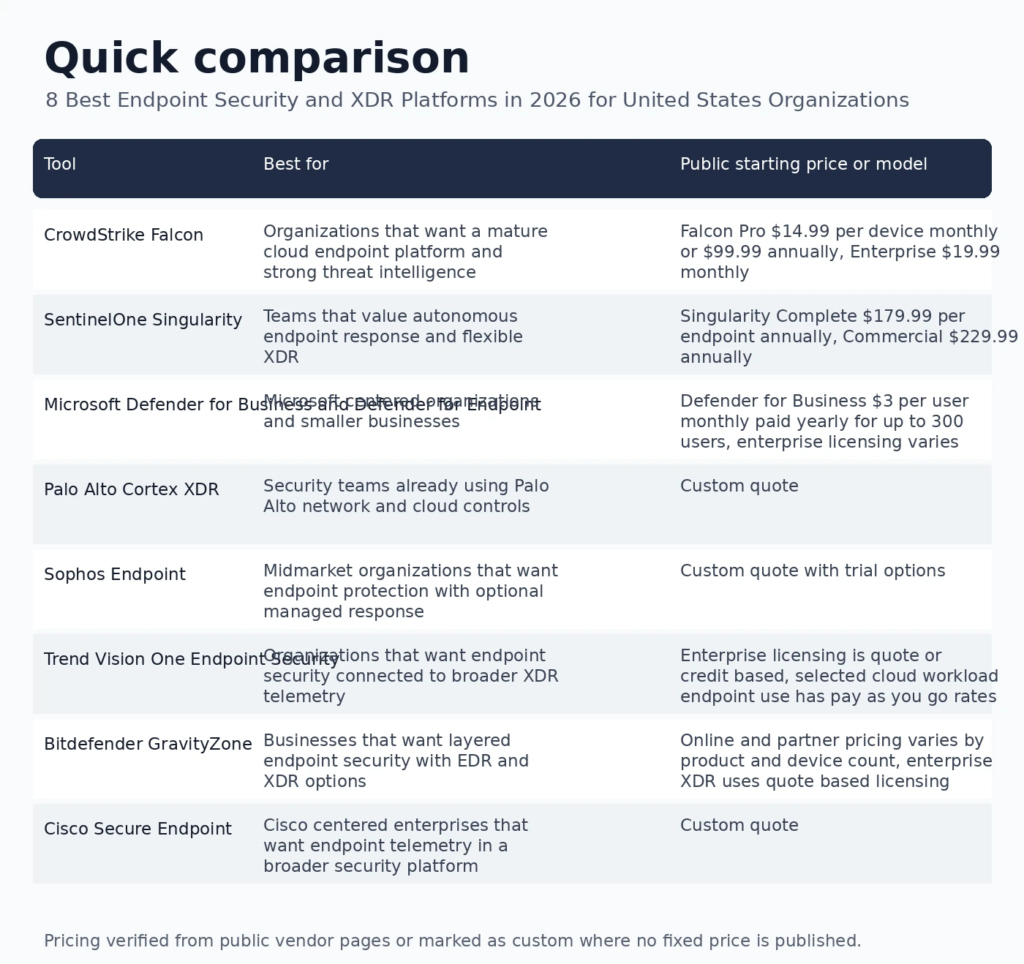
Infographic: Best options at a glance
How we evaluated these tools
We used current ranking pages to identify recurring enterprise evaluation criteria, then checked product and pricing details against official vendor sources. Products were not ranked by a fabricated laboratory score. Instead, each entry explains where the platform fits and what a buyer should validate during a proof of concept.
The NIST Cybersecurity Framework organizes cybersecurity outcomes around governance, identification, protection, detection, response and recovery. NIST also defines an endpoint protection platform as software safeguards for user machines that can include antivirus, firewalls and host intrusion detection or prevention. CISA Cybersecurity Performance Goals similarly emphasize protection, detection, response and recovery as connected activities.
These principles are useful because a strong endpoint product should support the larger incident response process, not simply report malware detections.
1. CrowdStrike Falcon
Best for: Organizations that want a mature cloud endpoint platform and strong threat intelligence
CrowdStrike Falcon combines endpoint prevention, EDR, threat intelligence, hunting and optional broader security modules in a cloud platform. It is widely considered in enterprise shortlists because one agent can connect endpoint events with a larger security operations workflow.
Why it stands out
- Cloud managed endpoint prevention and EDR
- Threat intelligence and threat hunting capabilities
- Broad Falcon platform modules for identity and security operations
- Public pricing for several endpoint bundles
Pricing
Falcon Pro $14.99 per device monthly or $99.99 annually, Enterprise $19.99 monthly. Confirm the current quote or calculator before purchase because usage and plan terms can change.
Limitations to consider
Total platform cost can increase as organizations add identity, managed services, SIEM or other modules. Buyers should also validate update controls and recovery procedures as part of operational resilience.
2. SentinelOne Singularity
Best for: Teams that value autonomous endpoint response and flexible XDR
SentinelOne Singularity combines prevention, EDR and XDR capabilities with automated response and an AI assisted investigation experience. Complete is positioned for growing teams, while Commercial adds identity detection, longer retention and managed threat hunting.
Why it stands out
- Automated endpoint detection and response
- AI assisted investigation workflow
- Identity and managed hunting on higher package
- Clear public annual pricing for core business packages
Pricing
Singularity Complete $179.99 per endpoint annually, Commercial $229.99 annually. Confirm the current quote or calculator before purchase because usage and plan terms can change.
Limitations to consider
Advanced enterprise and security operations capabilities move into higher packages or custom pricing. Teams should test policy tuning and response actions against their own endpoint mix.
3. Microsoft Defender for Business and Defender for Endpoint
Best for: Microsoft centered organizations and smaller businesses
Microsoft Defender provides endpoint prevention, EDR, vulnerability management and automated investigation with deep integration into the Microsoft security ecosystem. Defender for Business makes many enterprise style capabilities available to organizations with up to 300 users.
Why it stands out
- Strong Windows and Microsoft ecosystem integration
- EDR and automated investigation in Defender for Business
- Up to five devices per user on the small business plan
- Can connect with wider Microsoft XDR capabilities
Pricing
Defender for Business $3 per user monthly paid yearly for up to 300 users, enterprise licensing varies. Confirm the current quote or calculator before purchase because usage and plan terms can change.
Limitations to consider
Licensing becomes more complex in larger enterprises because capabilities are distributed across Defender products and Microsoft 365 suites. Organizations should map the exact licenses they already own.
4. Palo Alto Cortex XDR
Best for: Security teams already using Palo Alto network and cloud controls
Cortex XDR correlates endpoint data with other security telemetry and provides investigation, threat hunting and response capabilities. It is especially attractive when an organization already uses Palo Alto firewalls, cloud security or security operations products.
Why it stands out
- Cross source security telemetry and investigation
- Strong fit with Palo Alto security ecosystem
- Endpoint prevention and XDR response options
- Advanced query and hunting capabilities
Pricing
Custom quote. Confirm the current quote or calculator before purchase because usage and plan terms can change.
Limitations to consider
Pricing is quote based and licensing includes plan and compute concepts that need careful sizing. Smaller teams may need more implementation help than with a simplified endpoint suite.
5. Sophos Endpoint
Best for: Midmarket organizations that want endpoint protection with optional managed response
Sophos Endpoint combines prevention, EDR and XDR capabilities with centralized management. Sophos is also attractive to organizations that may want managed detection and response support instead of operating every investigation internally.
Why it stands out
- Endpoint prevention and EDR capabilities
- XDR and managed response options
- Windows, macOS and Linux coverage
- Central management for midmarket security teams
Pricing
Custom quote with trial options. Confirm the current quote or calculator before purchase because usage and plan terms can change.
Limitations to consider
Public list pricing is not simple, so buyers need a quote. Feature availability varies by package and managed service choice.
6. Trend Vision One Endpoint Security
Best for: Organizations that want endpoint security connected to broader XDR telemetry
Trend Vision One connects endpoint security with broader security operations, cloud, network, email and identity capabilities. The endpoint offering emphasizes prevention, vulnerability protection, EDR and native XDR correlation.
Why it stands out
- Broad native XDR platform coverage
- Endpoint, server and cloud workload options
- Strong fit for organizations using other Trend products
- Free trials available for several product areas
Pricing
Enterprise licensing is quote or credit based, selected cloud workload endpoint use has pay as you go rates. Confirm the current quote or calculator before purchase because usage and plan terms can change.
Limitations to consider
Pricing can be difficult to compare because enterprise licensing uses credits, packages and partner quotes. Buyers should request a scenario based estimate rather than rely on a single unit price.
7. Bitdefender GravityZone
Best for: Businesses that want layered endpoint security with EDR and XDR options
Bitdefender GravityZone spans small business endpoint security, EDR, enterprise endpoint packages and XDR. It provides a layered prevention model with centralized management and lets organizations expand into response and cross endpoint correlation as needs grow.
Why it stands out
- Several endpoint packages for different organization sizes
- EDR Cloud and XDR options
- Unified management for endpoints and servers
- Free trial options
Pricing
Online and partner pricing varies by product and device count, enterprise XDR uses quote based licensing. Confirm the current quote or calculator before purchase because usage and plan terms can change.
Limitations to consider
The product family includes many editions and add ons, so organizations should confirm which detection, retention and XDR features are included in the exact license quoted.
8. Cisco Secure Endpoint
Best for: Cisco centered enterprises that want endpoint telemetry in a broader security platform
Cisco Secure Endpoint provides endpoint protection, detection and response that can connect with other Cisco security products and threat intelligence. It is most attractive when the organization already operates a Cisco security ecosystem and wants shared investigation context.
Why it stands out
- Endpoint prevention and response capabilities
- Integration with Cisco security ecosystem
- Threat intelligence context
- Enterprise management and investigation workflow
Pricing
Custom quote. Confirm the current quote or calculator before purchase because usage and plan terms can change.
Limitations to consider
Public pricing is quote based, and the platform is less compelling for organizations with no Cisco footprint. A proof of concept should validate agent performance and console workflow.
How to choose the right platform
Start with the operating model. A small IT team may value automated investigation and managed response more than advanced hunting flexibility. A large security operations center may prioritize telemetry depth, query capability, retention and integrations with SIEM, identity and cloud security.
Platform coverage also matters. Confirm Windows, macOS, Linux, servers and mobile requirements, then check how the vendor handles unmanaged devices and remote workers. The NIST endpoint definition is broad enough to remind buyers that protection involves more than antivirus alone.
Run a controlled proof of concept with representative endpoints and normal business applications. Measure detection quality, false positives, policy management, investigation speed, endpoint performance, isolation and rollback options, and the effort required to recover a device after a bad update or security incident.
Finally, model the full price. Include endpoint licenses, XDR data retention, identity modules, managed response, vulnerability management, server protection, support and any SIEM or log ingestion charges. The least expensive starting license is not always the lowest cost security program. Teams responsible for application delivery can also use FCA’s web development roadmap and full stack syllabus guide to connect endpoint controls with the wider development and deployment lifecycle.
Questions to ask before you buy
- Which workflows will this product replace or improve?
- What usage metric actually determines the monthly bill?
- Which features require a higher plan or an add on?
- How will the platform fit existing source control, identity, analytics or security systems?
- What data leaves your environment and how long is it retained?
- Can the team export configuration and data if it later changes vendors?
Frequently asked questions
What is the best endpoint security platform overall?
CrowdStrike, SentinelOne and Microsoft Defender are common broad shortlists, but the best platform depends on existing security tools, endpoint mix, response model, budget and the level of internal security expertise.
What is the difference between EDR and XDR?
EDR focuses on endpoint telemetry and response. XDR combines endpoint data with additional sources such as identity, email, network or cloud signals to improve cross domain detection and investigation.
What is an endpoint protection platform?
An endpoint protection platform is software designed to protect devices such as workstations and laptops. Modern platforms typically combine prevention with monitoring, behavior analysis and response features.
Is Microsoft Defender enough for a small business?
Defender for Business includes prevention, vulnerability management, EDR and automated investigation for organizations up to 300 users. Whether it is enough depends on compliance needs, managed response requirements and the rest of the security stack.
How does CrowdStrike compare with SentinelOne?
Both provide cloud endpoint security and EDR. CrowdStrike has a broad Falcon ecosystem and public bundle pricing, while SentinelOne emphasizes autonomous response and offers clear Complete and Commercial annual endpoint packages.
Do XDR platforms replace a SIEM?
Not always. XDR can unify and correlate security signals, but many enterprises still use a SIEM for broader log retention, compliance, custom analytics and security operations workflows. Some vendors increasingly combine these functions.
Should endpoint security include mobile devices?
If employees access business data from phones or tablets, mobile security should be part of the endpoint strategy. Product coverage varies, so confirm operating systems and management requirements during procurement.
How much does endpoint security cost?
Pricing ranges from low single digit user plans for small businesses to hundreds of dollars per endpoint annually plus optional modules. Enterprise XDR pricing is often custom and depends on endpoint count, retention and services.
Can endpoint security stop ransomware?
Modern endpoint products use prevention, behavior monitoring and response controls that can stop many ransomware techniques, but no product eliminates risk. Backups, identity controls, patching and incident response remain essential.
What should be tested during an EDR proof of concept?
Test detection quality, false positives, agent performance, response actions, investigation workflow, operating system coverage, policy deployment, alert routing and the effort required to contain and recover a compromised device.
When should a company buy managed detection and response?
Managed detection and response is useful when the organization cannot staff continuous monitoring and investigation internally. It can also supplement an existing security team during nights, weekends or complex incidents.
How should US organizations compare XDR vendors?
Create a requirements matrix covering telemetry sources, endpoint count, data retention, response automation, managed services, integrations, compliance needs and total annual cost. Then validate the shortlist with real endpoint activity rather than vendor demonstrations alone.
Final verdict
There is no single winner for every organization. The best choice is the product that fits the existing workflow, produces useful outcomes with manageable operational effort and has a pricing model the team can forecast. Start with two or three candidates, test them on representative work and document the decision criteria before committing to a long contract.
For more software and development research, explore the Futuristic Coding Academy blog and the full stack developer roadmap.